
Collecting Double Rent: What Is the Law?

For both standard landlords and Airbnb hosts, there are times in your experience as a rental property owner, where you may face a situation where you are essentially “collecting double rent”.

Now if you do online searches on this topic, “collecting double rent” or “double dipping on rent”, you’ll very likely come across many websites or threads which state that it’s unlawful to collect double rent. For instance these: https://www.reddit.com/r/legaladvice/comments/e1qlpe/is_it_legal_for_landlords_to_charge_double_rent/
And https://archive.ph/0SXsI as well as https://archive.ph/1LncG

I want to demonstrate why this is not necessarily the case. This thread suggests the reason why “double dipping” on rent is not unlawful https://boards.straightdope.com/t/landlord-double-dipping-on-rent/86140/6

Double Dipping is Common for Airbnb Hosts

Additionally, “double-dipping” situations are actually quite common for Airbnb hosts. Let me give a few examples.

(1) A guest books a stay of any length, and then cancels, but does not get a full refund, or sometimes doesn’t even get a partial refund, because of the terms of the cancellation policy. For instance: they book a 2 month long stay, and then cancel the stay a week later. According to Airbnb’s long term cancellation policy which applies to all reservations over 28 days long, this guest would be obligated to pay for the first month of the stay regardless of when they cancel the stay, if they cancel more than 48 hours after booking.
Or, suppose the guest booked a weeklong stay, and then cancelled 14 days before arrival. With a strict cancellation policy, he would only get a 50% refund. If he cancels less than a week before arrival, he’d get no refund.
However, in each of these situations, the host may be able to re-book some or all of those dates. If that happens, the host would then be collecting both a full or partial rent from the guest who cancelled, plus the rent for the guest who re-booked some or all of those dates.
(2) Another example situation would be that a guest books a stay, of whatever length, but then for some personal reason, departs early. Perhaps their plans changed, or they were looking for permanent housing and found an apartment earlier than expected.
The host then may re-book the now vacated space, and earn double rent for the days that are part of the departed guests’ paid reservation, but which are now being rented out to another guest because the first guest vacated and checked out early.

Notice that Airbnb has never taken any action to prevent any host from such “double dipping” and being paid twice, essentially, for one or more days of rental fees. And in my opinion, Airbnb could not take action to prevent this, because there’s nothing unlawful about it. To understand why, all we need is a basic understanding of contract law.

Contract Law

In contract law, one party is paying a specific amount to another party, to obtain something, such as a product or services. In rental property contracts, the agreement is that renter A (call him Steve) pays X amount to property owner B (call him David) , in exchange for use of a specific property, such as a house, apartment or private room, for specified dates. In such contracts, it is generally stipulated or implied that the rented property will be free from serious defects or problems that would materially and detrimentally impact the renter’s use of said property, such as a nonfunctioning shower, or a hole in the roof that allows rain to pour in, or a broken bed.

The cancellation policy that applies to this rental contract, contains the totality of terms which apply to cancelling the rental before arrival, or departing early and not staying for the full rental term, or amount of notice that needs to be given when departing, eg 30 day’s notice for standard long term rentals.
Government Cannot Intervene in Private Contracts

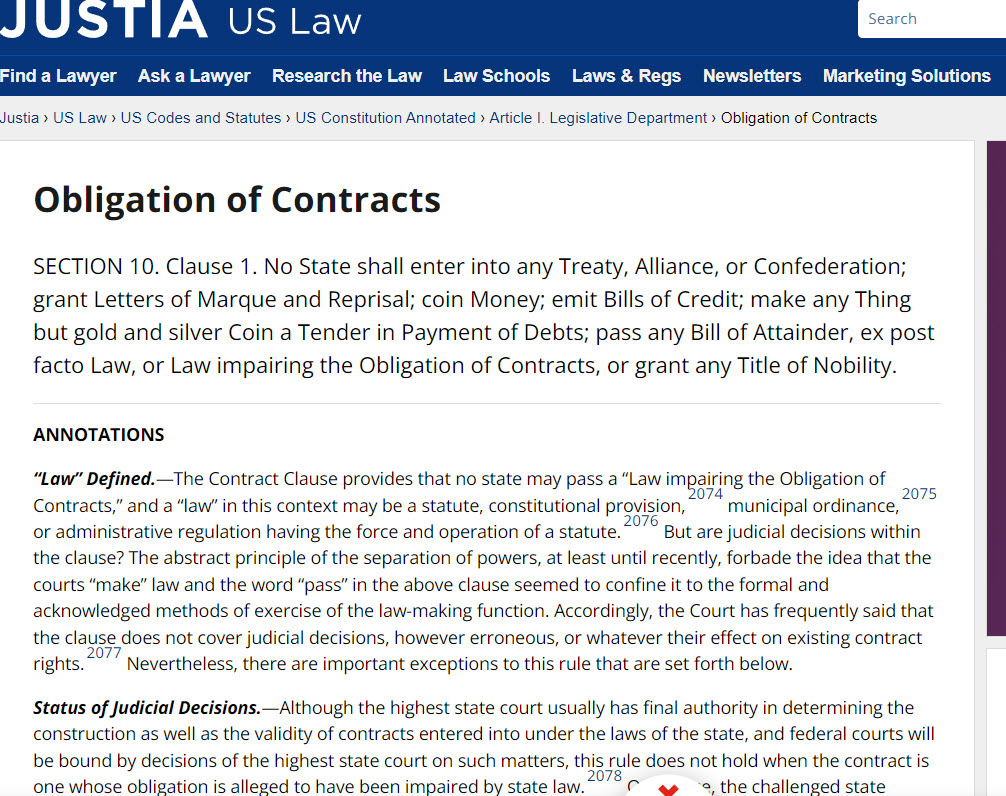
Something that many of us have been conditioned not to realize, is that the government and court system cannot intervene in private contracts or business contracts, to the extent that we have seen occur. Private contracts between parties are just that: they are private. The Constitution in Article 10 Clause 1 https://constitution.congress.gov/browse/article-1/section-10/
states that individual states cannot pass laws which impair the obligation of contracts. This means that government cannot interfere in the private contracts between individuals. See here for more explanation:
https://law.justia.com/constitution/us/article-1/71-obligation-of-contracts.html
If you’re going to object and say that this can’t be true because government does this all the time, you are completely failing to understand the situation. The fact that something unlawful or unconstitutional has often been done, by some part of the government, doesn’t magically make that lawful or constitutional. It simply makes the government corrupt and criminal.

I’ve noticed over the last few years especially, that many people seem to be “thinking backwards”, as I refer to it. Instead of looking at what the law actually is and then seeing if government actions are in line with the law, they look at government actions, and reason, in a very flawed and backwards manner, “if government is doing X, then X must be lawful.” This kind of thinking is not only backwards but shows a dangerous naivete and shows a person who would have no ability whatsoever, to be able to see if their Constitutional Republic were in fact turning into a communist or totalitarian state. Because they would just be fine with whatever the government did, idiotically assuming that “if the government does it, it must be lawful.” I can’t strongly enough condemn such mindless thinking.

Nevertheless, some business contracts can be declared void by courts, in whole or in part, because of certain conditions. This article explains that: https://www.findlaw.com/smallbusiness/business-contracts-forms/will-your-contract-be-enforced-under-the-law.html For instance if the contract is “unconscionable” and would give rise to situations that are clearly grossly unfair, a court may void the contract.

When we look into situations where a landlord collects double rent, the articles on this state that there is no statutory law on this, but there is case law on the matter. I believe there is no statutory law, because any statutory law on the matter would be unconstitutional and in violation of Article 10 Clause 1 of the US Constitution. There may be case law where double collection of rent wasn’t allowed, but I couldn’t find any, and even if such cases do exist, this doesn’t mean they were decided correctly, lawfully or constitutionally.


Because the contract as written contains all the terms of the contract, nothing can be “implied” to be contained that is not contained. As well, and most significantly for our purposes, the contract between renter Steve and property owner David has nothing to do with a totally separate contract between hypothetical renter C (call her Melissa) and property owner David. Which means, that whatever Steve and David agree to in their contract, has nothing whatsoever to do with what Melissa and David agree to, in their separate contract.

Some argue that the first renter’s obligation to pay is voided, because once the space is rented to someone else, the landlord “cannot offer anything of value” for the rent. See here https://answers.justia.com/question/2020/06/09/can-a-landlord-collect-double-rent-for-t-773727
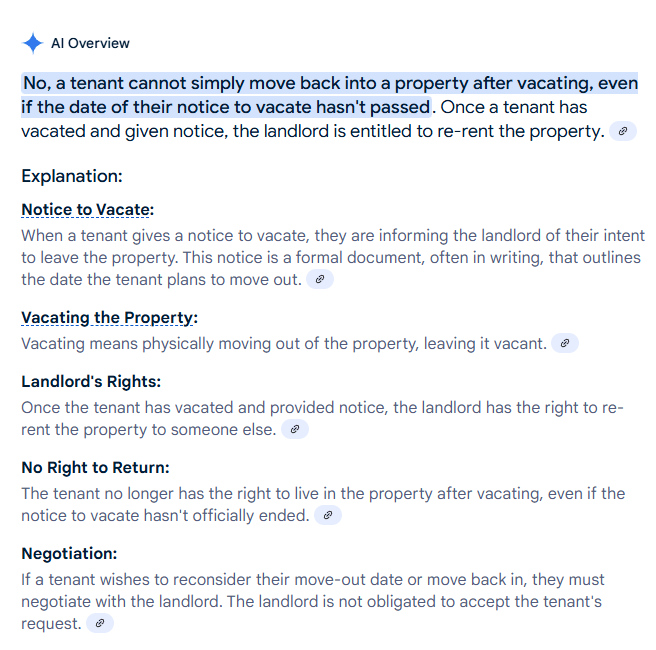
But that argument is weak. By moving out prior to the date to which point he owes rent, a renter has implicitly indicated that he no longer seeks “anything of value” from the space he rented. In fact, even if he did seek something of value there, and wanted to make use of the space after moving out, he would be prohibited from doing so, as stated here in this AI overview of the law on this matter:

The crux of the matter here is that contracts are binding, even if one party decides of their own free will to give up something that they have a right to, under the contract. For instance, if Joe buys a new TV set that comes with 3 free Blue-Ray DVDs, but says he doesn’t want those DVDs, that doesn’t mean the store owner cannot sell those DVDs to someone else. Yes Joe had a right to those, and the price he paid included them, but the fact that he gave them up and didn’t take them, doesn’t mean that he doesn’t have to pay the full price, because he’s not taking advantage of them.

Others argue that the landlord cannot charge the first tenant for rent if he gets a new tenant, because the landlord is obligated to “mitigate his damages.” See here https://www.avvo.com/legal-answers/can-a-landlord-collect-double-rent–2009234.html and see the AI statement on this here:

But this doesn’t apply to a situation where someone didn’t “break a lease”, but simply left early. There are obviously no “damages” when a renter departs early after having paid all the rent they owe. The term “breaking a lease” really only applies to a situation where the renter is on something other than a month to month lease, such as a yearlong lease, and where they would be able to leave without having paid the rest of the rent owed under contract. In a month to month contract, this is not possible to happen, as they have generally paid the landlord the last month’s rent in advance. So they can leave with 30 day’s notice at any time. The fact that they may give 30 days’ notice but leave in 15 days, obviously doesn’t involve any “damages”, hence, the landlord has no obligation to “mitigate damages.”

Why Double Dipping on Rent is Often Lawful

Let’s now use one of our above examples to discuss why double collection of rent is not always, but quite often lawful.

Suppose Steve rented an apartment from property owner David for 3 months, either on Airbnb, or directly. Suppose the cancellation policy was that which generally applies to long term rentals, namely that Steve had to give 30 days’ notice of departure in order to pay less than the 3 months full rent. That is, if 1 month into his stay, he realized he would only need to stay 2.5 months, he could give notice at that point and would only be obligated to pay for 2.5 months. But if Steve only gives notice at a point 2 months in that he is departing in 2 weeks, eg after 2.5 months of his arrival, he would still have to pay for the whole 3 months because of the requirement to give 30 days’ notice.

Renter Has Several Options

So, suppose Steve realizes 2 months in that he only needs to stay 2.5 months, because his plans have changed. He then has several options. These involve departing at different points in time, asking if a friend could stay in the unit, asking host about a refund perhaps based on rebookings, etc.


Renter Option One: Ask Property Owner for Refund Related to Departing Early

One of the most common situations when a guest departs early, is that they ask about getting a refund. They may first ask if they could just do an alteration request and be permitted to change their reservation to depart early. Sometimes hosts will do this, particularly if they expect no difficulty filling the now open space in their calendar.

One awkward part of this type of situation, is that renters may say something such as “I’m giving you enough time to find another renter.” But they aren’t the ones running the business, and they do not know how long it may take to find another renter, so they should not presumptuously speak as if they do. Nor would they know if that particular host has a type of business where bookings come in months in advance. This is often the case for listings at vacation spots, as people arrange their vacations far in advance.

The renter may ask the property owner if his friend can stay in the unit, since he won’t be there and it’s paid for. The property owner is under no obligation to allow this, since this wasn’t part of the contract, but would allow it if he wishes.

Alternatively, Steve may ask the property owner David if he would consider refunding Steve’s rent for the 2 weeks he won’t be at the unit, if David is able to re-rent the space. I would say that in at least 20% to 30% of early departures, in my experience, the renter makes such a request.

Something to notice about this type of situation, is that here we actually have the renter wanting the property owner to “collect double rent”, hoping that the duplicated rent will all go to him, the original renter. So renters may at times want a double rent situation if they can benefit.

Now let’s look at this in a bit more detail. Airbnb hosts are familiar with how the rent for the unit, varies according to length of stay. So, if the original renter Steve booked for 3 months, his nightly rate would be less than someone booking for a week or less. So, let’s suppose Steve leaves two weeks early, and has paid $60 per night as a discounted monthly rate. But suppose David is willing to help Steve get a refund by trying to rebook some of the nights, and obtains a new renter Kathy who will be staying 5 days. Because she’s staying less than a week, her nightly rate is $85 a night. So, supposing Kathy booked a 5 day reservation and paid 5 X $85 = $425 to David, note that this entire $425 would not (or, should not) go as a refund to Steve, because Steve didn’t pay $425 for 5 nights. He paid $60 X 5 = $300 for 5 nights. So in this case, Steve would get $300 back, and David would keep the additional $125.

The rationale for this arrangement would perhaps be clearer if David were able to rebook the entire 2 weeks from Steve’s stay. If Steve were able to get a complete refund for days not stayed, he would get 14 X $60 = $840.
Now the weekly rate for this listing is $75 a night, meaning that Steve would earn 14 X $75 = $1050 by re-booking it to one guest for 14 nights. Can we see now that it would not be fair for Steve to get $1050 as a refund, when he actually only paid $840 for these 2 weeks initially, as part of his reservation? How would it ever be right for someone to get a larger refund than their original payment? Refunds cannot be more than 100% of the payment, right?

Provided Steve understands this (which may not be the case), Steve would have in effect condoned David making “double rent” on the space Steve had paid for, because Steve benefitted from this situation.

Note that in this type of situation, unless David was in fact making an additional income like this, he would have no motivation to help out Steve and agree to try to re-rent the unit, if all that is accomplished by that is that Steve gets some money back, but David just gets the same amount as he would have if he didn’t lift a finger to help Steve. Perhaps David is generous and has a charitable motivation, but I’d predict that by the 12th, 20th or 40th time this happens David is likely to feel less generous and charitable. Operating as a business and not a charity organization, it makes no sense for David to try to help Steve, unless David also gets something out of the situation.

And, particularly if a nightly rent differential doesn’t come into play to benefit the property owner, this is where what I call the “administrative fee” comes in.

What I recommend David do in this situation, is explain to Steve that he’s not willing to do extra work just to enable Steve to get a refund that he isn’t owed, unless he, David, will be paid in some way for that work. So, David could offer to refund David for any days rebooked, less an “administrative fee”, which David considers reasonable in relation to the work to advertise, communicate with prospective rebooking renters, and rebook the space. This is what I have at times done, when renters leaving early ask if there’s a way they could get a refund.

I recommend however, that David assess carefully to see if Steve really thinks this is reasonable, or is resentful that David isn’t willing to just give him all his money back for rebooked dates. I say this, because more than once I have offered this arrangement to an Airbnb guest, only to discover after all was said and done, that they expressed their gratitude for the refund by writing a nasty review complaining that I deducted an administrative fee from their refund. Failing to realize I had no obligation whatsoever to provide them any refund. So that anything they obtained, they should have been grateful for.

Consider A Policy Stating No Refunds Given other than What Cancellation Policy Provides

In fact, because of a few such bad experiences with Airbnb guests that occurred after I went out of my way and beyond my obligation to try to help them get a refund, I now will almost never offer to do this for any Airbnb guest or renter.  I’ve had enough of ending up being resented for work I did to help them.

What I set up then, to clarify things, was that in my house rules I made it clear that by booking a stay at my property, guests or renters agree not to even request a refund other than that they would automatically get in accordance with the cancellation policy. Meaning, for instance, that if I had strict cancellation policy and they booked a 2 week stay, and cancelled 20 days in advance, they would get a 50% refund, but not a 100% refund. And the house rules stipulate that they are not to ask for a 100% refund in this case.

Now you might ask me, “why prohibit guests from even asking for a refund?” The reason is, that there tends to be an attitude of entitlement behind the asking. Meaning, that it is not always an innocent asking. The unspoken reality tends to be more like, “Hey, can you give me a refund if I leave early? If not, I’ll retaliate in my review of you and claim your house was dirty.” I have experienced this enough times to know that this is how it goes. Basically the message is “Hey, can you please be responsible for issues in my personal life? If not I’ll retaliate against you.”

By stating in your house rules that guests are not to ask for a refund, this doesn’t prevent this from happening, but might help, when it does prevent someone from “setting you up.”

Renter Option Two: Keep Possession of the Unit After Vacating Unit

Now if Steve decides to depart early, he could theoretically “keep possession of the unit” after departing such as by leaving some of his things in the unit, and keeping the keys. He is retaining possession of the unit, and it’s his to use for the time he contracted for and paid for. It’s possible a renter will do this, and keep possession of the unit, even though he will not be living in it it, because he feels he might as well make use of what he paid for, for instance, to use as a storage area for a time. Which would be an understandable use of the space. Yet is is also possible he will retain possession of the keys, just to prevent the property owner from re-renting it and collecting any double rent, without having any desire to continue making use of the unit. As long as Steve keeps possession of the unit he rented during the time period he contracted to rent it for, which he can do by keeping the keys if nothing else, property owner David may not re-rent it. Even if Steven isn’t using it and has completely vacated the space.

In my experience, it is very uncommon for Airbnb guests or renters to do this, since by keeping the keys after partially or completely vacating the premises, if there is really no good reason for them do not have fully checked out, they are essentially conveying that they wish to control the property owner, and want to retain the keys in order to prevent him from taking advantage of their having departed early to re-rent the space. While it is completely their right to do this and not surrender the premises until the expiration of their contract, this type of action is adversarial and controlling in nature. And what reasonable renter would want to be seen that way?

There is really almost no “good” or non-adversarial reason for a renter to either leave some of his things in the unit for a significant period of time after moving most everything out, or keeping the keys after moving out completely. I can think of one good reason, which would be something like the renter has a bicycle, or other large item, but has nowhere to store it or no way to move it at the moment, and so is delaying in moving this item out. Other than something like this, which if asked about the renter would easily be able to explain as the reason for his only partial move-out, I can’t think of any non-adversarial reason for a renter to be “half in and half out”, having departed but still with one foot in your doorway.

Keeping the keys for a significant period of time after moving out, particularly when the property owner asks why this is being done and the renter refuses to provide an answer, is also just plain creepy. Particularly when the renter was renting a room in the host’s home. The feeling the host is left with is that after someone has completely departed and the host has said goodbye to them, that person could just show up in the host’s home again at any random time. That’s a rather creepy situation. It’s creepy because if someone has moved everything out and has another place they are staying, there is no good reason they should be coming back into their prior unit. There are only creepy reasons.

To gain more insight, consider another hypothetical situation with a similar theme. Suppose Jane is departing early from a stay at Linda’s home, and realizes just before she is due to depart, that there is a lot of food she has, which she she is unable to take with her. But suppose it sticks in her craw and galls her to think of leaving that good food, which she paid a good amount of money for, in Linda’s house for Linda herself to consume. First she offers to sell the food to Linda, but Linda declines to pay for it.

So then Jane decides she will throw out the considerable amount of good food, JUST to prevent Linda from being able to make use of it. Perhaps Jane thinks again and decides to even go further: she worries that if she throws out the food at Linda’s house, Linda will see it in the garbage and fish it out and make use of it. “Darn it all that wouldn’t be fair!” thinks Jane, “After all, I paid for it and it isn’t right that Linda should benefit by what I paid for.” So Jane then goes to considerable effort to bag up the food and walk down the street and dispose of it in a public trash can, just to prevent Linda from getting it for free!!



Do you see how adversarial this seems? This is in essence what a renter is doing when they make any effort to intentionally prevent a property owner from benefitting from something that their circumstances or choices require them to leave behind. It really leaves one with an unpleasant feeling.

In addition, consider that in one of the common reasons for a renter to depart early, namely that they were apartment hunting and have found a place to move to earlier than expected, why is it that the renter imposes on the Airbnb host or current landlord, rather than their new landlord, to accommodate them? Meaning, why do they expect to get a refund from the owner of the place they have been staying, as opposed to getting a more convenient move-in date from their new landlord? Eg, such that their new lease begins on the day they move out of their current place? I have often wondered this, because I’ve numerous times had Airbnb guests who said that they found permanent housing, but rather than ask the new landlord for a move in date after their reservation with me ended, they expected me to refund them if they left early for the new place. It’s almost as if they regard my business as less legitimate than that of their new landlord, and while they can accept him being firm on the terms of the rental, they somehow think I shouldn’t be. Why?

So, my prediction is that any guest who does something like this on Airbnb, is showing themselves to appear over-controlling, adversarial or retaliatory. And, at least on Airbnb, that is likely to lead to the guest obtaining a less-than-stellar review from the host.


Renter Option Three: Not Keeping Possession of Unit After Vacating Unit

Now it is instructive to note that the only situation in which Steve is likely to retain possession of the unit after vacating it, eg keeping the keys and the right to return and use the space during the time period he’s paid for it, is the situation in which Steve is not leaving the general area. For instance, if he just moves to another apartment in the same city. If he is going to a part of the state pretty far away (eg moving from northern California to southern California) or moving out of state, or leaving the country, he really could not do this. Theoretically, he could keep the keys with him, and mail the keys back so they arrive around his contractual departure date, however this would not make much sense. He could be viewed as having vacated without turning in the keys and thus be charged for lost keys. If he claims that he is keeping the keys just to prevent property owner David from re-renting the space, from a great distance away, that seems overly controlling and silly, to do from a distance, where it is abundantly clear that Steve has left for good and will not be using the unit any more.

Basically if Steve has left the area and is a significant distance away (out of state or out of country) there should be no reason he’s trying to maintain possession of the unit. That just makes no sense. I’ve also never experienced or heard of anyone doing that.

So this is the kind of situation, where renter Steve has turned in his keys and left the area, where property owner David could certainly lawfully re-rent the space, and collect double rent for any rebooked days.

The fact that Steve has fully vacated the unit and turned in his keys, means that he no longer has lawful possession of it, he has surrendered possession of it, which means that David is free to rent it to someone else.

So if David then rents the space to Melissa, and obtains double rent for several of the days that Steve has paid for, this is actually none of Steve’s business. And no government has a leg to stand on if they try to prevent this. It’s none of the government’s business.

This may be difficult for some to understand, who are stuck on the issue that Steve paid for this space.

Perhaps another thought experiment could help. Suppose Steve bought a pair of used shoes at “Ralph’s Gently Used Shop”, but ended up finding that he didn’t like them that much. So, he puts them out in a “free” box on the sidewalk, for someone else to take. Suppose Ralph himself happens along and finds and takes the shoes, and then re-sells the shoes (that he already sold to Steve) at his shop. Would we claim that Ralph had no right to do that, because he already got paid for those shoes? No. Because Steve was giving the shoes away.

Even if Steve took the shoes back to Ralph’s, said he didn’t like them, and asked for a refund, and Ralph according to his refund policy declined to refund him, if Steve simply handed the shoes back to Ralph, Ralph would not be breaking any law by re-selling the shoes. Yes, he could in that situation get paid twice for the same set of shoes, but it was Steve’s choice to hand the shoes back to Ralph, when he could have kept them.

When Would Double Rent Be “Unconscionable”?

In terms of the “unconscionable” type of contract, yes it could be viewed as manifestly unfair to the point of unconscionable, if Steve for example rented the unit for a year lease, had to leave after a month due to a family emergency, and then David re-rented the space for the rest of the year, but insisted Steve also pay for the space for the rest of the year. That would seem quite unfair, to be forcing someone to pay 11 months’ rent that is also being paid by a 2nd replacement renter. But in all the cases I’ve experienced and am familiar with, we are not talking about periods of time exceeding one month, because you can’t do yearlong leases on Airbnb, and I’ve never done year leases or known personally anyone doing yearlong leases. Generally, the “double rent” situations I’ve been in have been in the range of a few days to 2 weeks.

The other point about this, is that as it does require extra work by property owner David to re-book the space, one could view any “double rent” he brings in, for a few days or week or so, as entirely his administrative fee, paying him just for his extra work.

Beware of Spies On Premises Looking for Property Owner Making Double Rent

Now something to be aware of, especially if you’re an Airbnb host who is looking to re-rent a space where an Airbnb guest has departed early, is that the guest may have assigned a spy or spies to check up on the host, to see if they are re-renting the space. For instance, an over-controlling guest may have a friend in the area and asked him to drive by the apartment and see if anyone is occupying it during days he paid for, after surrendering possession of the unit. Or a guest who booked a room in a house where there’s another guest staying, may ask that other guest to see if the room has been re-rented after he departs, and let him know if that happens. I have experienced this happening with at least one guest.

Spying to see if the property owner is doing what he likes with his own property.

In my case, two female guests who rented two separate guest rooms at my house (call them Roxanne and Stacy) became fast friends at my house (where I also live) and Roxanne departed a week early. Roxanne wanted a refund and I declined to offer her any refund. As it happened, I had someone inquire about a direct booking, via my own website, for days that overlapped this departed guests’ reservation. So I rebooked the room to the new guest. Come to find out, Roxanne had solicited the aid of Stacy in spying on what I was doing in my own house. After the new guest arrived, Roxanne wrote a nasty review accusing me of dirty dealing by rebooking her room after she departed early.

Roxanne is ignorant of contract law and what it means to surrender possession of a space you rented. And if Airbnb were run well, such comments in a review would lead to the removal of said review, insofar as they have nothing to do with the stay itself, but rather with things happening after the stay, which are none of a guest’s business anyhow, so a guest should not be permitted to comment on.

Ethics of Double Rent Collection

The matter of ethics as relating to collecting double rent is a separate topic. And ethics are a personal matter. Some property owners may feel it’s unethical to collect double rent and would avoid doing this in any situation. Others, particularly Airbnb hosts, may be aware of ways that Airbnb has acted unfairly in decisions pertaining to the hosts’ income (as in, deciding to refund a guest more than he was due, over and above the host’s objections) and decide that when any opportunity arises to collect double rent, that should be viewed as a way to recoup income that they feel Airbnb has wrongfully deprived them of.


Also think — perhaps the property owner originally worked to always try to refund renters if they left early and he was able to re-rent the space…until he found out what a hassle this was. How renters would quibble with him about how much they got back. How he wasn’t getting paid for his effort. How he saw that he was not doing any good enabling renters to believe they had refund rights not mentioned in the contract, or which were in contradiction to the cancellation policy. And he began to realize that his efforts to be generous were actually undermining his business and his hope to see others take responsibility for their part in the contract. At which point he changed course and ceased to offer extra refunds.

Think too: sometimes the universe just gifts us with a little extra. Sometimes a renter moves into an apartment and finds “gifts” there in terms of useable items abandoned by the previous renter.

Sometimes things just “fall into our lap” and make our life a bit easier. And given all the hardships that those in the property rental business have had, especially with the virtually communist level of massive and unconstitutional government overreach that we have experienced within this business, it’s nice when sometimes a little extra comes your way.

Mail Delivered to the Wrong Address: What are Our Obligations? Assessing Whether US Law Is Legitimate or Workable

In this article, I want to explore one particular area of federal law where I perceive some inherent problems, and that is as pertains to the “obligations” that the government imposes upon us, as regards mail wrongly delivered to our address. Because this issue is a big one for those who’ve had renters at their home, such as Airbnb hosts, I will mainly consider it in relation to mail for renters. Even though most Airbnb hosts have mostly short term guests, some do have longer stay guests, and the issue of guests or renters receiving mail can be an issue regardless of length of stay.

This issue can also be viewed as related to “tenant’s rights”, and used to demonstrate how tenants have gradually gained more and more “rights”, while property owners have seen their rights be whittled away. I have other articles exploring this more at length: in this one I want to mainly focus on one specific area, which pertains to the receipt of mail at an address where one is a renter. Note that for this article I’ll narrow this issue even further, to a situation where a renter is renting a room at the property owner’s own residence, eg in the landlord’s home or Airbnb hosts’ own home.

For a couple decades, I’ve worked with and gotten to know several people in the property rental business, Airbnb hosts or standard landlords, and thus have gained some insight into various types of problems that may arise for them in the course of their business. One of these problems is as regards mail.

Mail is not an generally issue for those who are renting out entire houses or apartments to renters, where they simply receive mail as would any occupant of said house or apartment. The issue is of more concern for those who are renting one or more rooms in their own residence, and especially those who are doing relatively short term rentals, so that they may rent to dozens or even hundreds of people over many years. Mail is more an issue for these homeowners, first because they usually have only one mailbox, and their mail gets mixed in with mail for their renters. And secondly, it’s even more an issue when they have many shorter stay renters, and thus potentially can end up with more problems when they receive mail for many people who are no longer at their home.

US Post Office Does Not Allow Multiple Mailboxes for One Address

So to begin with, the US Postal Service will not allow more than one mailbox at any given home, unless there is more than one “official” unit at that home with an officially separate address. So a homeowner who has one room he rents out, is not able to just set out a different mailbox for his guest or renter ( I will hereafter use the term “renter” to refer to both guests and renters) . The USPS will not honor that. Thus, it is unavoidable that his mail gets mixed in with mail for his renter or renters. So this already creates a problem, in that the homeowner becomes responsible in a way for the renter’s mail since he has to handle it.

The other and most likely larger problem, is that the more renters that the homeowner has over time, the more likely the amount of mail he obtains is going to increase, because it’s invariably the case that both first class and junk mail will be arriving at his home, for various renters, after they have departed.

As well, many shorter term rentals, homeowners are concerned with someone “establishing residence” at their home by using their address. See here: https://community.withairbnb.com/t5/Support-with-your-bookings/U-S-Mail-delivery-at-my-air-B-and-B/m-p/1867812

This happens for a few reasons, regardless of a renter’s good intentions. First, businesses sell addresses to other businesses, so if the renter buys an item from one business, and then moves and gives that business his new address, this doesn’t help if that business has already sold his previous address (the homeowner’s address) to 25 or 50 other businesses. Second, when you provide an address to any entity, be it a business, or government agency or any other entity, it is possible that when you “change your address” with them, they just add in the new address without removing the previous address they have for you. Thus mail can continue to be sent to the old address.

Receipt of previous renter’s mail, especially first class mail, then imposes a burden on the homeowner, in that his understanding is that he’s legally obligated to some action as regards this mail. Eg either arrange for the previous renter to pick it up, or write something on it such as “return to sender: addressee unknown” and give it back to the USPS. Another problem could arise, such as, if the homeowner has either never permitted renters to receive mail, or currently has no renters receiving mail, he may simply open any mail that he takes out of his mailbox, without looking at the addressee, assuming it is all for him. And then find out only after opening an item, that it is not addressed to him.

So, in light of all these potential issues, I sought to look into what actually are the laws as regards renters’ mail being received at a rental property, particularly if received at the property owner’s own residence.

False Claim: Renters Have A Right To Receive Mail at Rental Property

Given the several issues arising from renter’s mail, I wondered if it wasn’t possible for the homeowner in this case to simply prohibit the renter from receiving mail at his home. To insist that he rent a PO Box and get mail there.

In researching this issue, I came across claims that renters have a “right to receive mail” at a rental property. However, I found no evidence to support this claim. The USPS site says that “landlords are obligated to help their tenants receive mail” but cites no law to that regard. I found other posts on the question that suggested the answer was not straightforward, which strongly suggests that no, renters have no “right” to receive mail at a rental property: even at an apartment, which is not what I am considering in this article.

This article says that it could be a “criminal offense” to prevent a tenant from getting their mail, however, statements are made in the article that do not relate specifically to the question asked, and the laws cited also do not relate to some of the statements made. The article states that “tenants have a legal right to receive mail”, but provides no support for this statement whatsoever. The writer first cites 18 U.S.C. § 1701, however if we look at that section of US Code, https://www.law.cornell.edu/uscode/text/18/1701 we can see that it has nothing whatsoever to do with any alleged “tenant’s rights” to receive mail. It only pertains to obstruction of mail. It would not be possible to “obstruct” someone’s mail simply by telling them they have no right to have mail delivered to your address, as they could have that mail delivered elsewhere such as a PO Box.

The author also cites California Penal Code § 594 however if we look that up, https://codes.findlaw.com/ca/penal-code/pen-sect-594/ we see that this law as well has nothing to do with any alleged tenant’s rights to receive mail, or even with theft of mail or obstruction of mail delivery. It only has to do with vandalism or damage of public property, which would apply to mailboxes as they are considered such.

Hence, I believe that renters have no lawful “right” to receive mail at a rental property, and that this has been a “made up right”, wherever it’s been cited, as I find no law to support this claim.

Is It True that a Homeowner Is Obligated to Do Anything in Particular With Mail Wrongly Delivered to Him?

Now let’s look at the next issue. Which pertains to the question of what, if anything, is a homeowner required to do with mail which is “wrongly” delivered to him, eg is delivered to his house for people who either do not reside there, or whom he has not given permission to receive mail at his home.

First, let’s look at items delivered to the wrong address, which are not officially considered “mail”, eg Amazon and other retailer packages. Those are simpler to deal with. As stated in this Reddit thread, people have found through experience that Amazon has no process for misdelivered packages, and generally will tell people just to keep them. Eg, as a free gift.


And this reply was of interest:

This link was pointed to, https://www.nj.com/business/2016/12/bamboozled_if_a_retailer_sends_you_stuff_by_mistak.html which article clarified that federal law states that you get to keep any retailer item sent to your home by mistake. And of course if the item was sent there for a previous occupant who is no longer there, that falls into that category of sent to your home by mistake. As it turns out, companies are prohibited from mailing unordered merchandise to customers. You have the legal right to keep it as a free gift, according to the Federal Trade Commission (FTC).

Now, let’s look at regular mail.

The general understanding, is that we are all responsible for mail that comes to our home which is addressed to other people, who do not live at our home, or who live there but are not allowed to receive mail there. There are many, many sites that state something to this effect: that  “it is illegal for someone to inspect, dispose of, or destroy another person’s mail”.
https://www.ymcorp.com/mail-from-previous-tenants/ and https://www.allied.com/blog/view/all-blogs/2024/03/15/what-to-do-with-mail-that-is-not-yours and https://www.egmlaw.com/blog/2021/11/is-it-illegal-to-throw-away-someone-elses-mail/
There is a law related to this, 18 US Code 1701, mentioned above, which I find here.
That law makes a crime of what is called “obstruction of correspondence.” Under this law, it would be viewed that if you do anything with other’s mail other than give it to that person, or return it to the USPS, you are “obstructing” that correspondence eg that mail.


And yet, what about the distinction made, in this regard, between what’s called “first class mail”, and “junk mail?” It’s widely & commonly thought that it’s okay to throw away “junk mail” addressed to others, but not “first class mail.” Eg see here, where we read that “non first class mail” is considered trash by the USPS and can’t even be forwarded.

As well, this person posting on Reddit claims they have tried 3 times to return certain mail to the post office, only to keep getting it back in their mailbox again: https://www.reddit.com/r/USPS/comments/18rit3g/is_return_to_sender_not_a_thing/

One Reddit responder who apparently works at the post office, explains that non-first-class mail cannot be returned to sender, and simply is thrown in the trash.

And yet, the law itself makes no distinction in this regard. See here: https://law.stackexchange.com/questions/52349/is-it-illegal-to-throw-away-the-previous-tenants-standard-mail and https://www.usestable.com/blog/what-to-do-with-mail-that-is-not-yours

And indeed, if we look at the actual text of the law, we find no distinction whatsoever between “types” of mail, eg whether it is first class mail or so-called “junk mail” that is not first class. Hence, from the text of the law itself, we would have to conclude that as suggested by this post above, it would be unlawful for anyone to dispose of any mail received at his home, addressed to anyone but himself, regardless what kind of mail it is. Eg, the law insists that “junk mail” as well as first class mail cannot be “obstructed” in its delivery to the stated recipient.

Now consider this issue: where did the category “junk mail” come from? If we explore this, I think we will find that the USPS itself created the problem of “junk mail”, by offering lower mailing rates to businesses who engaged in mass mailings. But the USPS likely realized that with those lower mailing rates, and that mass amount of mail, it could not handle return-to-sender services for all such mail, and then exempted itself from 18 USC § 1701, by unlawfully floating the idea that “non first class mail” was exempted from this law, when in fact the plain text of the law makes no such distinction.

Now that we have established this from the text of the law, let’s think through some consequences of this, shall we? I believe this will be quite illuminating!!

Consequences If We Are All Responsible For All Mail Coming to Our Home Not Addressed to Us

First of all, if the law is clear that it’s a crime to obstruct ANY mail, not just first-class mail, then what are we to think about the USPS itself refusing to return so-called junk mail or non first class mail to sender? Wouldn’t that in itself be a crime? Yes it would! So, if we really apply “18 USC §1701. Obstruction of mails” generally, then the very first and quite massive crime we find in relation to that, is that of the US Postal Service itself. Under this law, according to the plain text of the law, the USPS cannot lawfully refuse to return to sender, any mail at all that has a specific addressee, eg that doesn’t say “X or current resident.” And yet it does that all the time! It’s important to keep in mind that in our Constitutional Republic, the only bodies who can lawfully create any law, statute, code, rule, regulation or ordinance, are those elected by the people to do so, namely US Congress, state legislatures, and local government bodies eg mayor and city council. Hence, no government agency, such as the various administrative agencies, or the USPS, can create law. Thus, the USPS cannot itself create policy pertaining to or exempting itself from, 18 US Code §1701.

Second, let’s do a thought experiment about what would happen, if everyone were lawfully responsible, for every single piece of mail that arrived at their home, which was not addressed to them.

I have personally known several homeowners who have had dozens and in some cases hundreds of renters over several decades, and who regularly receive mail for renters who’ve departed. Most of this is junk mail, but some of it is “first class mail.” I asked one of these to count how many pieces of mail were received for previous renters, and he told me that he gets anywhere from 5 to 20 items per week, addressed either to previous renters, or even people he never heard of. Multiply that by 52 weeks in a year, and that becomes anywhere from 260 to 1040 items of mail per year, that he is burdened by and could, according to the text of the law, be responsible for returning to the US Post Office. Now consider he’s lived at his house for 15 years, and will likely be there another 30 years, and we have 45 years’ worth of others’ mail, which could be anywhere from 11,700 to 46,800 pieces of others’ mail, that he then would become responsible for, over all that time.

I want to suggest at this point, that on its face, 18 USC §1701 cannot hold, because it would place an impossible and unreasonable burden upon many people, to be responsible for a massive volume of mail, that by all rights should never have arrived at their home to begin with.

If we add to that burden, the possibility that he would have the experience described by one diligent person above, where she tried 3 times to return a piece of mail to the USPS, only to have it re-delivered to her home each time, we can see that the burden upon such a homeowner could be even larger.

Third, I want to contemplate an issue that apparently was not considered by those who drafted 18 USC §1701, which is, that it’s a general common-law principle that along with rights, come responsibilities. https://www.bostonreview.net/articles/samuel-moyn-rights-duties/ This article too discusses the “correlative relation of rights and duties” https://www.law.utah.edu/news-articles/correlativity-of-rights-and-duties-why-should-i-care-part-1/

Though many are unaware of this, and indeed I even spoke to one attorney who had never heard the term “common law”, in fact our entire legal system is based upon common law and natural law. We developed our legal system from English Common Law. And thus one can find common law principles cited often in court cases, even US Supreme Court cases. Unfortunately, our legal system has become “detached” from its common law foundation in many respects, and gone astray. This needs to be corrected. Our entire nation has also veered into unconstitutional laws and practices, (not through ignorance but intentionally) so that we have hundreds if not thousands of unconstitutional laws and statutes which corrupt lawmakers have passed (rent control being one of those), and we are in the midst of a time of massive correction. In the next few years we will see literally thousands of unlawful “laws” thrown out. Many of you may not see what is developing, in this regard, in the world around you, but you will soon.

18 USC §1701 Fails to Take Into Account Other’s Duties To Ensure Their Mail Goes to Them

The problem with 18 USC §1701 is that if we interpret it to mean that no one can dispose of mail that improperly arrives at his home, addressed to others, then we are essentially defining the “passage of mail” as necessarily taking place through an incorrect address. Does that not seem problematic?

And, we then place the burden or duty of the correct routing of mail, not on the named recipient, but on third parties, such as a previous landlord, or even a random person. And we in essence “compel a property owner” into government service, by requiring him to take certain actions to convey mail, in relation to receiving mail at his home, that should never have been sent there.

Again, let’s do a thought experiment to make this clearer.

Suppose Sally rents a room at Kevin’s home for 4 months, as a sublet. He tells her she cannot have mail sent to her at his home, but 3 months into the rental, she ignores this rule and has her bank statements and a couple other things sent there anyway. Kevin is upset to see she is having mail sent to his home. He hands her a couple pieces of her mail, but informs her that she must immediately cease using his address, and that any further mail sent here for her will be returned to sender. Then she moves out, but after she departs, he receives more mail for her. She wants to pick it up, but he tells her he won’t allow this, and instead hands it back to the mailman.

She argues that she is traveling at the moment and has no permanent address yet, so she can’t change her address yet, and complains that if he returns the mail, she won’t get it at all. He reminds her that she never had permission to use his address for mail in the first place.

Now suppose that because she’s angry, Sally retaliates against Kevin, and signs up to be on multiple mailing lists, so that he gets all kinds of junk mail for her. According to 18 USC §1701, Kevin would be responsible for all of this, indefinitely on into the future. Meaning, even though Sally was never allowed to use his address for her mail, the fact that she did now imposes an indefinite obligation upon him. Do you perceive the problem with this? In this construing of the law, the property owner Kevin has all the responsibility for conveyance of mail to Sally, while Sally herself is exempted from the duty to take any particular action to ensure that she get the mail sent to a proper place.

Other situations could also be considered which would also place an unfair burden on the homeowner Kevin. A renter who was allowed to receive mail while renting at his home, but who was advised he must change his address upon departure, could fail to change his address, and this too could result in an indefinitely long burden upon Kevin to mark “return to sender” on all such mail, and return all this mail to the postman. Or, it could happen that someone provides an incorrect address to some business or other entity, and mail comes to Kevin’s home for them, which never should have arrived there.

The point with all of these hypothetical cases, is that we do not see an appropriate common-law balance between rights and responsibilities here. We see one party (the renter) being given all the rights to receive mail, even through addresses they are not permitted to use, with none of the responsibilities to use only the correct address. And then, we see the other party, the homeowner, having no rights associated with restricting mail to his home, but carrying all the responsibility for mail wrongly delivered to his home, in the sense that he is obligated to participate in its conveyance. For this reason, it’s my opinion that this law is void and not enforceable, because it is not in keeping with natural or common law principles balancing rights with responsibilities.

Drilling Down to Find the Key Problem With 18 USC §1701

If we work to “drill down” and see where the problem originates with 18 USC §1701, I believe we can rather easily locate the central issue.

In essence, the current setup regarding mail delivery and the laws related to it, result in a situation where, quite oddly, and in my view quite unconstitutionally, all mailboxes are considered federal propertyhttps://www.mailboxesandsigns.com/blog/2020/posts/are-mailboxes-considered-federal-property/ That article states:

Yes, Mailboxes Are Federal Property. Assuming a USPS-compliant mailbox is installed and ready for use, it’s considered federal property. In other words, the homeowner doesn’t legally own his or her mailbox; it’s the property of the U.S. government. Prior to installation, however, mailboxes aren’t federal property….”

We see the same point made here: https://www.mackinac.org/5394 and here https://blog.oup.com/2017/07/mailboxes-us-mail/

So the immediate and obvious first problem with this claim that the federal government “owns” our mailboxes, is that the government did not buy these mailboxes, we did. And so if the government “claims” to own them, they have stolen them from us, taken our property without compensating us for that property, and this is a violation of the 5th Amendment to the US Constitution. https://www.justice.gov/enrd/natural-resources-section/fifth-amendment-takings-law

Others claim that the USPS doesn’t own the mailbox itself but can regulate what goes into it, hence the commonly understood restriction that only the USPS can put things in a mailbox. https://www.law.cornell.edu/uscode/text/18/1725 However, if the mailbox belongs to us, and not the government, how can the government regulate what can be put into it? This makes no sense. That would imply that the US Government is telling us what we can and cannot do with our own property. And in my opinion, that would likewise be a violation of the 5th Amendment of the US Constitution, as it would involve a government “taking” of our property to the extent that the government is telling us what we can and cannot do with our own property.

So, either way, it’s my opinion that this is unconstitutional and a violation of the 5th Amendment. As well, if the federal government claims to own our mailboxes, they are also intruding upon private land. The federal government is not permitted to make inroads upon private property in this way. There is no arrangement made for this in the Constitution. We have not given our consent to have federal government property placed on our private property. As well, consider the egress issue that is created if the federal government were allowed to “require” that private property all contain some item of federal property upon it.

Alternatively, if the government does not own our mailboxes, they cannot make laws about what can or cannot be put in these.

I believe that these issues regarding our “duty” to convey other’s mail, as expressed in the law about obstruction of mail, are completely dependent upon the federal government either owning our mailboxes or controlling what goes in them. Either of which I claim is unlawful.

Because if we think about it, the burden placed upon us to participate in conveyance of mail that should never have been delivered to our home, (eg our being unlawfully compelled into service of the US Government) would cease, if we controlled our own mailbox, and could simply stipulate that nothing was to be deposited there which did not have our name upon it. In other words, it should never be OUR responsibility to ensure that the government does not deliver other’s mail to our home, with that then turning into our burden when it does. This only happens because the government considers our mailbox to be theirs. So, the point at which we become improperly obligated to participate or compelled into service in the conveyance of other’s mail, is that point where the federal government has unconstitutionally intruded upon our sovereign private property.

Another thought experiment may be useful here.

If the federal government claims to own our mailboxes, then at what point does what is placed in those mailboxes theoretically become our property? Wouldn’t that be at the point where we remove it from the mailbox? I think so.

If that is the case, then suppose, returning to our story about Sally and Kevin above, the mail carrier puts mail for Sally into Kevin’s mailbox. And then suppose that Kevin never takes that mail for Sally out of that mailbox, because it isn’t his. If that mail remains in a mailbox that is owned by the federal government, wouldn’t that mail then be the responsibility of the federal government, and not of Kevin? I mean why would Kevin have to take any action with it at all, such as remove it, write “return to sender” on it, and place it in the spot for mail to be picked up. All he has to do in my view, is refuse delivery. Which he can do by just leaving it in the mailbox. It would essentially be the same, then, as if that mail for Sally had remained at the post office itself, at federal property there. Kevin would have nothing to do with it.

Conclusion: The Federal Government has no Basis to Coerce Property Owners to Participate in the Conveyance of Mail Wrongly Delivered to Their Property

Hence, I conclude that for the reasons and rationale explained above, the federal government has no legitimate authority to require any property owner to take any action whatsoever, with regard to mail wrongly delivered to their property. This can be explained in 2 different views on mailbox ownership.

If the federal government claims to “own” our mailboxes or regulate what goes into them, the property owner may in my view, simply refuse delivery of any wrongly delivered item, by leaving it in the mailbox. Which refusal is accomplished through the non-action of not taking the mail out of the box, rather than through the action of having to take it out, write something on it, and put it in a place to be picked up again.

Now if we go with the argument of the mailbox not belonging to the federal government, then it should suffice for the property owner to only once have to tell the mail carrier not to deliver any mail not addressed to that property owner, and perhaps follow that up by putting a sign on the mailbox to that effect. If the USPS does not follow the owner’s instructions in this regard, then it’s the USPS and not the owner who becomes responsible for obstruction of correspondence, as they are negligently delivering mail to the wrong address.

Finally, there is the “duty” along with rights issue. Irrespective of and separate from the issues of ownership of the mailbox or control of what goes into them, I believe that natural and common law both clarify to us that all situations of “rights” have to be balanced with those of “responsibilities”. Hence, we cannot have a situation where renters (and past home residents) have all the rights, expecting conveyance of their mail in any and every situation, whereas property owners have all the responsibilities, being required to convey other’s mail in every situation, even through an incorrect address, for an indefinite period of time.

If someone has not taken responsibility to ensure that their mail goes to the correct address, such as by correctly officially changing their address, not using a mailing address that they do not have permission to use, or contacting various businesses or entities to ensure the correct address is being used for their mail, why should others end up with problems and legal burdens as a result of their failure of responsibility?

I would contend that in a situation where someone has used an owner’s address to receive mail without the owner’s permission, or continues to use it after their permission to do so has ceased (eg after they have moved out), then a property owner has no responsibility whatsoever to take any action to convey their mail to them. Because in effect, the named recipient is the one who has obstructed their own correspondence, by failing to take action to ensure it is delivered to the correct location.


What does this “no responsibility to convey mail” mean in a practical sense? I believe it all comes down to the owner refusing delivery of any mail other than a list of “approved names”, or “current residents”, which could easily be posted on the mailbox.

If the USPS delivers mail to this address and this mailbox that the owner has clarified they are not accepting, then the USPS and not the owner should be held accountable for “obstruction of correspondence.”

USPS and Not Property Resident Should be Responsible for Delivery to Correct Address


And yet, thinking about this even a bit further, it shouldn’t even be the property owner’s (or occupant’s) responsibility to have to take the initiative and get creative and make a list of current residents and inform the USPS to only deliver mail for those persons to his address. Because even that puts the burden and initiative on the property owner. And it leaves open the possibility that, as this is not a recognized practice, the mail carrier will say “I’m sorry, we don’t do that, that’s not a thing in the USPS. We deliver any mail with this address to this box.” In fact, that is quite likely, I experienced that myself. After too often receiving mail for people who didn’t reside at my house, I told the mail carrier (who knew me well by name) not to deliver mail to my home for anyone but myself. He didn’t honor this request and continued to do so.

So really, the USPS itself, and not the property owner, should be the one initiating and implementing a system to prevent delivery of mail to the wrong address. Failing to do that, the government has no business “compelling into service” any of us to do anything with mail wrongly delivered to our homes. And if they do not come up with a method by which we can refuse service of such mail, in my view they cannot prohibit us from simply throwing out any such incorrectly delivered mail.

This post below explains the thinking in such a view:

Simply put, those who want their mail, need to be responsible to have the correct mailing address on file with the USPS. And the USPS needs to be responsible for routing all mail, both “first class” and “junk mail”, to the correct address, for indefinite periods of time. Businesses and other senders also need to be responsible to use the correct address, and realize if they do not, the recipient will not get the mail. If all these parties do not take responsibility for their part in the process, it is wrong in my opinion to compel anyone else into service to ensure that they get mail which was addressed and delivered to an address that they had no permission to use.

Passage Of Mail Cannot be Defined As Requiring Routing through Incorrect Address: Enforceability of Existing Law is Problematic

Lastly, 18 USC §1701 refers to “Whoever knowingly and willfully obstructs or retards the passage of the mail” and thus we are led to inquire as to what is the definition of “passage of mail.” If we look for the definition of “passage of mail”, I find it difficult to find a definition for that exact phrase, but the closest I get is that the passage of mail means “mail delivery” which is “the transporting of letters and packages through the post office”. I also find the definition of delivery here:
https://www.collinsdictionary.com/dictionary/english/mail-delivery “Delivery is the bringing of lettersparcels, or other goods to someone’s house or to another place where they want them”

What is notably missing in such definitions, is the inclusion of delivery to incorrect addresses as part of the passage of mail processes. Or the inclusion of random persons, not affiliated with the USPS, as part of the mail delivery service. I would say that it would never be acceptable to define the “passage of mail” as having to take place through an incorrect address. Hence, since the lawful passage of mail requires the correct address, in the first place, only those who’ve failed to provide the correct address or delivered to an address other than that stated on the item, could be considered as impeding the passage of mail.

Finally, I want to point out that apart from all else mentioned above, it would be virtually impossible to convict any random resident with a crime under this law, of refusing to be compelled into government service and participating in routing of other’s mail. Because in order to thus convict someone, it would first be necessary to prove that they received certain mail. And that cannot be done unless a certified or registered mailing was done, which they signed to receive, and it’s extremely unlikely anyone would sign to receive an item which was clearly going to the wrong address. Even if a postal carrier were to scan an item and scan the mailbox he put it into (which is not a practice used by the USPS) this could not be used to prove the resident obtained the mail, as many mailboxes are unlocked and stolen mail happens all the time. As well, even if the mailbox were locked, if more than one person lives at a given address and has access to the mailbox, how could it be proven which one of them handled that item of mail in question?

As well, even if it could somehow be proven that a particular resident obtained the mail item, it cannot be proven that he did not set it out to be picked up by the mailman again.

After I had my outgoing mail stolen off of my mailbox 20 years ago, ever since then, I no longer put outgoing mail on my mailbox, but rather take it to an official post office box and deposit it securely in there.

However, you can be very sure that if I were someone receiving a considerable volume of mail for people not residing at my home, I would not be making any effort whatsoever to take it all to an official USPS mailbox. I would at most, just stick it on my mailbox to be picked up by the mail carrier. And mail just sitting out in the open like that, could easily be stolen, or even just blow away. Or it could be picked up by the mail carrier, and then lost somehow in the system from that point onward.

Summary

So, in conclusion I hope I’ve helped you see why in my view, it is not feasible or lawful to seek to compel those receiving mail wrongly delivered to their address, to be coerced into service for the US government and be part of the mail delivery system.