
For both standard landlords and Airbnb hosts, there are times in your experience as a rental property owner, where you may face a situation where you are essentially “collecting double rent”.
Now if you do online searches on this topic, “collecting double rent” or “double dipping on rent”, you’ll very likely come across many websites or threads which state that it’s unlawful to collect double rent. For instance these: https://www.reddit.com/r/legaladvice/comments/e1qlpe/is_it_legal_for_landlords_to_charge_double_rent/
And https://archive.ph/0SXsI as well as https://archive.ph/1LncG
I want to demonstrate why this is not necessarily the case. This thread suggests the reason why “double dipping” on rent is not unlawful https://boards.straightdope.com/t/landlord-double-dipping-on-rent/86140/6
Double Dipping is Common for Airbnb Hosts
Additionally, “double-dipping” situations are actually quite common for Airbnb hosts. Let me give a few examples.
(1) A guest books a stay of any length, and then cancels, but does not get a full refund, or sometimes doesn’t even get a partial refund, because of the terms of the cancellation policy. For instance: they book a 2 month long stay, and then cancel the stay a week later. According to Airbnb’s long term cancellation policy which applies to all reservations over 28 days long, this guest would be obligated to pay for the first month of the stay regardless of when they cancel the stay, if they cancel more than 48 hours after booking.
Or, suppose the guest booked a weeklong stay, and then cancelled 14 days before arrival. With a strict cancellation policy, he would only get a 50% refund. If he cancels less than a week before arrival, he’d get no refund.
However, in each of these situations, the host may be able to re-book some or all of those dates. If that happens, the host would then be collecting both a full or partial rent from the guest who cancelled, plus the rent for the guest who re-booked some or all of those dates.
(2) Another example situation would be that a guest books a stay, of whatever length, but then for some personal reason, departs early. Perhaps their plans changed, or they were looking for permanent housing and found an apartment earlier than expected.
The host then may re-book the now vacated space, and earn double rent for the days that are part of the departed guests’ paid reservation, but which are now being rented out to another guest because the first guest vacated and checked out early.
Notice that Airbnb has never taken any action to prevent any host from such “double dipping” and being paid twice, essentially, for one or more days of rental fees. And in my opinion, Airbnb could not take action to prevent this, because there’s nothing unlawful about it. To understand why, all we need is a basic understanding of contract law.
Contract Law
In contract law, one party is paying a specific amount to another party, to obtain something, such as a product or services. In rental property contracts, the agreement is that renter A (call him Steve) pays X amount to property owner B (call him David) , in exchange for use of a specific property, such as a house, apartment or private room, for specified dates. In such contracts, it is generally stipulated or implied that the rented property will be free from serious defects or problems that would materially and detrimentally impact the renter’s use of said property, such as a nonfunctioning shower, or a hole in the roof that allows rain to pour in, or a broken bed.
The cancellation policy that applies to this rental contract, contains the totality of terms which apply to cancelling the rental before arrival, or departing early and not staying for the full rental term, or amount of notice that needs to be given when departing, eg 30 day’s notice for standard long term rentals.

Government Cannot Intervene in Private Contracts
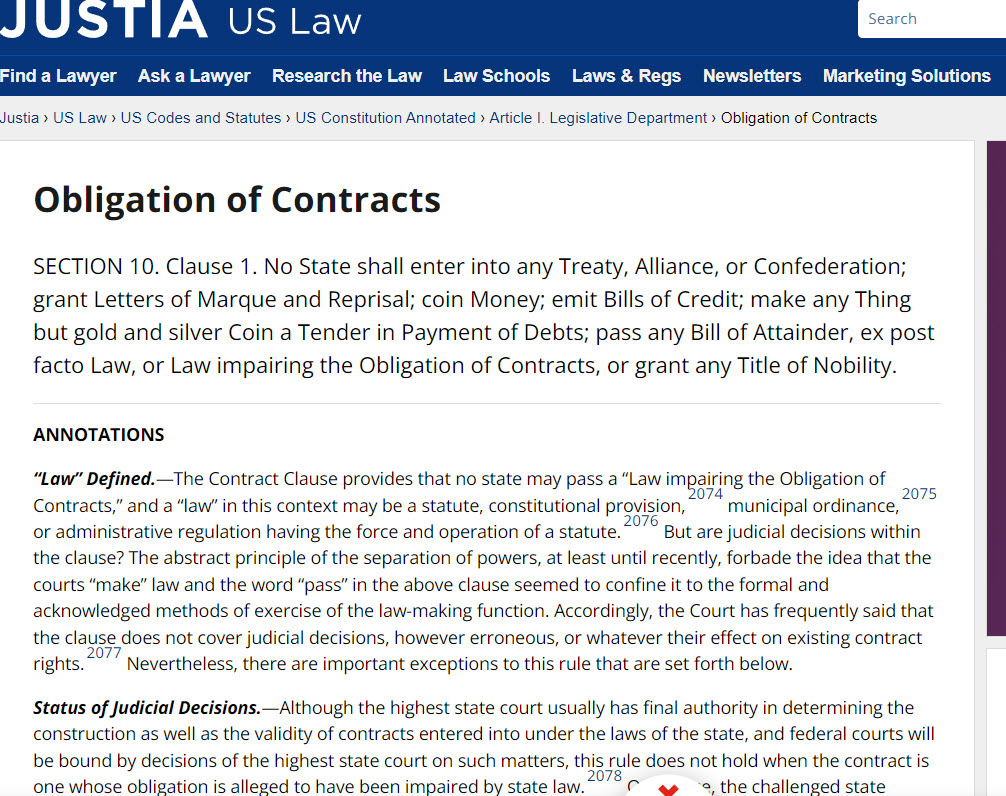
Something that many of us have been conditioned not to realize, is that the government and court system cannot intervene in private contracts or business contracts, to the extent that we have seen occur. Private contracts between parties are just that: they are private. The Constitution in Article 10 Clause 1 https://constitution.congress.gov/browse/article-1/section-10/
states that individual states cannot pass laws which impair the obligation of contracts. This means that government cannot interfere in the private contracts between individuals. See here for more explanation:
https://law.justia.com/constitution/us/article-1/71-obligation-of-contracts.html
If you’re going to object and say that this can’t be true because government does this all the time, you are completely failing to understand the situation. The fact that something unlawful or unconstitutional has often been done, by some part of the government, doesn’t magically make that lawful or constitutional. It simply makes the government corrupt and criminal.
I’ve noticed over the last few years especially, that many people seem to be “thinking backwards”, as I refer to it. Instead of looking at what the law actually is and then seeing if government actions are in line with the law, they look at government actions, and reason, in a very flawed and backwards manner, “if government is doing X, then X must be lawful.” This kind of thinking is not only backwards but shows a dangerous naivete and shows a person who would have no ability whatsoever, to be able to see if their Constitutional Republic were in fact turning into a communist or totalitarian state. Because they would just be fine with whatever the government did, idiotically assuming that “if the government does it, it must be lawful.” I can’t strongly enough condemn such mindless thinking.
Nevertheless, some business contracts can be declared void by courts, in whole or in part, because of certain conditions. This article explains that: https://www.findlaw.com/smallbusiness/business-contracts-forms/will-your-contract-be-enforced-under-the-law.html For instance if the contract is “unconscionable” and would give rise to situations that are clearly grossly unfair, a court may void the contract.
When we look into situations where a landlord collects double rent, the articles on this state that there is no statutory law on this, but there is case law on the matter. I believe there is no statutory law, because any statutory law on the matter would be unconstitutional and in violation of Article 10 Clause 1 of the US Constitution. There may be case law where double collection of rent wasn’t allowed, but I couldn’t find any, and even if such cases do exist, this doesn’t mean they were decided correctly, lawfully or constitutionally.
Because the contract as written contains all the terms of the contract, nothing can be “implied” to be contained that is not contained. As well, and most significantly for our purposes, the contract between renter Steve and property owner David has nothing to do with a totally separate contract between hypothetical renter C (call her Melissa) and property owner David. Which means, that whatever Steve and David agree to in their contract, has nothing whatsoever to do with what Melissa and David agree to, in their separate contract.
Some argue that the first renter’s obligation to pay is voided, because once the space is rented to someone else, the landlord “cannot offer anything of value” for the rent. See here https://answers.justia.com/question/2020/06/09/can-a-landlord-collect-double-rent-for-t-773727
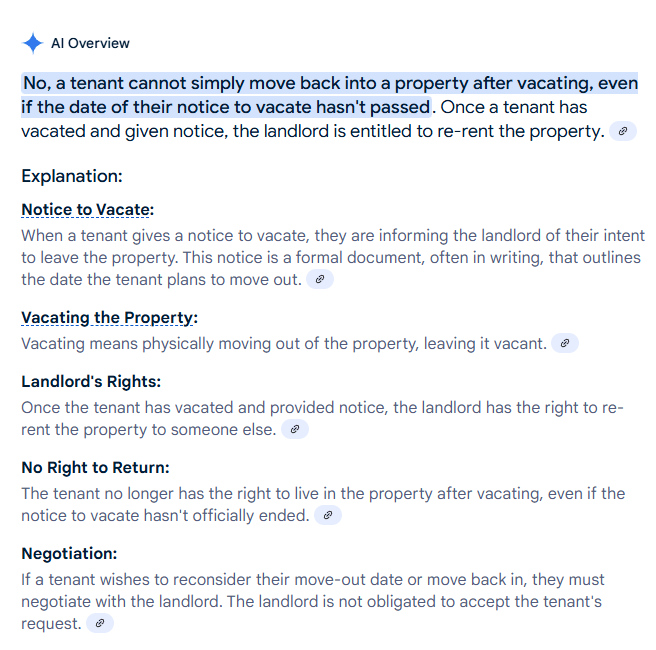
But that argument is weak. By moving out prior to the date to which point he owes rent, a renter has implicitly indicated that he no longer seeks “anything of value” from the space he rented. In fact, even if he did seek something of value there, and wanted to make use of the space after moving out, he would be prohibited from doing so, as stated here in this AI overview of the law on this matter:
The crux of the matter here is that contracts are binding, even if one party decides of their own free will to give up something that they have a right to, under the contract. For instance, if Joe buys a new TV set that comes with 3 free Blue-Ray DVDs, but says he doesn’t want those DVDs, that doesn’t mean the store owner cannot sell those DVDs to someone else. Yes Joe had a right to those, and the price he paid included them, but the fact that he gave them up and didn’t take them, doesn’t mean that he doesn’t have to pay the full price, because he’s not taking advantage of them.
Others argue that the landlord cannot charge the first tenant for rent if he gets a new tenant, because the landlord is obligated to “mitigate his damages.” See here https://www.avvo.com/legal-answers/can-a-landlord-collect-double-rent–2009234.html and see the AI statement on this here:

But this doesn’t apply to a situation where someone didn’t “break a lease”, but simply left early. There are obviously no “damages” when a renter departs early after having paid all the rent they owe. The term “breaking a lease” really only applies to a situation where the renter is on something other than a month to month lease, such as a yearlong lease, and where they would be able to leave without having paid the rest of the rent owed under contract. In a month to month contract, this is not possible to happen, as they have generally paid the landlord the last month’s rent in advance. So they can leave with 30 day’s notice at any time. The fact that they may give 30 days’ notice but leave in 15 days, obviously doesn’t involve any “damages”, hence, the landlord has no obligation to “mitigate damages.”
Why Double Dipping on Rent is Often Lawful
Let’s now use one of our above examples to discuss why double collection of rent is not always, but quite often lawful.
Suppose Steve rented an apartment from property owner David for 3 months, either on Airbnb, or directly. Suppose the cancellation policy was that which generally applies to long term rentals, namely that Steve had to give 30 days’ notice of departure in order to pay less than the 3 months full rent. That is, if 1 month into his stay, he realized he would only need to stay 2.5 months, he could give notice at that point and would only be obligated to pay for 2.5 months. But if Steve only gives notice at a point 2 months in that he is departing in 2 weeks, eg after 2.5 months of his arrival, he would still have to pay for the whole 3 months because of the requirement to give 30 days’ notice.
Renter Has Several Options
So, suppose Steve realizes 2 months in that he only needs to stay 2.5 months, because his plans have changed. He then has several options. These involve departing at different points in time, asking if a friend could stay in the unit, asking host about a refund perhaps based on rebookings, etc.
Renter Option One: Ask Property Owner for Refund Related to Departing Early
One of the most common situations when a guest departs early, is that they ask about getting a refund. They may first ask if they could just do an alteration request and be permitted to change their reservation to depart early. Sometimes hosts will do this, particularly if they expect no difficulty filling the now open space in their calendar.
One awkward part of this type of situation, is that renters may say something such as “I’m giving you enough time to find another renter.” But they aren’t the ones running the business, and they do not know how long it may take to find another renter, so they should not presumptuously speak as if they do. Nor would they know if that particular host has a type of business where bookings come in months in advance. This is often the case for listings at vacation spots, as people arrange their vacations far in advance.
The renter may ask the property owner if his friend can stay in the unit, since he won’t be there and it’s paid for. The property owner is under no obligation to allow this, since this wasn’t part of the contract, but would allow it if he wishes.
Alternatively, Steve may ask the property owner David if he would consider refunding Steve’s rent for the 2 weeks he won’t be at the unit, if David is able to re-rent the space. I would say that in at least 20% to 30% of early departures, in my experience, the renter makes such a request.
Something to notice about this type of situation, is that here we actually have the renter wanting the property owner to “collect double rent”, hoping that the duplicated rent will all go to him, the original renter. So renters may at times want a double rent situation if they can benefit.
Now let’s look at this in a bit more detail. Airbnb hosts are familiar with how the rent for the unit, varies according to length of stay. So, if the original renter Steve booked for 3 months, his nightly rate would be less than someone booking for a week or less. So, let’s suppose Steve leaves two weeks early, and has paid $60 per night as a discounted monthly rate. But suppose David is willing to help Steve get a refund by trying to rebook some of the nights, and obtains a new renter Kathy who will be staying 5 days. Because she’s staying less than a week, her nightly rate is $85 a night. So, supposing Kathy booked a 5 day reservation and paid 5 X $85 = $425 to David, note that this entire $425 would not (or, should not) go as a refund to Steve, because Steve didn’t pay $425 for 5 nights. He paid $60 X 5 = $300 for 5 nights. So in this case, Steve would get $300 back, and David would keep the additional $125.
The rationale for this arrangement would perhaps be clearer if David were able to rebook the entire 2 weeks from Steve’s stay. If Steve were able to get a complete refund for days not stayed, he would get 14 X $60 = $840.
Now the weekly rate for this listing is $75 a night, meaning that Steve would earn 14 X $75 = $1050 by re-booking it to one guest for 14 nights. Can we see now that it would not be fair for Steve to get $1050 as a refund, when he actually only paid $840 for these 2 weeks initially, as part of his reservation? How would it ever be right for someone to get a larger refund than their original payment? Refunds cannot be more than 100% of the payment, right?
Provided Steve understands this (which may not be the case), Steve would have in effect condoned David making “double rent” on the space Steve had paid for, because Steve benefitted from this situation.
Note that in this type of situation, unless David was in fact making an additional income like this, he would have no motivation to help out Steve and agree to try to re-rent the unit, if all that is accomplished by that is that Steve gets some money back, but David just gets the same amount as he would have if he didn’t lift a finger to help Steve. Perhaps David is generous and has a charitable motivation, but I’d predict that by the 12th, 20th or 40th time this happens David is likely to feel less generous and charitable. Operating as a business and not a charity organization, it makes no sense for David to try to help Steve, unless David also gets something out of the situation.
And, particularly if a nightly rent differential doesn’t come into play to benefit the property owner, this is where what I call the “administrative fee” comes in.

What I recommend David do in this situation, is explain to Steve that he’s not willing to do extra work just to enable Steve to get a refund that he isn’t owed, unless he, David, will be paid in some way for that work. So, David could offer to refund David for any days rebooked, less an “administrative fee”, which David considers reasonable in relation to the work to advertise, communicate with prospective rebooking renters, and rebook the space. This is what I have at times done, when renters leaving early ask if there’s a way they could get a refund.
I recommend however, that David assess carefully to see if Steve really thinks this is reasonable, or is resentful that David isn’t willing to just give him all his money back for rebooked dates. I say this, because more than once I have offered this arrangement to an Airbnb guest, only to discover after all was said and done, that they expressed their gratitude for the refund by writing a nasty review complaining that I deducted an administrative fee from their refund. Failing to realize I had no obligation whatsoever to provide them any refund. So that anything they obtained, they should have been grateful for.
Consider A Policy Stating No Refunds Given other than What Cancellation Policy Provides
In fact, because of a few such bad experiences with Airbnb guests that occurred after I went out of my way and beyond my obligation to try to help them get a refund, I now will almost never offer to do this for any Airbnb guest or renter. I’ve had enough of ending up being resented for work I did to help them.
What I set up then, to clarify things, was that in my house rules I made it clear that by booking a stay at my property, guests or renters agree not to even request a refund other than that they would automatically get in accordance with the cancellation policy. Meaning, for instance, that if I had strict cancellation policy and they booked a 2 week stay, and cancelled 20 days in advance, they would get a 50% refund, but not a 100% refund. And the house rules stipulate that they are not to ask for a 100% refund in this case.
Now you might ask me, “why prohibit guests from even asking for a refund?” The reason is, that there tends to be an attitude of entitlement behind the asking. Meaning, that it is not always an innocent asking. The unspoken reality tends to be more like, “Hey, can you give me a refund if I leave early? If not, I’ll retaliate in my review of you and claim your house was dirty.” I have experienced this enough times to know that this is how it goes. Basically the message is “Hey, can you please be responsible for issues in my personal life? If not I’ll retaliate against you.”
By stating in your house rules that guests are not to ask for a refund, this doesn’t prevent this from happening, but might help, when it does prevent someone from “setting you up.”
Renter Option Two: Keep Possession of the Unit After Vacating Unit
Now if Steve decides to depart early, he could theoretically “keep possession of the unit” after departing such as by leaving some of his things in the unit, and keeping the keys. He is retaining possession of the unit, and it’s his to use for the time he contracted for and paid for. It’s possible a renter will do this, and keep possession of the unit, even though he will not be living in it it, because he feels he might as well make use of what he paid for, for instance, to use as a storage area for a time. Which would be an understandable use of the space. Yet is is also possible he will retain possession of the keys, just to prevent the property owner from re-renting it and collecting any double rent, without having any desire to continue making use of the unit. As long as Steve keeps possession of the unit he rented during the time period he contracted to rent it for, which he can do by keeping the keys if nothing else, property owner David may not re-rent it. Even if Steven isn’t using it and has completely vacated the space.
In my experience, it is very uncommon for Airbnb guests or renters to do this, since by keeping the keys after partially or completely vacating the premises, if there is really no good reason for them do not have fully checked out, they are essentially conveying that they wish to control the property owner, and want to retain the keys in order to prevent him from taking advantage of their having departed early to re-rent the space. While it is completely their right to do this and not surrender the premises until the expiration of their contract, this type of action is adversarial and controlling in nature. And what reasonable renter would want to be seen that way?
There is really almost no “good” or non-adversarial reason for a renter to either leave some of his things in the unit for a significant period of time after moving most everything out, or keeping the keys after moving out completely. I can think of one good reason, which would be something like the renter has a bicycle, or other large item, but has nowhere to store it or no way to move it at the moment, and so is delaying in moving this item out. Other than something like this, which if asked about the renter would easily be able to explain as the reason for his only partial move-out, I can’t think of any non-adversarial reason for a renter to be “half in and half out”, having departed but still with one foot in your doorway.
Keeping the keys for a significant period of time after moving out, particularly when the property owner asks why this is being done and the renter refuses to provide an answer, is also just plain creepy. Particularly when the renter was renting a room in the host’s home. The feeling the host is left with is that after someone has completely departed and the host has said goodbye to them, that person could just show up in the host’s home again at any random time. That’s a rather creepy situation. It’s creepy because if someone has moved everything out and has another place they are staying, there is no good reason they should be coming back into their prior unit. There are only creepy reasons.
To gain more insight, consider another hypothetical situation with a similar theme. Suppose Jane is departing early from a stay at Linda’s home, and realizes just before she is due to depart, that there is a lot of food she has, which she she is unable to take with her. But suppose it sticks in her craw and galls her to think of leaving that good food, which she paid a good amount of money for, in Linda’s house for Linda herself to consume. First she offers to sell the food to Linda, but Linda declines to pay for it.
So then Jane decides she will throw out the considerable amount of good food, JUST to prevent Linda from being able to make use of it. Perhaps Jane thinks again and decides to even go further: she worries that if she throws out the food at Linda’s house, Linda will see it in the garbage and fish it out and make use of it. “Darn it all that wouldn’t be fair!” thinks Jane, “After all, I paid for it and it isn’t right that Linda should benefit by what I paid for.” So Jane then goes to considerable effort to bag up the food and walk down the street and dispose of it in a public trash can, just to prevent Linda from getting it for free!!

Do you see how adversarial this seems? This is in essence what a renter is doing when they make any effort to intentionally prevent a property owner from benefitting from something that their circumstances or choices require them to leave behind. It really leaves one with an unpleasant feeling.
In addition, consider that in one of the common reasons for a renter to depart early, namely that they were apartment hunting and have found a place to move to earlier than expected, why is it that the renter imposes on the Airbnb host or current landlord, rather than their new landlord, to accommodate them? Meaning, why do they expect to get a refund from the owner of the place they have been staying, as opposed to getting a more convenient move-in date from their new landlord? Eg, such that their new lease begins on the day they move out of their current place? I have often wondered this, because I’ve numerous times had Airbnb guests who said that they found permanent housing, but rather than ask the new landlord for a move in date after their reservation with me ended, they expected me to refund them if they left early for the new place. It’s almost as if they regard my business as less legitimate than that of their new landlord, and while they can accept him being firm on the terms of the rental, they somehow think I shouldn’t be. Why?
So, my prediction is that any guest who does something like this on Airbnb, is showing themselves to appear over-controlling, adversarial or retaliatory. And, at least on Airbnb, that is likely to lead to the guest obtaining a less-than-stellar review from the host.
Renter Option Three: Not Keeping Possession of Unit After Vacating Unit
Now it is instructive to note that the only situation in which Steve is likely to retain possession of the unit after vacating it, eg keeping the keys and the right to return and use the space during the time period he’s paid for it, is the situation in which Steve is not leaving the general area. For instance, if he just moves to another apartment in the same city. If he is going to a part of the state pretty far away (eg moving from northern California to southern California) or moving out of state, or leaving the country, he really could not do this. Theoretically, he could keep the keys with him, and mail the keys back so they arrive around his contractual departure date, however this would not make much sense. He could be viewed as having vacated without turning in the keys and thus be charged for lost keys. If he claims that he is keeping the keys just to prevent property owner David from re-renting the space, from a great distance away, that seems overly controlling and silly, to do from a distance, where it is abundantly clear that Steve has left for good and will not be using the unit any more.
Basically if Steve has left the area and is a significant distance away (out of state or out of country) there should be no reason he’s trying to maintain possession of the unit. That just makes no sense. I’ve also never experienced or heard of anyone doing that.
So this is the kind of situation, where renter Steve has turned in his keys and left the area, where property owner David could certainly lawfully re-rent the space, and collect double rent for any rebooked days.
The fact that Steve has fully vacated the unit and turned in his keys, means that he no longer has lawful possession of it, he has surrendered possession of it, which means that David is free to rent it to someone else.
So if David then rents the space to Melissa, and obtains double rent for several of the days that Steve has paid for, this is actually none of Steve’s business. And no government has a leg to stand on if they try to prevent this. It’s none of the government’s business.
This may be difficult for some to understand, who are stuck on the issue that Steve paid for this space.
Perhaps another thought experiment could help. Suppose Steve bought a pair of used shoes at “Ralph’s Gently Used Shop”, but ended up finding that he didn’t like them that much. So, he puts them out in a “free” box on the sidewalk, for someone else to take. Suppose Ralph himself happens along and finds and takes the shoes, and then re-sells the shoes (that he already sold to Steve) at his shop. Would we claim that Ralph had no right to do that, because he already got paid for those shoes? No. Because Steve was giving the shoes away.
Even if Steve took the shoes back to Ralph’s, said he didn’t like them, and asked for a refund, and Ralph according to his refund policy declined to refund him, if Steve simply handed the shoes back to Ralph, Ralph would not be breaking any law by re-selling the shoes. Yes, he could in that situation get paid twice for the same set of shoes, but it was Steve’s choice to hand the shoes back to Ralph, when he could have kept them.
When Would Double Rent Be “Unconscionable”?
In terms of the “unconscionable” type of contract, yes it could be viewed as manifestly unfair to the point of unconscionable, if Steve for example rented the unit for a year lease, had to leave after a month due to a family emergency, and then David re-rented the space for the rest of the year, but insisted Steve also pay for the space for the rest of the year. That would seem quite unfair, to be forcing someone to pay 11 months’ rent that is also being paid by a 2nd replacement renter. But in all the cases I’ve experienced and am familiar with, we are not talking about periods of time exceeding one month, because you can’t do yearlong leases on Airbnb, and I’ve never done year leases or known personally anyone doing yearlong leases. Generally, the “double rent” situations I’ve been in have been in the range of a few days to 2 weeks.
The other point about this, is that as it does require extra work by property owner David to re-book the space, one could view any “double rent” he brings in, for a few days or week or so, as entirely his administrative fee, paying him just for his extra work.
Beware of Spies On Premises Looking for Property Owner Making Double Rent
Now something to be aware of, especially if you’re an Airbnb host who is looking to re-rent a space where an Airbnb guest has departed early, is that the guest may have assigned a spy or spies to check up on the host, to see if they are re-renting the space. For instance, an over-controlling guest may have a friend in the area and asked him to drive by the apartment and see if anyone is occupying it during days he paid for, after surrendering possession of the unit. Or a guest who booked a room in a house where there’s another guest staying, may ask that other guest to see if the room has been re-rented after he departs, and let him know if that happens. I have experienced this happening with at least one guest.

In my case, two female guests who rented two separate guest rooms at my house (call them Roxanne and Stacy) became fast friends at my house (where I also live) and Roxanne departed a week early. Roxanne wanted a refund and I declined to offer her any refund. As it happened, I had someone inquire about a direct booking, via my own website, for days that overlapped this departed guests’ reservation. So I rebooked the room to the new guest. Come to find out, Roxanne had solicited the aid of Stacy in spying on what I was doing in my own house. After the new guest arrived, Roxanne wrote a nasty review accusing me of dirty dealing by rebooking her room after she departed early.
Roxanne is ignorant of contract law and what it means to surrender possession of a space you rented. And if Airbnb were run well, such comments in a review would lead to the removal of said review, insofar as they have nothing to do with the stay itself, but rather with things happening after the stay, which are none of a guest’s business anyhow, so a guest should not be permitted to comment on.
Ethics of Double Rent Collection
The matter of ethics as relating to collecting double rent is a separate topic. And ethics are a personal matter. Some property owners may feel it’s unethical to collect double rent and would avoid doing this in any situation. Others, particularly Airbnb hosts, may be aware of ways that Airbnb has acted unfairly in decisions pertaining to the hosts’ income (as in, deciding to refund a guest more than he was due, over and above the host’s objections) and decide that when any opportunity arises to collect double rent, that should be viewed as a way to recoup income that they feel Airbnb has wrongfully deprived them of.

Also think — perhaps the property owner originally worked to always try to refund renters if they left early and he was able to re-rent the space…until he found out what a hassle this was. How renters would quibble with him about how much they got back. How he wasn’t getting paid for his effort. How he saw that he was not doing any good enabling renters to believe they had refund rights not mentioned in the contract, or which were in contradiction to the cancellation policy. And he began to realize that his efforts to be generous were actually undermining his business and his hope to see others take responsibility for their part in the contract. At which point he changed course and ceased to offer extra refunds.
Think too: sometimes the universe just gifts us with a little extra. Sometimes a renter moves into an apartment and finds “gifts” there in terms of useable items abandoned by the previous renter.
Sometimes things just “fall into our lap” and make our life a bit easier. And given all the hardships that those in the property rental business have had, especially with the virtually communist level of massive and unconstitutional government overreach that we have experienced within this business, it’s nice when sometimes a little extra comes your way.
 globalhostingblogs
I think the perspective is very one sided. If I rent an apartment and want to leave it empty, what business is that of the owner? I am in my right to live in the unit or just leave it empty. If I leave it empty, and the owner re-rents the unit, the owner has almost certainly broken the lease, and the new tenants would be guilty of trespassing. Even the owner would have limited rights to even enter the unit. As long as I am complying with the terms of the lease, empty or occupied, is the lease is not still active?
LikeLike
Steve, did you read the article I wrote? Because the situation you describe is not at all related to what I discuss in the article.
You are talking about a renter who maintains possession of the unit, using it in an unconventional way, but who has given no indication they’ve vacated the unit, and most significantly, has not surrendered their keys to the owner, which is a legal requirement when giving up possession of the unit.
This was definitely NOT what I wrote about.
The article pertains to situations where a renter departs early, and lawfully vacates the unit, meaning, turns in their keys. In all examples I provide in the article, I’m talking about a renter who occupied the unit in normal fashion, and then vacated early. Note that the lawful, legal definition of vacating the unit involves turning in one’s keys. Obviously if a renter has not turned in their keys and officially vacated, then the property owner cannot re-rent the unit, because keeping the keys means keeping possession of the unit.
You need to brush up on your reading comprehension skills if you didn’t realize that the example you gave has nothing to do with what I’m talking about in the article. In the future I suggest not commenting on an article if you haven’t actually understood the points being made in it.
LikeLike