
Many of us who either do standard long-term rentals, or do Airbnb hosting of short term stays, have developed a set of house rules. There are several purposes in having house rules.
One purpose might be to prevent damage of property, for instance, if the property owner is renting a furnished room or apartment, there may be a rule that the renter cannot either move large furniture around, or bring additional furniture in, and this may be intended to help prevent damage, such as scratching of floors that can occur if large furniture is dragged around.
Another purpose for house rules could be to ensure that the environment stays suitable for other renters. This is especially important with regard to short term stays. So, a property owner may prohibit the bringing of pets, or smoking on the property, in order to avoid problems such as pet dander in the unit that could negatively impact other renters with pet allergies, or the lingering smell of smoke that could be offputting to other renters.
Still another purpose could come into play if the property owner has more than one renter in his property at a time: for instance if he rents out more than one room in his house. In this case, the owner would want to do what he can to ensure that one renter’s behavior doesn’t negatively impact someone else’s experience. So for instance there may be rules stipulating that renters must clean up after themselves when using the common areas, kitchen and bathrooms, or that they cannot socialize in the house beyond a certain point at night, to avoid disrupting other renters who are trying to sleep.
Yet if you do research online about the topic of property owners and rule violations, or Airbnb’s stance on rule violations, you’ll find that it is an ambiguous issue. In some places it’s stated that landlords cannot deduct from a renter’s security deposit for rule violations, and that Airbnb is not willing to fine guests for violating a host’s house rules. Yet I also found some posts saying that landlords can charnge for rule violations if this is in the lease. Well, it should be obvious that if a landlord bills a renter for rule violations and they do not pay the fine before they vacate the unit, then this should be lawful to deduct from their security deposit.

Also one can find many posts online stating essentially that Airbnb does not support fees for rule violations. These kinds of posts can be found on Reddit, or on the Airbnb Community Center, or on independent hosting forums.

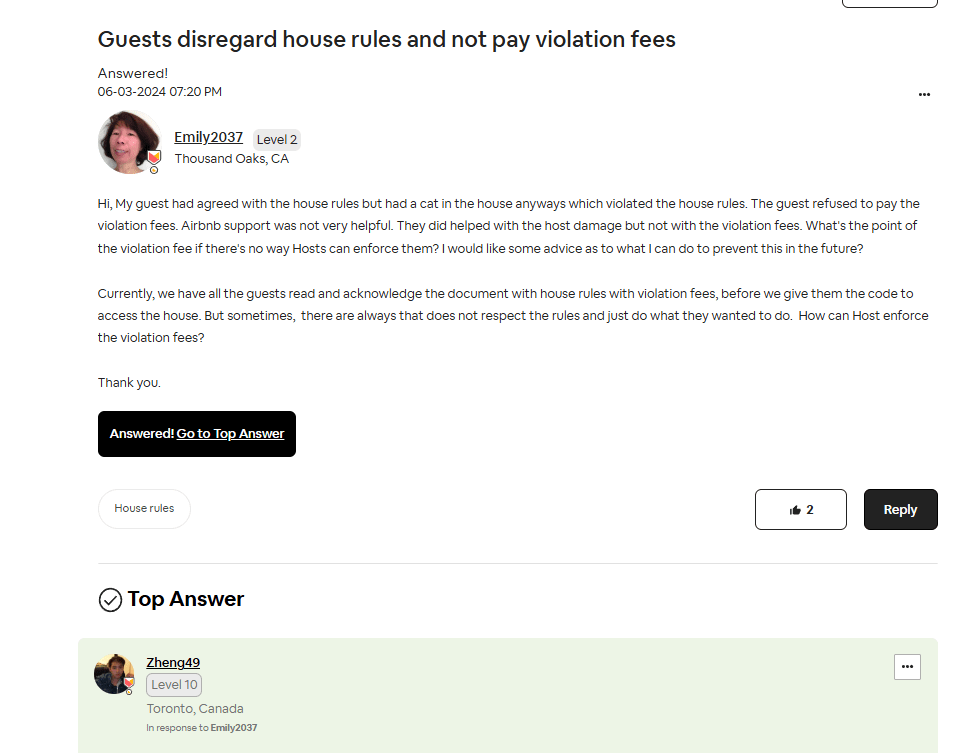
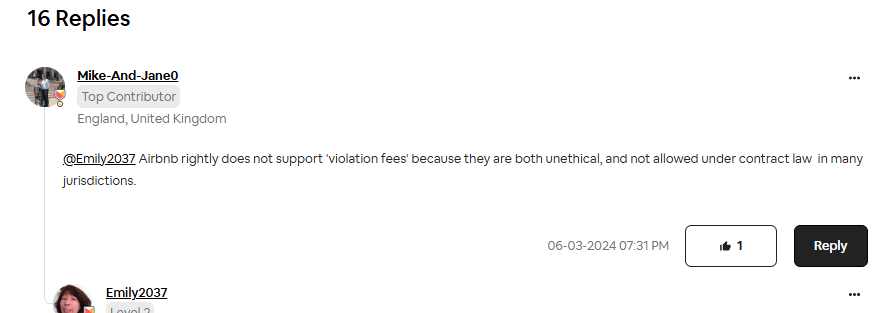


So if we look at these things we find online, it seems that property owners or hosts may be able to charge fines if a renter breaks the rules of the rental contract, but then we have the contradiction that such fines are not apparently allowed to be deducted from security deposits. Even though this is indeed a breach of contract, charging a fine (and deducting that from the renter’s security deposit, which is pretty much the only way the landlord can ensure they’ll get paid) is not apparently allowed.
Now let’s take a deeper look at this issue. From the various websites that have information on security deposit rules in let’s say California, which is one of the stricter states with more extensive rules on security deposits, we can find a long list of rules about these deposits and how they are to be handled, according to California law.
Looking at this site for instance https://www.hemlane.com/resources/california-security-deposit-laws/
We can find the following among other rules about security deposits:
(1) The property owner cannot collect more than one month’s rent as a security deposit, although in some cases two month’s rent can be collected.
(2) The security deposit must be kept in a separate bank account, separate from the property owner’s personal finances.
(3) Renters have to be informed in writing where their security deposit is being held.
(4) Violations of these rules (1-3 above) can “result in significant penalties.”
(5) The security deposit can only be used to cover: damages, unpaid rent, cleaning or repairs needed.
(6) If we look at the California law relating to security deposits, found here:
https://leginfo.legislature.ca.gov/faces/codes_displaySection.xhtml?sectionNum=1950.5&lawCode=CIV
we see that in addition to the above, the property owner is required to take photos of the unit before and after the renter occupied the unit.
I want to make a few remarks about these “laws” pertaining to security deposits. First, there is the point I made in this article https://globalhostingblogs.com/2025/06/18/why-short-term-rental-regulations-are-unlawful-an-analysis-from-the-perspective-of-natural-law/ which is that the US Constitution itself, in Article 10, says that states may not pass laws impairing the obligations of contracts. This has been interpreted in different ways to suit different purposes, but if we consider this against the backdrop of common law and natural law, I believe it becomes clear that, in general, government has no business meddling in private contracts. In fact this would be true whether or not there was this statement in the Constitution.
Simply put, people have the right to enter into business contracts with each other, which are generally fair as viewed through the lens of natural and common law. “Fair” doesn’t mean no security deposits of more than one month’s rent. “Fair” could be interpreted to mean no outrageous terms, such as a fine of $10,000 for not removing shoes on entering the premises. “Fair” is relative, and one of the notable characteristics of common law, unlike statutory law, is that while statutory law makes sweeping generalizations and ignores unique circumstances, common law is able to attend to and recognize the uniqueness of every individual circumstance, and measure fairness differently in regards to each.
So for instance, suppose you have a property where the rent is $2500 a month, but you’ve furnished it with antiques that are collectively worth a significant amount, so that you decide you want to ask for a security deposit in the range of $5000 or $7000 because of these antiques. What right does the government have to say you can’t do this, if you find a renter who agrees to this because they can afford it and love the opportunity to live in such a finely furnished place? The answer is, the government has absolutely no right to meddle in such a situation. The government has no right, or lawful authority, to set limits on security deposits. Nor does it have the right to tell you that you can’t put these in your regular bank account, or that you have to inform the renter where you are keeping the security deposit!! None of that makes any sense. It’s huge illegal overreach by the criminal government. In fact, I’d consider it more than illegal overreach, I’d consider it an example of a criminal government “setting up” the property owner to be the fall guy, when you consider that many small landlords, such as the homeowner renting out just one room in their home, do not have a separate bank account for their rental business.
Now let’s consider the “law” that security deposits can only be used for damages, cleaning and unpaid rent, but not as fines for rule violation. What would be the reason for barring property owners for using the security deposit to fine renters for rule violation? The argument seems to be that no damage was done by the renter in such circumstances. But if such fines actually are allowed, and we’ve seen evidence in the screenshots above that this is likely the case, as well as in the screenshot below saying that landlords can fine for use of someone else’s parking space, we have to ask — wouldn’t any fines due, automatically become deductible from the security deposit, if not paid prior to the point the renter departs? I would think so.

As well, many types of rule violations do indeed cause “damage”. Not necessarily property damage, but they can cause inconvenience, annoyance, extra cleaning work, extra time spent communicating, and more.
For instance, if one renter uses another renter’s refrigerator space, another renter’s bicycle parking space, another renter’s food, makes noise late at night that wakes another renter up, leaves dirty dishes in the sink that cause another renter to have to wash their dishes, and so on, we can see that “damage” is being done by such rule violations.
One of the significant problems with all statutory law, as opposed to common law, is that it seeks to create one law or policy that is then applied to everyone across the board. No consideration is made for unique circumstances.
When I searched online as to whether a renter can be fined for causing disturbance to other renters, such as noise disturbances, I found this:

This seems to contradict the info above that says that “habitual noise disturbances” can be grounds for fines. As well, we can see that this information seems much more oriented to long term tenants renting separate units, and not to shorter term renters renting rooms in a property owners’ house.
For instance: suppose you have 2 renters each staying about 1 month. The house rule is that renters are not allowed to make phone calls or socialize in the house after 10pm, to avoid disrupting other’s sleep. Suppose one of these renters makes phone calls at midnight, and continues to do this in spite of you asking him not to. These calls disrupt the sleep of the other renter.
Well, since the renter is only staying one month, evicting him does no good. You would have to give 30 days’ notice to evict and he’s only staying 32 days. So you can see that in a case like this, the threat of eviction is pointless. Another type of leverage is needed to gain compliance, and this is where fines for rule violation could be useful. If you let the renter know that according to the house rules he will be fined for breaking this rule about no phone calls in the house after 10pm, you might have more potential to gain his compliance, than if you did not have this leverage. This is the kind of thing that statutory law fails to accommodate, as it cannot take different situations into account, as well as common law. The entire nature of common law is to consider each persons’ unique situation, rather than to impose the same rule blindly upon everyone regardless of their situation.
What I Recommend When Fining A Renter for Rule Violations
First, you need to clearly state in your house rules that there may be a fine for rule violations. I recommend making it clear that renters will not be billed for one-off rule violations, such as accidentally leaving some dishes in the sink one day, but rather for continual rule violations, such as leaving dishes in the sink every few days, continually. Or continuing to break rules after having been told what they may not do.
Second, as one will find on Airbnb forums, one will not have much luck billing Airbnb guests for rule violations. If you have an Airbnb guest breaking one or more of your house rules, what you need to do is see if you can determine how this rule violation created extra work for you, such as extra cleaning work. So if a guest continually left out dishes in the sink, you could keep track of all the instances where they did this, and then charge a reasonable extra cleaning fee for the extra work that this caused for you to clean up after them.
Third: I do not recommend telling the renter or Airbnb guest that you will be fining or billing them for these kinds of things, before they have completed their stay and vacated your house. In general as a property owner or Airbnb host, you want to conduct yourself in a way that is likely to prevent retaliatory moves by the guest or renter. If you let them know while they are still at your house that you’re going to fine them for several instances of leaving dirty dishes in the sink, what might result from that is that you end up with MORE dirty dishes in the sink, or maybe even broken dishes in addition to that.
My experience has been, that in the majority of cases of those I have to bill for damages, or in cases where I make deductions from a renter’s security deposit, the renter becomes upset and argues that they were not responsible for the damage, or has some other reason for not paying, such as that “I didn’t do it on purpose”. As if their intention had any bearing on the matter. It does not. Thus, there is no advantage at all to informing someone before they move out, about what you’ll be charging them for. They are unlikely to voluntarily pay for this, especially if they didn’t themselves initiate the discussion, and come to you saying they had damaged something and offering to pay for it. Yes there are some stellar renters like this who will offer to pay for something that you didn’t even know was damaged, but this is not the case with the majority, sadly.
That said, the bill for extra cleaning would come after an Airbnb guest departs, and such bills and fines for a non-Airbnb renter would come out of their security deposit after they depart.
Because the law on the matter is contradictory, with it being simultaneously said that landlords can fine renters for rule violations if this is something stipulated in a lease or rental agreement, while it is also stated that such fines cannot be deducted from a security deposit, I do not know what would happen if such a case ended up in small claims court.
This in fact is one of the reasons that I generally do not rent to locals and people who live in my area. Because if you have a dispute with a local, they are in the area so it’s convenient for them to take you to small claims court. But if you have a dispute with a renter who is here for a short time until they return to a whole other state or nation where their home is, that is not a person who’s in any position to be able to take you to small claims court. In fact it’s generally sufficient that they live in another part of your state. I recently rented to a young student for about 8 months while she finished her last year of school at the local college. At the time she moved out, she was moving 400 miles away to her home city. When I deducted from her security deposit for the cost of a new mattress, due to the fact that she had peed on the mattress, resulting in a giant 3 by 3 ft yellow stain on it, her mother got into the act and sent me a threatening letter saying her daughter would sue me in small claims court if I didn’t immediately refund her entire deposit. I did no such thing and withheld the whole deposit (which was not a large amount, less than half her monthly rent) and never heard a peep from either of them again. Her mother had stupidly threatened me that her daughter would fly to my city and stay in a hotel for the small claims court case, and then bill me for those expenses. I am smart enough to know that such expenses cannot be charged in a small claims case.
I currently have a situation where I had a relatively nice renter who stayed for 2 months for a summer internship at the local university. He’s from a European country. Though he was a nice man, he was just unable to follow rules for keeping the kitchen clean, and was careless as well. On multiple occasions, he left dirty dishes and utensils in the sink, on the counter, on the stove. He left the stove splattered with grease, he put dirty pots back in the clean pots shelf, he broke or damaged 3 different kitchen appliances. In one case he threw away parts of a blender without even telling me. He damaged several dishes by piling way too many things on the dish rack, causing some dishes to chip or crack. According to my calculations thus far, he will lose his entire security deposit, which again, was not that much, less than his monthly rent. The deductions will be mostly for damages and extra cleaning required on my part, as on many occasions I had to clean up after him in the kitchen. I will probably also charge him a small amount for two rule violations: namely, not cleaning up after himself in the kitchen, and also, not informing me after he broke 2 appliances to the point where they are unusuable and must be replaced. My house rule is that renters are obligated to tell me and offer to pay if they break something of mine. If a renter simply breaks my property and throws it away without telling me, and I find out who did this, I am likely to charge them both the cost of the item as well as a fine for the rule violation, which relates to being so disrespectful as to not even tell me about the breakage, but rather try to hide it by just throwing it away!
Yet I’m not telling him in advance about the deductions I’ll make. He will find out after he departs and is back in Europe, unable to do anything about this.
Since I have more than one room renter at a time in my house, he is likely to claim that “it wasn’t me” who caused all this damage and mess in the kitchen. However, I was able to determine that it was him, based on talking to others who were here during times that overlapped with him, and finding for instance that no one else even used the appliance that ended up broken, he was the only person using that. As well as finding that certain messes were left during a time when he was the only one home. In a small claims court setting, I might have difficulty “proving” it was him who left these messes and caused these damages. Which is another reason it’s a good thing he will not be in my area after he moves out of the room at my house.
 globalhostingblogs