
In this article, I want to provide some perspective on why it is challenging to do Airbnb hosting in your own home, meaning, your permanent residence, as opposed to a separate rental property. Quite a number of Airbnb hosts rent out on Airbnb other properties that they either own or rent, and those types of rentals have their own unique issues, while in-home rentals bring hosts quite a separate set of issues.
I want to clarify at the outset that in this article I’m not presenting business problems, as much as I am attempting to point out some annoyances or inconveniences that hosting in your own home can bring to you. These annoyances or inconveniences do not necessarily amount to “business problems” in the sense that they are not necessarily issues faced by every in-home host (people differ in their style of hosting!) and also, even when present, are not necessarily significant enough to make someone not want to host in their own home. I myself am an example of that: I’ve experienced most all of the things I describe in this article, but am still an in-home Airbnb host, because “all things considered”, this is the best choice for me at this point in time. The benefits outweigh the annoyances, at this point in time.
However, the “math” that leads to this choice, is precariously “hanging in the balance”, with regard to how things are in a time of transition in the nation and world. It’s quite possible that within a year’s time, or even less, the math that says being an Airbnb host is the best choice, may not continue to add up.
Additionally, I want to clarify that the point of this article is to present a quite comprehensive list of possible inconveniences. It is not my aim to present a “balanced” picture of in home hosting that also discusses all the possible benefits thereof. I hope it goes without saying that no one could be a host for more than a few months, much less over a decade if they didn’t experience any positives to this business. Also, we all have a pretty good understanding of the positives. Yet the focus and purpose of this article is to help people clearly understand what they are getting into, vis a vis various “inconveniences” that may accompany in home hosting.

As I begin to explain the types of annoyances and inconveniences that can arise when hosting in your home, I also want to clarify that yes, many of these will be perceived as relatively “small” issues, and some may view them as so minor that they aren’t relevant. But people’s sensitivities differ, and some may find these more annoying than others.
As well, one has to keep in mind the overall cumulative result when you add up multiple “small” annoyances. Even a small burr in your clothing can become very annoying the longer it scratches on your skin. Something that happens “once” is not necessarily a problem. But with in-home hosting, what most will eventually realize, is that even though one particular kind of problem may occur relatively rarely, for instance only once every few months, when you have say 36 different possible annoyances, some of which occur only every few months, others which occur every week — this creates a different overall picture, than if you’re merely dealing with a handful of relatively rare issues.
(1) A good experience with guests, is based in part on guests arriving with appropriate expectations for what you offer. Meaning, they aren’t expecting MORE than you offer, only to end up disappointed when they don’t get what they expected. Yet, it is difficult to ensure that guests do have appropriate expectations, for several reasons.
(a) Most guests do not read the full listing description or house rules prior to requesting to book a stay. I know this because I have “code phrases” inserted in my listing and house rules, which tell the reader to convey the code phrase to me when requesting to book, and only about 5 to 10% of guests do this.
(b) Airbnb’s website is poorly designed, and actually mitigates against guests reading the house rules before booking, as they have to scroll down and click on a “show more” link to even see the house rules, which most do not know to do.
(c) Airbnb’s advertising and presentation, is misleading, and seems to encourage guests to have inappropriate expectations for more modest offerings. In fact, Airbnb has done a lot in the past many years, to make it more difficult for in home hosts and those with more “modest” offerings, to be successful, because their emphasis has been on “entire place listings”, and their version of “in home” stays is unrealistic in that it portrays scenes like guests sitting down having dinner with a welcoming family in a “perfect” home setting: something that I would guess does not reflect the vast majority of in home stays.
(2) When Airbnb makes it more difficult for hosts to ensure guests arrive with appropriate expectations, this means more work for hosts. It also means an increasing possibility of a guest-listing mismatch, which usually will be much more of a hassle for the host than for the guest.
(a) Hosts have to spend extra back-and-forth time communicating with the guest to ensure they’ve read the listing and house rules, before they book.
(b) Many guests send a reservation request, but then do not check their messages for many hours thereafter. This makes things even more difficult for hosts wanting to ensure the guest understands the setting and house rules before accepting their request, as hosts have only 24 hours to accept or decline, and guests do not realize this. I’ve had several instances where I had to decline a request from a guest, because they did not respond to my inquiry about whether they had read the house rules, within 24 hrs of requesting a stay.
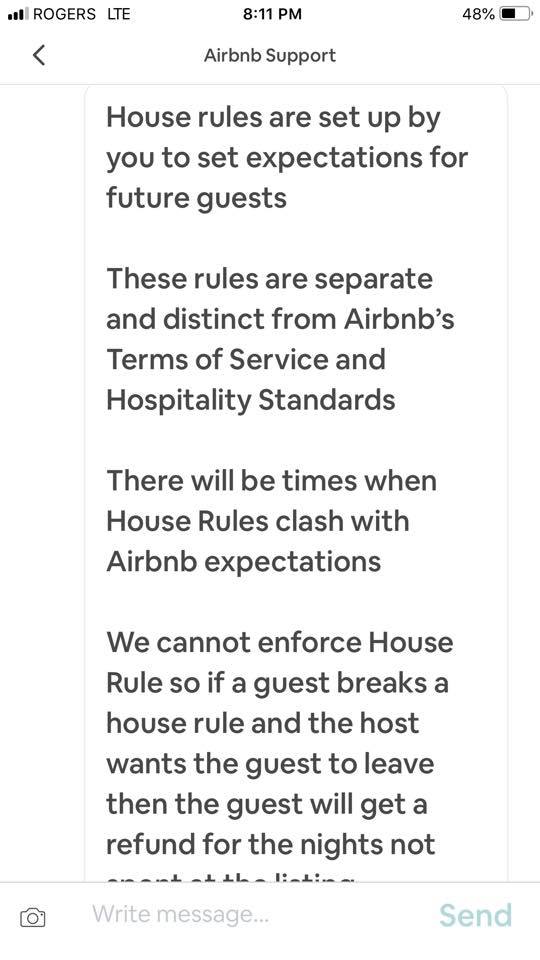
(c) Airbnb has quite confusingly placed certain host replies to basic policy matters, in the section they call “house rules”, and these few answers (such as whether smoking or pets are allowed) are unfortunately easily mistaken by guests as the extent of the host’s “house rules.” Thus, if I omit to specifically request that the guest relay the “code phrase” from the actual house rules, I have had quite a number of guests arrive at my house, stating that they read the house rules, and then being surprised to discover that my house rules are actually about a page long, and cover more issues than just no smoking and no pets. Meaning that, NO, they did NOT read the house rules. They simply read the boxes that the host checked on these few questions Airbnb gave each host.
(3) It’s difficult to effectively screen guests, given the limited amount of information that hosts have. It used to be the case, in the early days of Airbnb, that it was possible to have a phone conversation with a guest before accepting their request to stay. No more. As well, it used to be the case that a host could actually see the profile photo of the guest, before accepting a request from that guest, but a few years ago Airbnb changed that, on the basis that they believed it could lead to “discrimination” if a host could actually see who wanted to stay in their home. Never mind that in some cases, the way a guest presents themselves (or hides themselves!) in their profile photo, is quite useful info that hosts should be able to have when deciding whether to accept a guest.
As well, it’s not do-able to do any type of internet search or background check on the guest, prior to accepting their request, as you won’t know their last name until the booking is confirmed.
So, all that the host has, is what they can obtain via direct communication with the guest, and then from the reviews of the guest, if any, by prior hosts.
It is possible to get one more bit of info if you use the AirReview app. Using this allows you to see the reviews that this guest has written about hosts’ listings, as well. Which at times is quite important info, as when a guest writes appalling reviews of prior stays, this could be a red flag that you do not want to risk taking in that guest and obtaining a similar bad review from them.
It is notable that Airbnb does itself not show these reviews that the guest has written of their past stays. It would be difficult to find these, if not for the AirReview app. This is just one of several indications that attentive hosts will notice, about how Airbnb appears to be more oriented to its own interests, than to protecting hosts and supporting their ability to do business safely.
As well, even if a prospective Airbnb guest is already in your area, it’s not advisable to allow them to come over and see the place before booking, because arranging for this could be viewed by Airbnb as a violation of their T&C which prohibit “exchanging contact info before booking.” Keep in mind that some hosts do long term stays via Airbnb (and some guests seek these: for instance foreign students coming to an area for a semester of school) and it’s typical for someone staying longer to want to see the place before booking.
(4) It’s unfortunately all too uncommon that even guests who read the host’s house rules, do not carefully and responsibly follow the house rules during their stay. In fact, having been a host for about 11.5 years now, my experience has been that it’s more often the case than not, that guests often “forget” the house rules after reading them. In my experience, guests often feel entitled to “rewrite” the rules to suit their convenience.
As an example of rewriting the rules: suppose you have kitchen hours in your house, and state that guests are not to use the kitchen after a certain hour, say 10pm, with the goal being, that your or other guest’s sleep is not disturbed by late night activity in the kitchen. I’ve had many an occasion of waking up to noise from the kitchen, and going into my kitchen at 11pm, or midnight, sometimes even 1am, and finding a guest in there cooking or dining. When told that they have broken the rule of no kitchen use after 10pm, they will often say “but I was trying to be quiet”. Meaning, they took it upon themselves to rewrite my house rule. Instead of “no kitchen use after 10pm” they rewrote it to say “you can use the kitchen after 10pm if you are quiet.” Nope!
The consequences of this guest rule breaking could vary, ranging from a fairly minor inconvenience to the host, to a sequence of events which could be catastrophic for the host in that it could end their hosting career.
As an example of somewhat minor inconveniences: the guest forgets to take off their shoes when coming in the house, as directed, and tracks in some dirt or mud.
As an example of a rather catastrophic result: the guest books a stay at a listing where the host doesn’t allow guests to bring friends over, but fails to read the house rules. Guest arrives and invites friends over for dinner. The host notices this and reminds the guest of the rule, asks the unapproved guests to depart, the guest becomes irate, calls Airbnb and complains, perhaps making up a story that the host made him feel unsafe, or creates a fictional story about the house being very dirty and uninhabitable. Then suppose that this really escalates in the manner that we’ve unfortunately seen is possible, and Airbnb sides with the guest and terminates the hosts’ Airbnb account.
Hosts know that, all too often, such things actually happen, even though with reasonable customer service and a bare minimum of due diligence, by Airbnb staff, these things should never happen.
Fortunately, I do think it is quite rare that things like this become “catastrophic” for the host. Even so, many inconveniences can flow from this issue. The host is first inconvenienced by having to remind a guest to follow the house rules, and pointing out where they have not done so. At best this is awkward. It causes the host to have to be put in a parental role, which we do not want.
But the host may also be additionally inconvenienced when the guest is unable or unwilling to change his or her behavior, and continues to break house rules, such as by failing to clean up after themselves when using common areas.
Guests who do not follow house rules, especially about cleaning up after themselves, can inconvenience other guests at the house as well. And if there are other guests inconvenienced, this can create yet a third type of inconvenience for the host, if that guest complains about the other guest’s lack of cleanliness, which the host may be powerless to do anything about.
Yes, one can critique the guest in the review after their stay, but — assuming that communicating with the guest has not accomplished anything — apart from guests’ concern about the possibility of a critical review (and some appear not to have any) there are not really any means of leveraging the guest to do better.
(5) On that note, as regards guests who for whatever reason are upset with a host, Airbnb has in my opinion enabled rather than mitigated their ability to successfully retaliate against hosts.
The primary leverage that guests have in retaliating, isn’t really the review itself, but the ratings. Any host who has accumulated a decent number of reviews, is not really harmed by a negative review, particularly if it is fairly clear to a reasonable observer that the review is not honest or accurate.
But guests can harm a host by giving them low ratings. Again, if Airbnb were run in a completely reasonable way, this would not be a problem either. The way that ratings SHOULD be used, is only as a guide to guests, so they can get a general sense of what to expect from various listings. But Airbnb has unfortunately “weaponized” the ratings, so that they will begin to threaten hosts who receive even just two very low ratings, over a period of many years, that their listing “is at risk of being suspended.” This in spite of the fact that 2 very low ratings (eg 1 or 2 star ratings in some category, even as part of an overall higher rating grouping) should clearly be seen as outliers if the host has, say, 5 or 10 years of receiving mostly 4 and 5 star ratings, and has a relatively high average rating, say in the 4.8 range.
There is no good reason for Airbnb to be weaponizing ratings. Doing so, seems to be a result of their tendency to infantilize guests, and attempt to reduce guest’s responsibility for doing their own due diligence when seeking a place to stay.
(6) Let me explain this point a bit further, as regards how I perceive Airbnb infantilizing guests, and how this becomes a problem for hosts.
So in any business contract, the two parties to the contract are each responsible for doing their “due diligence”. This means that anyone buying something needs to understand what they are buying, and anyone paying for a service or renting accommodations needs to understand what is the service they are paying for, or the accommodations they are renting.
In my view it’s a significant flaw in Airbnb’s business model, that Airbnb minimizes guests’ responsibilities, both in ensuring that the listing they book fits their needs before they book (eg, as by reading the whole listing description and house rules), as well as in working with host to resolve any problems or disputes, before calling Airbnb to intervene.
The “weaponization of ratings” by Airbnb occurs when, in contrast to hotel industry ratings which simply are used to help a guest know what to expect, Airbnb uses these ratings to decide which listings to remove. This infantilizes guests, because it removes from them the responsibility to decide whether to book a place, taking the ratings and reviews into account. If a guest wants to book a place that has a 3.9 star average rating, perhaps because it’s less expensive than listings with higher ratings, should they be deprived of this choice just because some other childish guest booked a 3.9 star listing and was irrationally upset when it didn’t meet their 5.0 star expectations?
Hosts should not be penalized because guests do not take responsibility for ensuring that the listing they are booking will meet their needs. Yet this happens under the Airbnb system.
(7) Being an Airbnb host involves living in a nearly constant (albeit usually low-level ) state of fear and dread, that one is suddenly going to have a problem guest, a guest who becomes retaliatory for whatever reason, and either gives a very low rating or perhaps calls Airbnb to complain or even make up a story. And so there is the ongoing sense for hosts that “there’s a guillotine hanging over my head.” This may seem exaggerated to say this, but if you become part of a host community, you’ll see the stories. Hosts who have been going great for many years, few if any complaints, then suddenly they get “the guest from hell” who calls Airbnb with a complaint, even a false one, and next thing you know that host has “been terminated” eg figuratively guillotined, their Airbnb career over.
(8) Airbnb is overly involved in host’s businesses, eg it is overly controlling. This is a continual stressor for hosts, who feel jerked around by new policies and rules. They rightly feel that this is THEIR business and they ought to be able to run it as they see fit.
This issue tends to be seen most readily when disputes arise.
While it’s true that Airbnb can’t easily know what the truth is and mediate a dispute, this actually is a good reason for Airbnb to not involve itself in disputes at all.
If you look at how Airbnb has depicted itself in terms of tax issues, it is ostensibly just a “third party payer” which collects payments from a first party and transfers them to a second party. Depicted this way, Airbnb should have little to nothing to do with the business between the two parties whose payments it processes. But as hosts will all come to realize, Airbnb is quite significantly involved in controlling their hosting businesses. It applies to all of us a quite voluminous set of “terms and conditions” which we are obligated to accept if we want to be allowed to list our property on its platform.
Some of these conditions limit the ways we can do business, particularly as regards rules on cancellation policies and refunds, or reimbursements for damages. If we were really running our own businesses, we could set up any type of cancellation policy. And take a security deposit to ensure we were reimbursed fully for any damages caused by the guest. But that isn’t possible on Airbnb. We have to select among the options it allows for cancellation policies, and it is Airbnb, not hosts, who decide if we will be paid for damages to our property.
When a guest is not satisfied with some aspect of their stay or the listing, or wants to change their reservation and depart earlier and get a full refund for days not stayed, a dispute might arise. Similarly, a dispute may arise if the guest damaged the host’s property but doesn’t want to pay for the damages.

These disputes in my view, should be resolved by the two parties themselves, without Airbnb intervening. By inappropriately putting itself in position to resolve all manner of disputes, Airbnb has in my view set itself up to be distrusted or resented by host and guest alike. But probably more so by the hosts.
Many hosts feel that the customer service people they speak with about a dispute, are not mature enough and do not have sufficient common sense to be able to see the issue clearly. As well, even the best customer service person is limited in what they can do in cases where they may not have all the facts.
The only disputes that Airbnb should be involved in, in my opinion, are those where (a) the guest alleges false advertising, and that the listing is not what they booked, or finds that they were a victim of fraud where they paid for a nonexistent listing. Or, (b) where Airbnb acts as an insurer, and covers costs for such exceptional situations as: guests have their property stolen while at the listing, or are injured there, or where host has property stolen, or incurs costs as a result of egregiously inappropriate behavior, crimes or wrongs by the guest, such as unpermitted parties, squatting, vandalism, or is injured by the guest.
For all “ordinary” situations, those are disputes that guest and host should resolve themselves. If we think about it, what happens with “ordinary” rentals where there is a dispute? For instance those advertised on Craigslist? The two parties resolve everything themselves.
(9) Airbnb pressures or requires hosts to explain why they are declining a prospective guest, which is not only overcontrolling, but is none of Airbnb’s business whatsoever. This is MY house, not theirs, and they have no business asking to know my personal reasons for declining anyone.
Moreover, it could both exacerbate or escalate a situation with a prospective guest, if one were to explain why one declined them, and this could even possibly be used by the prospective guest to attempt to retaliate against the host.
A host’s reasons for declining a guest are based on their own personal screening process, quite possibly one developed over many years of experience. They have their own reasons for their choices. It is in general a mistake to try to explain to any prospective renter why you’re not considering them as a renter or guest. On the one hand, one wants to avoid hurting their feelings, and on the other hand, one does not want to get drawn into an argument. For instance, if I’m declining someone because of a bad review they have, I don’t really care to discuss this with them. If I wanted to discuss it with them I’d have asked them questions about it before declining them. If I’ve declined them without asking them anything, then this means nothing they can say by way of explanation will change my mind. For instance, I recently read a review of a guest where the host said that the guest brought a cat over without telling the host. Even though that particular host allowed animals, in my view, it’s never appropriate to bring an animal without disclosing this in advance to the host.
People with service animals theoretically are allowed to bring those to a host’s home without disclosing this in advance, but that is in my view totally unlawful.
As well, by requiring hosts to explain why they are declining a prospective guest, Airbnb is setting up hosts to try to trap them as engaging in “discrimination”, which is wrong.
And if a host were to say something to a prospective guest, by way of explaining why he declined, that could be used by a prospective guest to try to retaliate. Common sense in the property rental business is just that you do not explain your refusal to rent to anyone, and by having policy that flies in the face of common sense on this issue, Airbnb puts hosts in jeopardy and at risk.
(10) Though many hosts are fortunate to be extroverts who enjoy meeting and socializing with the many guests they host in their homes, many hosts are not extroverts, and aren’t oriented to a lot of socializing. As well, many guests do not want a lot of socializing with the host. They just want a place to stay and then do whatever they came to the area for. The result for the host is that it feels like a significant part of their home is not theirs, but is a separate rental property. Within this kind of situation, there isn’t really the ability to feel that one’s home is entirely one’s own. This creates an underlying low-level kind of stress.
(11) There are many specific inconveniences from the above situation. One of the more obvious ones, is that the host ends up having to mostly follow the same “house rules” that his guests and renters are to follow. For instance: if the guests aren’t allowed to bring friends over to socialize, how will it seem to the guests if the host brings friends over? If the guests aren’t allowed to use the kitchen to cook dinner late at night, this means the host can’t do that either. Experiencing these kinds of limitations in one’s own house, can be depressing. Most people want more freedom in their own permanent residence.
(12) Additionally, a host sharing the space with guests, may well feel that they are not “free to be themselves” in their own home. Self-expression can take many forms — such as through art, design, religion or politics. One of the more obvious ways that this can occur is something that has become a greater issue in our nation during the last few years, when significant political divisions have arisen, between Democrats and Republicans, the vaxxed and the unvaxxed, Biden supporters and Trump supporters, as well as events relating to Russia and Ukraine or Israel and Gaza. There are several other socio-political issues where big differences of opinion can arise. Given that some people can become very uncomfortable when realizing that others in their vicinity have a different political view, it behooves a host to remain silent and neutral on these issues and more. Meaning, among other things — it would be wise not to fly “political flags” or put up political signage at one’s home.
Yet, given that many feel they can’t be themselves fully with family members, or friends, or in their communities, people tend to see their own home as a place where at last they ARE able to be fully themselves. So, how will it feel to them if they find that they can’t even be themselves in their own home, but have to hide there too, because of potential negative consequences and tension that could arise if they do not hide?
This can feel quite stifling.
(13) To take it a step further…imagine that you’re a host who’s realized that one or more of your guests has political views which are completely opposite of yours, and would either be offended by your views, or on the other hand, suppose there are just some things about your life that you want to keep private. Such as that you are struggling with depression after your father died. So, you do not talk to guests about these things. But you live in the house, and quite possibly, it may be possible for one or more guests to hear you when you are on the phone in your own room, talking to a friend. Now you realize, you have to worry that a guest in your home could hear you saying things, that you wish to keep private, when you are talking to a friend on the phone in the privacy of your own room….do you see how uncomfortable this could be?
(14) This relates to another issue for hosts, which is, that if you’ve done in-home rentals for awhile, you may have discovered, that the kind of people who make ideal renters, are not necessarily the kinds of people you’d choose as friends, and vice versa.
See, some hosts, especially if they are inexperienced, will look at the things I mentioned above about how awkward it can be to have guests or renters in their home who have completely different views on some things, religious or political or otherwise, and decide that “okay, so I’ll rent to people who are more like me.”
But that is actually not very do-able.
To begin with: people who own homes, tend to be older, and relatively established in their lives and location. Whereas those seeking a room to rent in someone’s home, are virtually all younger people, often students or on vacation. Older people are more well-heeled, and tend to rent entire place listings. So right there, is a significant barrier to hosts obtaining guests “like myself.” As well, if the host is unconventional in his or her community, for instance has political views that are unusual in his or her area, the host may then discover that most of those visiting and staying as guests, also have different or opposite views.
(15) Many hosts get into the business without realizing this, but the “landlord-tenant” or “host-guest” business is one of the most difficult kinds of businesses to be in, in the sense that it involves an “imposed intimacy” with others, eg living with others and being exposed to their living habits, in a way that does not occur in most other types of business. This can cause many types of stress for the host.
There are several examples of this beyond guests’ habits as far as keeping common areas clean. To list a few:
(a) The guest may keep common areas clean, but their own room is a mess. This can cause stress for the host who worries about damage caused by a careless guest. I’ve had damages caused by guests who put a can of soda on the floor, and unknowingly knocked it over, resulting in a big sticky congealed mess on the carpet. Or a guest who ignored the coasters I put in the room for the purpose, and set a drink on a bare wood furniture, causing permanent staining. Or a guest who apparently ate his meals in the bed, resulting in spilling a cup of coffee in the bed, and ruining the mattress…he had apparently conveniently removed the mattress protector before doing this! Or a guest who loved using essential oils and would set those on a bookshelf, causing permanent oil stains on the shelving. Anytime a host walks by a guest room when the door happens to be open and notices there is a pig sty inside, anxieties about this kind of carelessness can arise.
(b) People from some nations do not have good sewer or septic systems in their country, so they are in the habit of putting all used toilet paper in the wastebasket, instead of in the toilet. Imagine how embarrassing or awkward it could be for a host and other guests, if one guest does this, and the sight or smell of such begins to be evident to others.
(c) Some guest’s cooking styles, or food preferences, can result in what others in the house experience as “bad smells” from cooking. One prime example is the smell of fish, hanging in the air well after someone has finished cooking and eating.
(d) Some guests do not have common sense about appropriate boundaries, and may appear in common areas without adequate clothing, or may have “inappropriate” personal conversations with others in the house, or on the phone in common areas. An example is a male guest who takes a shower, then wraps a towel around his waist and comes into the kitchen and proceeds to make breakfast in such a state. Or a female guest who appears in the kitchen wearing only her bra and underwear. It has happened!
(e) Unbeknownst to the host, some guests’ living circumstances are unstable or precarious, and so a host may get bookings from people who are essentially homeless. I have had at least 3 such bookings. Other guests may be in some other type of “urgent” or emergency situation, for instance, fleeing domestic violence, experiencing some type of ongoing urgent health issue, (these may be traveling to your area for medical appointments) or having recently experienced some type of personal crisis. For instance, I had one guest who said he had recently been injured in a robbery or burglary, which had apparently resulted in his need to leave his home immediately, and he made everyone in my house uncomfortable by sitting in the kitchen without a shirt on, possibly intoxicated, talking about how badly his life was going and how desperate he was.
(e) Some guests have odd behaviors or mannerisms, which can make host or other guests uncomfortable. This may happen in spite of these guests being otherwise polite, respectful and friendly people. For instance, I had one guest who, whenever I spoke to him, would rub his hands together and stroke his fingernails, which were abnormally long. While harmless, this kind of behavior is weird, and can readily make a host uncomfortable in his own home. What I have found, is that when I have a guest that in any way makes me feel uncomfortable, I notice that I am then trying to avoid them. Which is very inconvenient to have to do when in one’s own home. The result essentially feels like being made a prisoner in one’s own home, feeling that certain areas are “off limits” or need to be avoided at certain times.
(16) Guests can even unwittingly, “colonize” or appropriate part of the hosts’ home, which easily can make a host uncomfortable.

One example: I had a guest who stayed in a part of my house which he mostly had to himself, as others would generally only be in that area to use the laundry facilities. Every time I went to this part of the house when he was home, he’d act as though he was uncomfortable or “taken off guard” by my simply going into a part of my house. For instance, he seemed to always keep his room door open into the common space in this area, and then would suddenly close the door if I came into the area. Or, if I came to the area where there was a small kitchenette next to the laundry machines, and he was in this area, he’d become awkward as if I had intruded upon his privacy. You never want to end up feeling that you are an intruder in your own house, but this is exactly what happens, sometimes in subtle ways, sometimes in less subtle ways, when a guest “colonizes” part of your house.
Another guest renting that room, had the small kitchenette near the room mostly to himself, however I told him that as others used this common area to do laundry, he had to follow the rules to keep the kitchen clean and put things away after using the kitchen. He did this for a short time for his 4 month stay, but after 1 month, he began always leaving a mess in the kitchen, and NEVER putting anything away. This is a very good example of a guest “colonizing” a space.
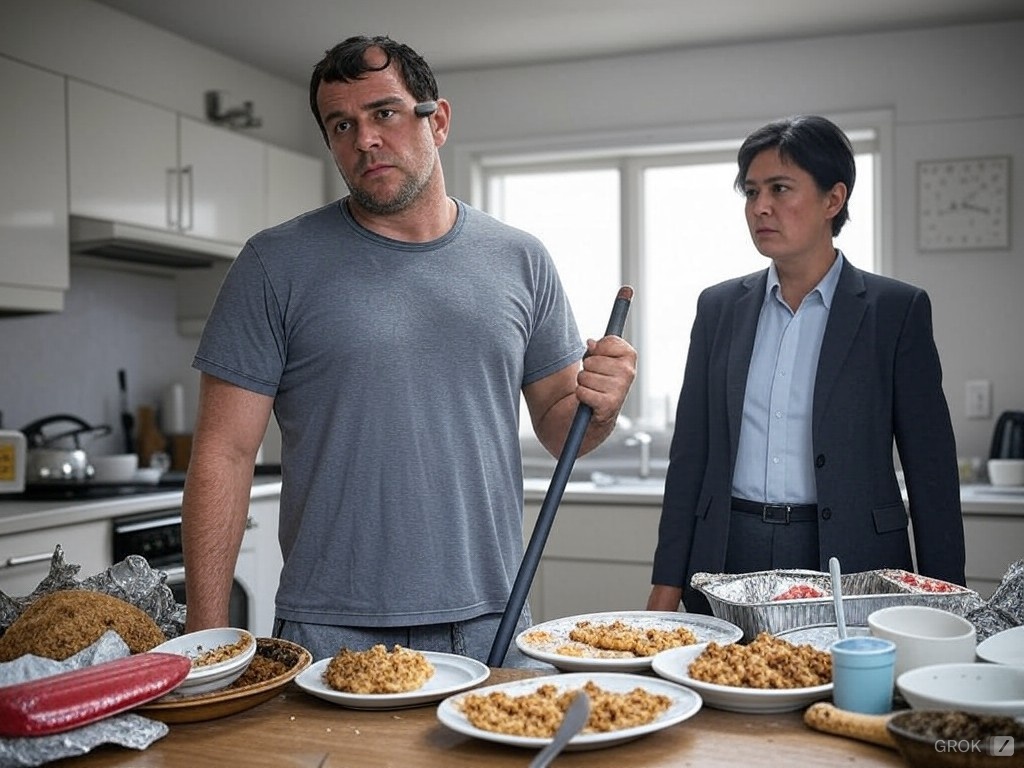
Another example of this would be a guest who comes into a commonly used kitchen to prepare a meal, and takes over all the space in the kitchen. They put their things all over the stove, all over the counter, all over the kitchen table, and the sink is full of their unwashed dishes. Though this is only temporary, and they’ll be cleaning up when they are done, they’ve made it difficult for anyone else to use the kitchen while they are there.
(17) Things become even more problematic and uncomfortable, when guests go “one step up” from colonizing, and begin what I call “banding together to subvert the host’s authority.” This can also happen without the guests even being consciously aware they are doing this. It’s something that can easily happen if the host is just one person (as opposed to a whole hosting family) and is hosting more than one guest.
For instance: especially if the hosts’ own room in the house is further from the kitchen than the guest rooms, it can too easily happen that although the house rules state no cooking in the kitchen after 10pm, 2 or 3 guests “agree” that cooking after 10pm is “not a problem” and begin to do this. Their reasoning is that since the host is further away and wouldn’t be disturbed by any noise, and since they have “agreed” with each other that none of them would be disturbed by someone cooking at midnight, therefore it is okay to do. Their mistake was to think (usually unconsciously, not intentionally) that the house rules were up for a vote, and that “the majority wins” and they can “outvote” the host.
I emphasize that this is usually not a conscious attempt by guests to subvert host’s authority, because my experience has been that it usually isn’t. Rather, they’ve simply assumed that any house rules that exist, exist only to make guests comfortable. So, they then reason that if they are all comfortable, “it’s no problem” to do something that is theoretically not permitted.
In such a situation, the host (assuming he or she notices the flouting of some house rule…say if he gets up at midnight to go to the bathroom and finds 2 or 3 guests cooking in the kitchen at this hour) is then uncomfortably forced to assert his authority, and confront the guests, which is particularly awkward to do at a late hour, and at a time when the host is in the middle of nightly sleep. This kind of confrontation also tends to be very uncomfortable for guests. And, even though such a situation is clearly entirely the guests’ fault, my experience is that they will blame the host for it, for instance by calling him “OCD” or “anti-social”, and may well seek to retaliate in their reviews, or in some other manner.
It’s in this regard that the “banding together” of the guests to subvert host’s authority takes on another dimension. It can morph from simply banding together to give themselves permission to do what they have no right to do, eg violate one or more house rules, into coordinating a retaliatory attack on the host, as by coordinating multiple negative reviews and ratings that use similar complaints or even false claims.
I had this happen too, more than once. Three guests “became friends” at my house during their stay. Two of those were already friends before booking: I had made the mistake of accepting two reservation requests from two students who said they knew each other: both needed to stay about 4 months in my area. A third young student booked my 3rd guest room and became fast friends with the 2. These banded together to subvert my authority vis a vis certain house rules, which they repeatedly violated in spite of my speaking to them numerous times about these. Eventually I had to give up speaking to them about not cleaning up after themselves, as it became clear that no amount of reminders would lead to cooperation with house rules.
During their 4 months at my home, I was in a sense “held captive” by a group of 3 guests who frequently refused to clean up after themselves, used the kitchen after hours, did laundry after hours, blamed me when they left the tub dirty, and would appear in the kitchen inappropriately attired. When they departed, they then also banded together to all give me bad reviews accompanied by 1-star ratings. This was their way of saying “Don’t you dare get in our way of taking over your house and disrespecting you.”
(18) Younger people with less real-life experience, in particular, can be more difficult as guests, as they may hold unrealistic expectations that to some degree or another, are characterized by failure to adapt to the real world. In particular, the natural world.
For instance, these people may send you an urgent text, asking you to come remove a big bug from their room, and when you make haste to attend to them, you discover it’s just a leaf that has blown in through the window. This really happened to me. Or, a guest doesn’t seem to understand that fruit trees drop fruit, and complains about dropped fruit in your yard or walkway, as though there is some way you can prevent a fruit tree from doing what it naturally does. A very common complaint from guests who don’t seem to realize that they are living on earth, and that earth has a thing called nature, and that “nature happens.”

This failure to cope with nature, is at the basis of a whole variety of guest complaints that are basically complaints about things being as they naturally are, particularly in a house that is lived in, and is a permanent residence, as opposed to some unrealistic ideal and imaginary sterile environment. For instance, why would any rational person complain about a spot on a baseboard, a small cobweb, or any number of very common issues in ordinary homes, even more common in older homes.
(19) It can be difficult, as a host, to try to find a way to be as ideally hospitable as you’d like to be, and accommodate some guests’ needs, without ending up creating problems for yourself. One of the areas where I’ve had difficulties with this, is as regards guests receiving mail at my house.
I started out with a rule prohibiting guests receiving mail at my house. The reason for this rule, was that I’d been renting space in my house for many years prior to having Airbnb guests, and had realized that far too often, after a renter departed, I would continue to receive mail for them, often many years after they had left. I even received mail for people who had lived at my house many years before I ever bought the house!
As an astute person may realize, the amount of mail that I could end up receiving each day or week, could get out of control rather quickly, if as the years went by, I had hundreds of guests, and enough of them had mail sent to my home and ended up getting on junk mail lists that even they could not get themselves out of.
The problem is, that some guests do need to receive mail, and it’s not very convenient for them to rent a PO box for a few weeks or 3 months, to get mail, when they could just have it sent to my home. As well, some “authorities” such as their employer or university, tell them that they have to provide their home address, not a PO Box.
The result…just yesterday when I took my mail out of my mailbox, I saw that a full 50% of the mail in my mailbox, was not for me, and was also not for anyone currently staying at my house. Half the mail was for people long since departed. One of whom, was a person I never even had as a renter…she lived at my house more than 20 years ago before I bought it!
(20) It can be a difficult “balancing act” to both decorate your guest rooms in a way that you enjoy, and that you believe guests will appreciate, while at the same time, trying to minimize your exposure to damages or loss through theft. It’s not common at all that a guest actually steals something, but it does happen, I’ve had it happen 4 times. Once it was a book, another time an attractive hanging candle holder, another time a curtain was stolen (?), and another time a bicycle was stolen. Because there is this possibility of theft, or damage, it’s best that you never put anything in a guest room, that you have an emotional attachment to.
For instance: once on a vacation I bought a hollow ostrich egg on a stand, which I thought made an attractive and unusual decor item. I made the mistake of putting it in one of the common areas in my house, thinking it could be enjoyed by my guests. One day I went to throw out a garbage bag in the trash, and there found the remains of my shattered ostrich egg. Someone had broken it, didn’t tell me about it, and just scooped up all the parts and threw them away, apparently hoping I wouldn’t notice.
(21) One of the biggest challenges in having renters or guests staying in your home, is maintaining the appropriate boundaries. Apart from issues I mentioned above about how hosts need to be neutral as regards their opinions on various social and political issues, so as not to offend guests whose views are opposite, there are all sorts of “is this a business relationship or a friendship?” issues. These issues confuse both hosts and guests, and can make both uncomfortable.
For example: guests with poorer boundaries will sometimes ask if they can “borrow” hosts’ personal belongings. While some hosts do not mind loaning out their belongings, it should never be assumed that it’s appropriate for guest to even ask about this. It’s one thing to ask to borrow an umbrella, but some guests ask to use a host’s coats, a host’s computer or printer, or items that a host uses in another business they run. Declining such a request leads to discomfort: really a guest should never ask to borrow such personal items.
Another example: sometimes you’ll get repeat bookings from someone who’s stayed before, and they may want to book directly. In which case you may do as I do, and require that they pay a refundable security deposit in case of damage. It can be awkward if after staying 2-3 times and not causing any damage, they then ask if they really have to pay the security deposit, and say that if they damage anything, they’ll pay for it afterwards.
The awkwardness is that the entire point of the security deposit, is that a renter cannot be trusted to pay afterwards for any damages that they cause. If everyone were an upstanding person who could be trusted to pay for what they damaged, there would be no reason for ANY security deposits. The fact that this is a standard business practice, underscores that the assumption has to unfortunately be, that people are not trustworthy in this regard.
So, when a guest asks if they really have to pay the security deposit, the subtext is, “Don’t you trust me?” And so just by asking this, the guest is painting you into a corner, where they are forcing you to in essence declare that if you insist on doing “business as usual”, then no, you do not trust them.
The problem is, that the reality of the rental business, especially if you have a couple decades of experience in it as I do, is that it’s more often the case than not, that a renter is reluctant or even unwilling to pay for damages they have caused to your property. Of course, there are many very responsible and upstanding people who as soon as they inadvertently damage or break something, will offer to pay for it.

But my experience suggests that such truly responsible and respectful people, are only about 5 to 10% of guests. Much more often, I will experience things like the following:
(a) I find my dishes broken or in the trash, and the person who broke them has simply discarded them without even telling me that these were broken.
(b) Pots or pot handles are burned in such a way that they have to be discarded, but the person who did this, never mentions it to me.
(c) I find my silverware gradually disappearing, and at times, find that someone has discarded a paper food container, and inside that container I find some of my silverware also mistakenly and carelessly being thrown in the trash.
(d) A guest damages sheets or towels, or even worse, causes damage to furniture (eg, liquid spills on furniture, soda spills on carpet) but doesn’t mention this to me, leaving me to discover this damage after they depart.
(e) Sadly, my estimate is that in at least half the cases where I submit a request for reimbursement because I’ve found damages in the room where the guest stayed, the guest denies that they were responsible for the damage.
(f) When some guests offer to pay for the damages in whole or in part, there is an attitude of resentment, and the message being conveyed is that people shouldn’t be expected to pay for damages that they cause to your property. This leads to more stress for the host, and means that they are likely to experience stress every time they have to ask a guest to pay for damages. In reality, it should be the guest who experiences the stress, as they were the ones responsible for the damages.
(22) Something newer hosts may not well appreciate, is the stress that can result from having to explain the same things, over and over, to many guests who stay at your home. The stress is greater, when as you give guests a tour of your home, you are realizing even as you do it, that guests probably will not remember everything you say, and you’ll have to repeat yourself later, or you’ll have a guest failing to remember some important part of your instructions.
For instance: no matter how many times I tell guests not to put plastic bags in the recycling bin (because those aren’t recyclable) and no matter how much I emphasize this, I end up finding plastic bags in the recycling bin.
Ditto with hair left in the shower drain, ditto with bits of food left in the kitchen sink, ditto with making sure to lock the door before leaving, and many other things.
In some cases, guests have such trouble assimilating what I am saying, that just one minute after I’ve explained to them which of their 3 keys is for what door, they will be asking me which key goes to what door.
(23) There can be many inconveniences associated with trying to do home repairs on your home, if you have guests staying with you. For instance: suppose you need to have your tub refinished, but this takes 2 days, and creates fumes. How will guests feel if told that they can’t take a shower for 2 days? Sometimes a repair can be done fairly quickly, but problems may arise in the middle of the repair because guests do not follow instructions.
For instance, I recently had to repair a shower faucet. In order to get new parts, I had to bring part of the faucet fixture (the diverter stem) with me to the hardware store. Removing and bringing this meant that if someone ignored my sign on the shower wall and turned on the water while the diverter stem was removed, this would cause a huge leak inside the wall, which would run down through the floor and through the ceiling of another guest room. So, in order to ensure this was less likely to happen (because I have learned some guests are so oblivious that they might not only ignore a sign taped on the faucet, but also turn on the water when part of the shower faucet was missing) I had to set a bunch of my tools on the floor of the shower to block anyone from standing in there. Rather inconvenient.
And there are many other issues. It’ can be hard to do work with power tools in the yard, to find a place out of the way of guests walking through the yard or walkways. Or to do it at a time that won’t bother them. When you realize that you wouldn’t have to think of any of these things if you had no guests, this can be annoying.
(24) An annoyance common both to in home and entire listing hosts, is the struggle to contain utilities costs, especially at a time when these are rising ever higher.

Guests do not pay directly for utilities, which can mean that they do not care about excess use of these, because they are not paying for this. Many will of course be considerate, but not everyone is. Though hosts can regulate the temperature in their house to limit costs for heating, they can’t very easily control the amount of hot water guests use in overlong showers. As well, it is disturbing to walk into your bathroom, as I have done more than once, and find that a guest has left the faucet running. It is very hard to understand how anyone could be so careless as to not turn off the faucet all the way, after using the sink or shower, but it has happened.
(25) There are some types of stress or “inconvenience” for you as a host, that really have nothing to do with the guest. One example of this, is that you may need more space in your house, than you can actually afford to use for yourself. Say that you have one bedroom you use, and the other 2 bedrooms in your house, you rent to guests. But suppose you are feeling you desperately need more space, and yet, you can’t get back space in your house, as your financial situation is such that you need to keep renting these rooms out to guests.
Over time, this can lead to a very awkward situation where you’re resenting your guests for taking “your” space.
(26) As well, it may not be you seeking more space in your home, but perhaps it’s your pets you want more room for. For example: I have outdoor rabbits who live in a rabbit hutch in my yard. They like to have time to get out of their hutches and run around, and I can let them out on the backyard patio, but I’d really like more space for them to run and explore. However, I can’t let them out anywhere else because in order to let them out in the side yard, I’d have to set up a portable pet fence there, which would get in the way of guests using that area. And I can’t bring my rabbits indoors, eg in the kitchen which has a tile floor, as that would not work with guests in my house.
So, my pets are experiencing limitations, which are a result of me having guests in my house, which is stressful to me.
(27) Yourself…your pets…also your plants and landscaping may not be as “free as they would like to be”, given your hosting business. For instance, you may have specifically chosen a certain kind of landscaping, because it works well for an area that guests use in the yard, or walk through, but if you didn’t have guests, you might have made different choices. In my case, I would like to extend my driveway and make it a little longer, so my car could fit better in the space, but I can’t do that because this would interfere with a walkway that guests need to use. I’d like to plant more vegetables, but can’t because one of the best spaces to do that, is an area that would interfere with guest’s use of the yard.
(28) It’s awkward that often times, you cannot be as honest and straightforward with renters and guests as you would like to be.
One of the most common and frequent cases where you can’t be as honest as you’d like, is when initially approached by someone who wants to rent your room. You may immediately see something in their presentation, that clarifies you will not be renting to them, but you may also realize that you don’t feel comfortable telling them why.
One example of this, would be that you see that the prospective guest has written a bad review of a host or listing where they stayed previously. Sometimes a bad review is warranted, but even when warranted, reviews should be written professionally.
So, I hope all hosts would see the red flags if they saw that a guest wrote a review of a past stay that went like this: “This JERK OFF host wouldn’t even give us 2 extra towels when we asked for them. AND, he complained when we had a friend over for only 1 hour. What a nasty person, I wouldn’t recommend anyone stay there!!!”
But it doesn’t even have to be that much of an inappropriate review, to show potential problems.
It should be fairly obvious that when you see something seemingly inappropriate about a guest, such as their communication, you’re not going to start explaining to them why you don’t want to rent to them. Especially if there is any indication you might have an “entrapment” type of guest who seems to be hunting for victims, hosts to try to “take down” and get banned, you don’t want to touch those with a ten foot pole.

And yet…it is stressful to realize that you can’t be honest with people, can’t tell them things that you can see it would help if someone pointed out.
Another example: you have a guest who has been satisfactory, but not ideal. Say for instance that they do not do very well in cleaning up after themselves when using common areas. If this guest asks to extend their stay for a significant amount of time, and they can see that you have the space open, it is awkward if you have to decline their request, particularly if you do not feel comfortable being forthright about why you are declining. Yes, on a theoretical level you could be honest with them, but on a practical level, it’s best to avoid antagonizing guests over their alleged deficiencies, as this can lead to retaliatory reviews. And truly, so much of host’s business decisions have to be oriented, far more than they should be, around fear of guests retaliating. As I mentioned above, if Airbnb were run in a truly responsible and wise manner, this concern about possible retaliation would not exist. But things have not been run well in this regard for quite some time.
(29) Another cause of stress for hosts, as well as many others in different industries and careers, is what could be called “the stress of living under the woke regime.” We’ve seen how the whole nation, in every sector, from government, to corporations, to universities, public education system, media and entertainment, has become dominated by what may be termed “woke” values. Meaning, a fixation on things like the idea that racism is everywhere, concern about “trans rights”, the view that there’s a white supremacist hiding behind every bush, or even the view that the US flag is now a symbol of racism, imperialism, or some other oppressive ideology.
If your values are in line with “woke values”, you may not be bothered by this, in fact you may appreciate it that your own personal views and values are now being implicitly imposed upon everyone else in the nation, by the status quo, nearly every government office, every corporation, etc.
But if you have “non-woke” values, or do not agree with the “woke regime”, or even if you simply believe that there should not be “thought police” in government or corporations telling us what we can and cannot think, then this can create possible problems for you in your rental business.
How would this happen? Well, one of the main ways is that innocent comments or actions are misinterpreted, sometimes apparently intentionally, by people who feel it’s their job to “punish” people whom they perceive as having “the wrong thoughts.” If you haven’t yet recognized that once someone is, for instance, accused of “racism”, that there is no way they can “prove they are not racist”, then you haven’t been paying attention.
So, the sad irony is that when we live in a society that has deemed it acceptable in any way to engage in “thought policing”, then really no one is safe. Because everyone is a potential “brownshirt”. You might in fact be one of the most “woke” people that you know. But if a guest happens to misinterpret or misunderstand something that you say, you might find yourself to be a target in the crosshairs of an ideology that you yourself have ardently supported. And wouldn’t that be an interesting case of “the chickens coming home to roost.”

(30) Are you an unconventional person? You may well experience more stress as a host.
When I say “unconventional” here, I don’t mean as regards socio-political issues, which I’ve already addressed. I mean something more like “eccentric.”
The reality is, that as is the case in many other types of industry or careers, people who are more “ordinary” will generally have an easier time fitting in. The reason for this, is that who you are or seem to be, is more apparent on the surface of things. People will have less questions (or concerns) about you, if they can more easily understand you. So, if you are a fairly ordinary (or even boring) person, who has an ordinary (or even boring)_type of house and furnishings, this actually could be easier for many guests, than if you are in any way unconventional or eccentric. And it will surely be easier for you as a host.
Unfortunately, the more unusual you are, the more likely it is that if you have guests in your home, you’ll have to “hide” yourself to some extent. Meaning, you can’t fully be yourself, even in your own home. I mentioned this issue in one of the points above, in the sense that it could apply to any host. But here, I want to clarify that the need to “hide oneself” can become all the more relevant, the more unusual you are.
For instance, suppose you have an entire room in your house devoted to the Dungeons and Dragons game, or an extensive insect collection, or a collection of antique toy dolls, or anything else that might be viewed as “eccentric.” You wouldn’t necessarily want guests to know about this, because — particularly with something like an insect collection — this could cause some guests to have anxiety. For instance, some might worry that you had live insects in there, giant spiders from the tropics or whatnot, which might escape, and…..and you just don’t want to give any reason to guests to have irrational worries.
So…see the awkwardness of this: you are now having to hide an entire part of your house or yourself, from guests who might misunderstand or have biases or fears, and thus develop anxieties, which could lead to problems for you.
(31) Guests who are clueless are another cause of stress for hosts. Most guests are pretty good about finding their way around, but some, particularly those from parts of the world where it’s my sense that they can afford domestic servants who take care of a lot of things that most of us do ourselves, seem quite clueless or helpless.
For instance: some guests are unable to follow simple instructions on how to get to your house. Others cannot figure out how to open a lockbox, even with elaborate instructions that include a video showing them how to do it. Others cannot figure out how to turn a faucet on, or to turn it off once they get it on. Just a few days ago I received a text message from a guest who said he couldn’t turn the shower faucet off. I went to the bathroom and found him in there with his phone, looking at the shower faucet helplessly as water poured out of it. Truly, one wonders how these people have managed to get this far in life, as oblivious as they are. One wonders if their parents wipe their bottoms when they use the toilet.
Another guest asked how to get hot water, not realizing that faucets deliver hot water. Another guest asked me just today if she had done something wrong, when she heard the refrigerator humming, not realizing apparently that refrigerators have motors and turn on and off. Where the heck has she been living that she doesn’t have even a simple understanding of how refrigerators work?
(32) Guests who do illegal downloading or other things that could get you in trouble. A couple times while hosting, I have received letters from my internet provider, that they had detected that someone had done illegal downloads through my internet service, and warned me that more of the same could lead to a termination of service. If you have more than one guest at a time, or have several guests in one month, you won’t easily be able to figure out who did this, and even if you did, the deed has already been done.
(33) Short term rental regulations or prohibitions, could cause stress for hosts. Over the last several years, we’ve seen more and more municipalities pass regulations that restrict, regulate or prohibit short term rentals. I’ve continued to maintain that all such legislation is unlawful. The purpose of government is to protect people and their property, and never to be involved in any type of “social engineering”, which is what STR regulations are. Yes, there have been some problems associated with short term rentals, but there are also problems associated with long term rentals. Such as drug-dealing, crime, domestic violence, blight, noise, harassment of neighbors, and many other issues. So have we ever seen a city move to ban long term rentals because of the problems renters cause? Of course not.
It’s been my view all along that not only are such STR regulations inherently unlawful and unconstitutional, but along with other government overreach such as rent control, eviction control, property tax, etc, they also represent a way that the government appears to be trying to take people’s property away from them.
The fact that these measures are unlawful, doesn’t mean that they can’t be enforced. For many years, really for many decades, courts have upheld legislation or practices that have been quite unlawful. We can perceive this when finally, after MANY decades, something is finally done about a practice that’s been unlawful all along. The SCOTUS decision overturning the Chevron case precedent was one such, https://www.scotusblog.com/2024/06/supreme-court-strikes-down-chevron-curtailing-power-of-federal-agencies/ and the recent court decision declaring Google an unlawful monopoly https://www.bbc.com/news/articles/cy9eegg0rdvo was another. Oftentimes, justice takes a long time to arrive, but arrive it finally does.
As a host, even if your city doesn’t prohibit STRs or regulate them, you may have to worry that at some point it will. Thus, hosts experience this additional stressor, that their entire “career” will be deemed “unlawful” by an out of control and overreaching local government.
(34) Some hosts have gone ahead and continued doing STRs, in violation of unlawful municipal regulations, believing that they are in the right. But if they do not have deep pockets, they may not be able to take this fight as far as it would need to go, to establish their simple right to do business without government meddling in their affairs. Some of the fees that have been imposed on those who defy their local government, have been very steep. In this case https://www.msn.com/en-us/news/crime/it-s-over-the-top-city-upholds-55k-penalty-for-illegal-short-term-rental/ar-AA1oqc9Z a man was fined $55,000 for doing STRs. In this case, the fine was $180,000!! https://www.reviewjournal.com/news/politics-and-government/las-vegas/las-vegas-homeowner-gets-180k-penalty-for-unlicensed-short-term-rental-2987004/
(35) It can be very difficult to go on vacation, or even to get fully away from work for just one day, when you are an Airbnb host. Especially if you have many relatively short stays, and you need to do all the cleaning and welcoming of guests yourself, it may be hard to schedule a vacation into your work. As well, it can be difficult even to just get away for one day, because hosts have to be attentive to emails to see if there are incoming reservation requests (which need to be responded to in a timely manner, in order to maintain optimal response time rating). There may also be messages from current guests, where they have questions or concerns, and you want to be able to reply promptly to those so guests feel supported. You don’t want to risk getting rated down in communication because it took you many hours to reply.
The upshot of this, is that it can be difficult even just to go on a walk during the day, if the walk takes you in a place where there is poor cell signal, because you may be worrying as you walk that you’re missing an important Airbnb messages.
To give an example of the kind of inconvenience hosts can experience: I once was walking in a place with poor cell signal, and got a message from an arriving guest, which alerted me to the fact that in spite of having been given very clear instructions, he had gotten into my house, but couldn’t find his room in my house. So, I was anxious because there he was, stuck in the kitchen unable to find his room, and if I couldn’t respond to him by phone, he’d be waiting there helplessly until I got to a place with strong enough cell signal to reply to him.
And this is NOT the way that most of us want to live. It’s not healthy, it causes a continual undercurrent of stress to never be able to “unplug” from our electronics, even when on vacation.
(36) In what ways might certain “requirements” of the job of being a host, conflict with your personality? These can be stressors as well. Above, I mentioned that it can be more difficult for introverts to be hosts, if they want to be alone but have guests who would like to socialize. This isn’t always an issue though, because sometimes the guest also likes to be left alone, and will be happier in the house of an introvert.
One of the types of “personality conflicts” that can be most difficult for an Airbnb host (but not necessarily for someone doing direct STR rentals not through Airbnb, or long term direct rentals) is when you really don’t like to clean your house, but at the same time, are not able to afford a professional housecleaner.
If you dislike cleaning, it can easily be a source of stress every time you have to clean your house…particularly when cleaning common areas. Cleaning guest rooms in between stays I experience as pleasant, because I enjoy the opportunity to make the space nice for someone who is arriving.
However, cleaning common areas of my house — kitchen, bathrooms — tends to be stressful, because I actually do not use these areas very much, as I have my own private small kitchenette and bathroom in my bedroom. So the feeling that I have, is that I’m constantly cleaning up after other people. The stress level is increased, the more that guests fail to adequately clean up after themselves –eg leave stove splattered with grease, food bits in the sink, food bits on the floor, exploded food in the microwave, etc.
(37) Experiencing an increasing squeeze between rental income and your expenses can be stressful, and in the last few years as inflation has increased and utilities expenses have increased, this has been more of an issue. It’s not always possible to increase your rates in order to adequately cover higher expenses.
(38) From all of the points mentioned thus far, gathered together and added up, you may able to understand that someone who hosts in their own home, in a very real and quite unfortunate way, could feel more like a “caretaker” of a home, rather than the owner of it. There is a real sense that your house is not actually entirely your house, if you can’t afford not to have guests or renters of any type in it. So, you are missing out on what may well be one of the main aims of owning a property, which is to experience that “my home is my castle.” And this can be depressing and very frustrating.

(39) Finally….especially if you have been been a host for many years, you may have reached the point where you want to retire and stop hosting, but can’t afford to yet. And this is one of the most awkward and stressful dilemmas of all for a host to have. Because you’re not only wanting more space in your house, and less work, but you’re literally wanting to have no one other than yourself in your house. And for someone who is in the “hospitality business” there are few things that can feel less “hospitable” to a host, than realizing they do not really want to have any guests any more.

In Summary
I found it synchronistic that just at this time when I was thinking of all kinds of different things that can bring stress to hosts, and feel annoying or inconvenient, I went online and discovered that Airbnb stock appears to be tanking, and has been on a downturn for some time now.
I noticed Airbnb stock has dropped 30% in the last 3 months,

And 25% just in the last month.
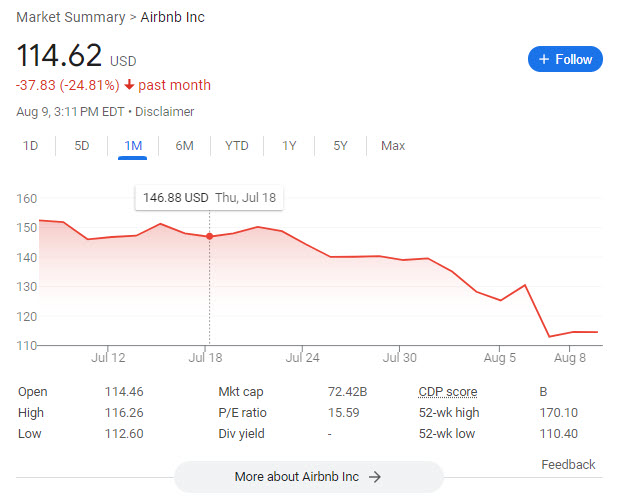
In this article on this topic, it’s stated that Airbnb cut 200,000 listings from its site since April 2023. https://www.investopedia.com/airbnb-stock-sinks-on-warning-about-slowing-us-demand-8691578
What is behind the slump? Opinions vary, but this article paints a concerning picture:
https://www.benzinga.com/trading-ideas/technicals/24/08/40251152/airbnbs-stock-nears-death-cross-is-the-vacation-over-for-investors
As well, TripAdvisor has plummeted nearly 38% over the last 6 months. This suggests a wider problematic trend for the whole travel industry.

Are We Headed for A Major Stock Market Crash?
There have also been some indications that we are headed for a big stock market crash and banking system failure. There have been many articles on this topic for the last year. Even Jaime Daimon, head of JP Morgan Chase bank, is talking about things going south. Which is something that bankers do not like to say.
https://www.cnn.com/2024/04/12/investing/jpmorgan-chase-bank-earnings-q1/index.html
If Airbnb continues on a downward trend, and if we also see a big stock market and-or banking crash, then many of our “hosting” annoyances and inconveniences will seem “small potatoes” indeed.
My sense is that we will have a big crash, but also that we will see things get much better once we are “on the other side.” Stay tuned and stay positive.









 of Airbnb and hosting more exciting, what problems arose, what were the inferior or problematic choices/policies made by AIrbnb and hosts, and, most importantly, what values do I believe in and advocate for hosts to get “back on track”, if they so choose.


 Spirituality may be viewed as more like sitting in zazen, or being a disciple of a mainstream religion, and listening to the yoga teacher or institutional church authorities tell you what to do and think, whereas soul is more like being a Mage or Mystic, and listening to the voice of the earth and the creatures, or your own Inner Guide. It is more closely tied to the unconscious realm, and thus to our dreams and the depths of who we are. Carl Jung, who wrote Modern Man in Search of a Soul, and explored his own soul’s depths in his amazing
  (which has been called “
 When you are in touch with your soul, you are aware of the “shadow” element in yourself, as in any setting or community. And all people and communities have a shadow element. One of the profund truths of the soul is that the more the shadow is suppressed, the stronger it becomes. You cannot sweep an infinite amount of dirt under the rug. Eventually the rug will become a tiny cloth atop a dirt pile grown into a mountain. “What is relegated to the unconscious comes to us as fate”, said Carl Jung, which is a bit of profound wisdom that too many in our times seem to neglect. And ignoring this truth means it will become your fate.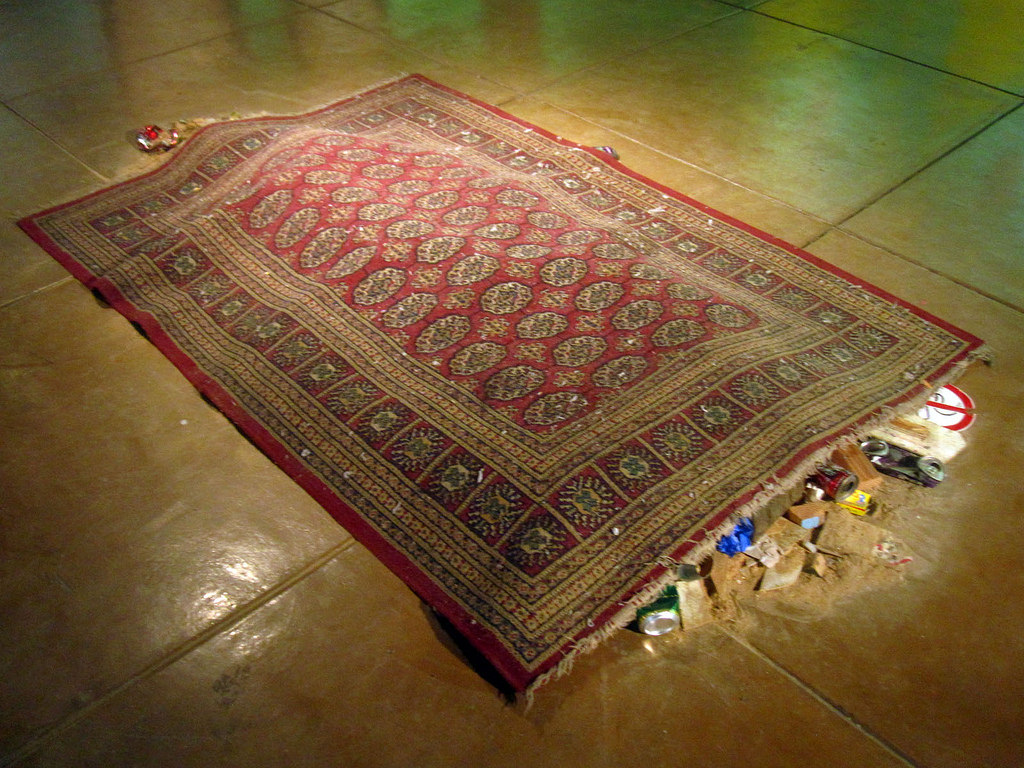
 Although in their case they are not representing a mainstream religion, but something more like a “religion” of technology, and a “religion” of the ideal luxury hotel. The clean, white minimalist style, like the clean spare website style of the Airbnb site, can be read as a representation of the refutation of the unconscious, and of the soul who wells up from the unconscious seeking expression in this world. This is not to say that the minimalist aesthetic is inherently lacking in soul, for it certainly can be an expression of a unique soul quality, as can any style or aesthetic. Rather, what I’m calling attention to is the uniformity of style, the imposition of style and the suppression of hosts’ unique selves in all aspects of their business — from how they choose to decorate, to how they choose to run their business and screen guests, — and this is where the problem lies.
 or, in the terminology of soul that we are using here, it could be viewed as “selling one’s soul to get ahead.”
 To let other people do their “soul work” for them. Face it, this is a kind of patronization — we “assign” some folk culture in another country to be “the ones who do that soul work for the rest of us”. At the same time, some of us are workaholics in our tech job, and the folk people out there can project all their innate inventiveness, math and logical ability, organizing ability, tech know-how and entrepreneurial spirit onto us, we get “assigned” to do that for them. All of this psychological projection of our growth tasks onto other groups of people mitigates against integration, because one half of humanity isn’t supposed to carry the growth of the other part. We are all called to become integrated, to become whole, in ourselves. So buy intriguing folk art if you like, but let it be a symbol of what YOU want to do and become in your life, not what you remain content to let someone else do for you.

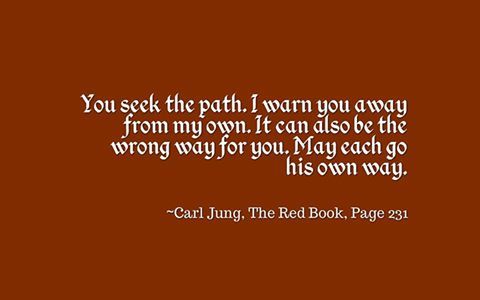 Carl Jung said, “Would you find the way? I warn you away from my own.” He understood well that being true to your soul means listening to your own heart, and only your own heart. No teacher, school, church, temple, doctrine or guru can teach you, but only you, yourself.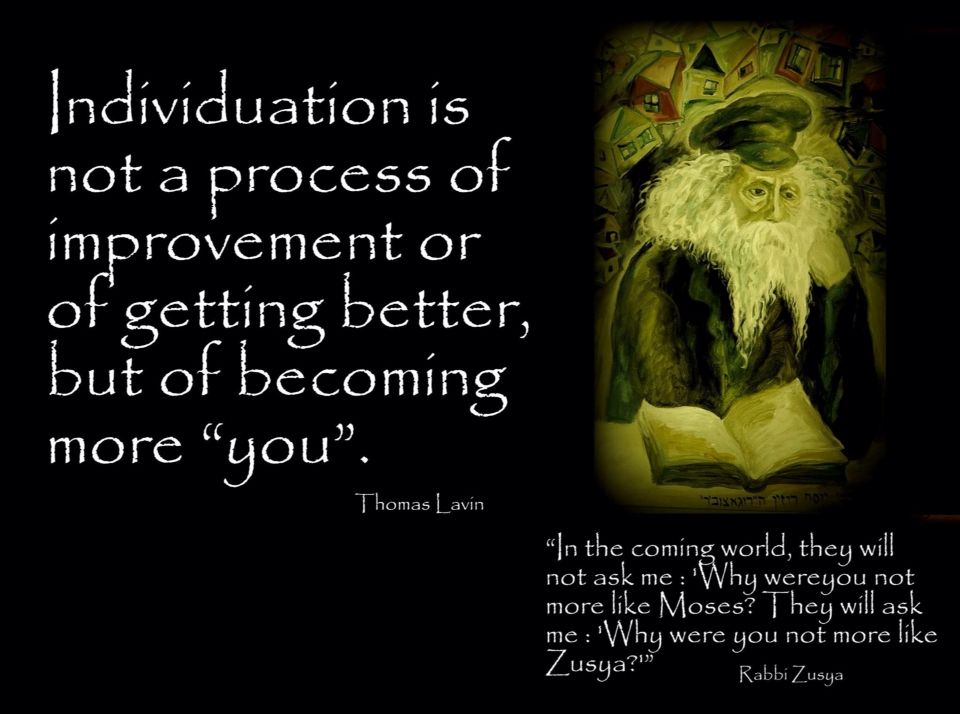





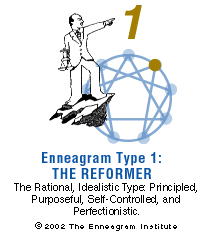
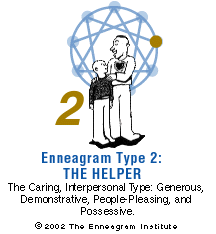

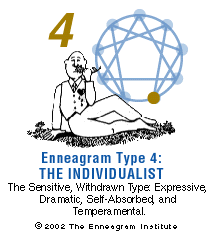
 Of all the TYpes, they may ask the most penetrating questions. In the host community, the Type 5 is likely to be the scholar of the set, who has done research or inquiries about hosting topics, laws, policies or practices, in a deeper or more extensive way than most other types. There may be an area that the TYpe 5 host specializes in and chooses to learn a lot about, and then this host could be a resource for the host community in that regard.







 globalhostingblogs
You must be logged in to post a comment.