In This Article
In this article I’ll provide a condensed history of changes in Airbnb from its inception, describing how it has become more overreaching, more controlling, and finally more tyrannical and totalitarian, especially with its recent policy changes. Then, I’ll explain some options for hosts on how to contend with these changes, either individually or collectively, and provide some tips on “workarounds.”
Airbnb History
I’ve been an Airbnb host for 13.5 years, since early 2013, and have observed the changes in Airbnb since it’s beginning stages. I’ve had the opportunity to observe the host community at large since the early years as well, since I was an early host community leader, running the New Hosts Forum along with Glenn and Andrew on the first iteration of the Airbnb Community Center, which back in those days was simply a motley collection of all kinds of host groups, all set up, run and moderated by hosts. On my Global Hosting Forum, I have a board with some info on early host groups: https://globalhosting.freeforums.net/board/119/history-original-airbnb-community-groups and about early Airbnb history: https://globalhosting.freeforums.net/board/199/early-airbnb-history
After Airbnb shut down those host-run groups, I followed the migration of hosts either onto the Airbnb Community Center (which many hosts didn’t want to use, since Airbnb controlled it and your Airbnb acct would be linked with whatever you posted) or over to independent host Facebook groups or other host forum websites.
The changes in Airbnb over these years have been quite significant and disappointing to hosts who were around in the early days. We often refer to those fun and exciting early years as “the old days of hosting.” In those days, in-home hosting was much more common than it is now. Those who know the history of Airbnb’s start will realize that Brian Chesky and his co-founders Joe Gebbia and Nathan Blecharczyk rented out an air mattress in their apartment, hence the name “Airbnb”. In 2013, 44% of hosts were in-home hosts, and 87% of hosts were renting out some or all of their own primary residence.
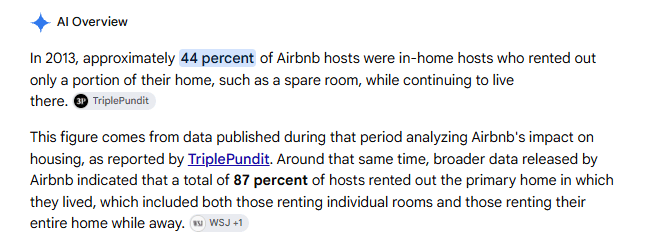
If we go back further in time, the number of hosts renting out private rooms is larger. In 2010, the percentage was 46.7%:
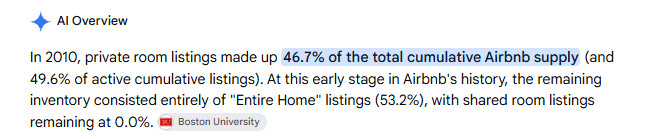
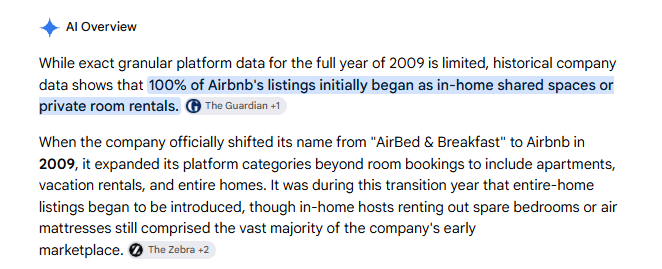
If we go back to 2009, which is a transitional year, the percentage of hosts renting private rooms in their own home was 100%!
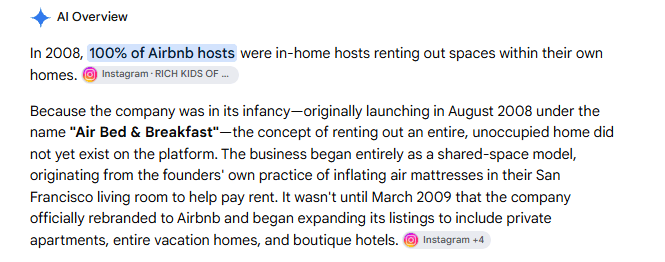
And in 2008, the concept of renting out one’s whole home didn’t even exist yet in the mind of Airbnb, which was founded in 2007.
But at this point in time, in 2026, in the US, the number of in-home hosts renting out space in their own primary residence, while they themselves live there too, is much smaller, only 11 to 16%:
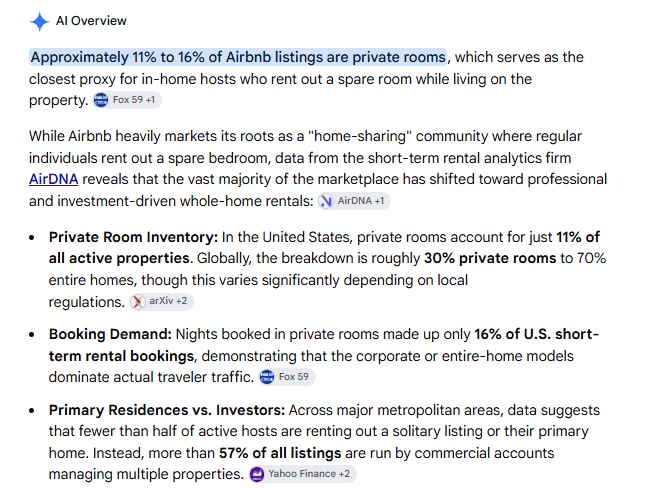
Further, whereas in 2013 only 13% of hosts were “investors” who rented out spaces that were neither private rooms in their home nor their primary residence, at this point, 57% of hosts are such “investors.”
Hosts who were around in the early days, and especially those who are in-home hosts, have felt disappointed and even betrayed as Airbnb has changed over the years, because our model of hosting has taken on minority status, and not a minority that earns much respect, either from Airbnb, or the host community, which often behaves, acts and talks as if there are no in-home hosts. The presumption in so many host posts on social media, is that their investor model of hosting is THE way to host. Many are the posts where hosts make assumptions about hosting which simply do not apply to in-home hosts.
So we in-home hosts find ourselves in the odd position of apparently being the standard-bearer of a valuable, meaningful and fun cultural phenomenon that even its originators have long ago forsaken.
Airbnb Shows an Increasing Preference for Hotel Like Listings
Why did Airbnb forsake the in-home host model? What I noticed, virtually from the very start in 2013, was that while on the one hand Brian, Joe and Nate started as in-home hosts themselves, their vision of hosting didn’t really match the reality of a primary residence, or a room rented in a host’s home. To begin with, they were all single men and didn’t own the property where they rented out an air mattress (they were renters of a San Francisco apartment), and hence, they didn’t necessarily have an appreciation of all the concerns that in-home hosts would have renting a room in their home. Concerns such as: if they had a partner and/or children, if they had pets, if they were allergic to pets, if they had valuables in their home, if they had to pay insurance, if they had a pool someone could drown in, if they had expensive furnishings someone could damage, if they had insurance claims for incidents caused by guests, if they were sued, if their home looked lived-in because it was lived in, and the hosts couldn’t afford a maid to clean it every other day, if they weren’t making hosting the center of their lives because they werne’t Airbnb founders, etc.
In other words, even at the start, Airbnb’s founders were relatively insulated and in a position to be ignorant of the real issues associated with home ownership and renting all or part of one’s own home.
When I looked at Airbnb’s advertising, even early on, I always noticed that its depiction of host’s homes was, shall we say, “airbrushed.” Everything was always perfect: unrealistically perfectly arranged, perfectly clean, and hosted by perfectly attractive people. In fact the homes tended to look not like homes lived in by actual people, but as homes designed and set up just for guests. So, from an early point in time, Airbnb was unfortunately already conditioning guests to expect an unrealistic perfection in Airbnb rentals, as well as creating an expectation to be able to rent homes that were not lived in at all by anyone except guests: meaning, Airbnb listings which were more and more like hotels, rather than primary homes.
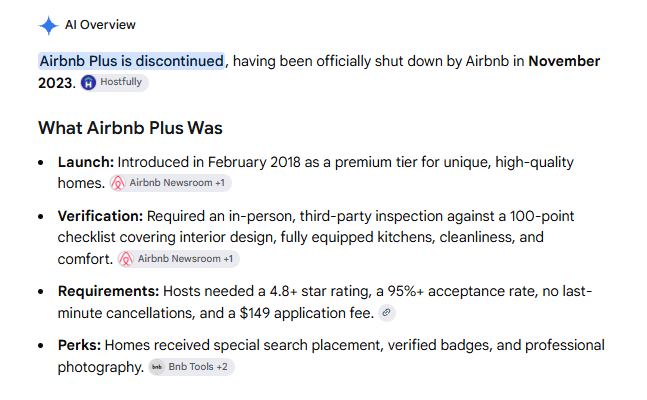
Airbnb’s early ventures into “Airbnb Plus” and “Airbnb Luxe” were further evidence of its desire to emphasize perfection and perfect cleanliness. As described in the AI Overview below, Airbnb Plus featured “high quality homes” which were extremely unlikely to be the host’s primary residence, for the simple reason that virtually no one who isn’t wealthy enough to have a maid on nearly daily service, can realistically live permanently in such circumstances as described. And anyone wealthy enough to do so, really doesn’t need the annoyance and stress that is part and parcel of having Airbnb guests.
Airbnb Luxe was the next iteration of this kind of emphasis.
Again, these high-end, spectacular homes are quite unlikely to be the host’s primary residence, and are likely to be entirely investor properties.
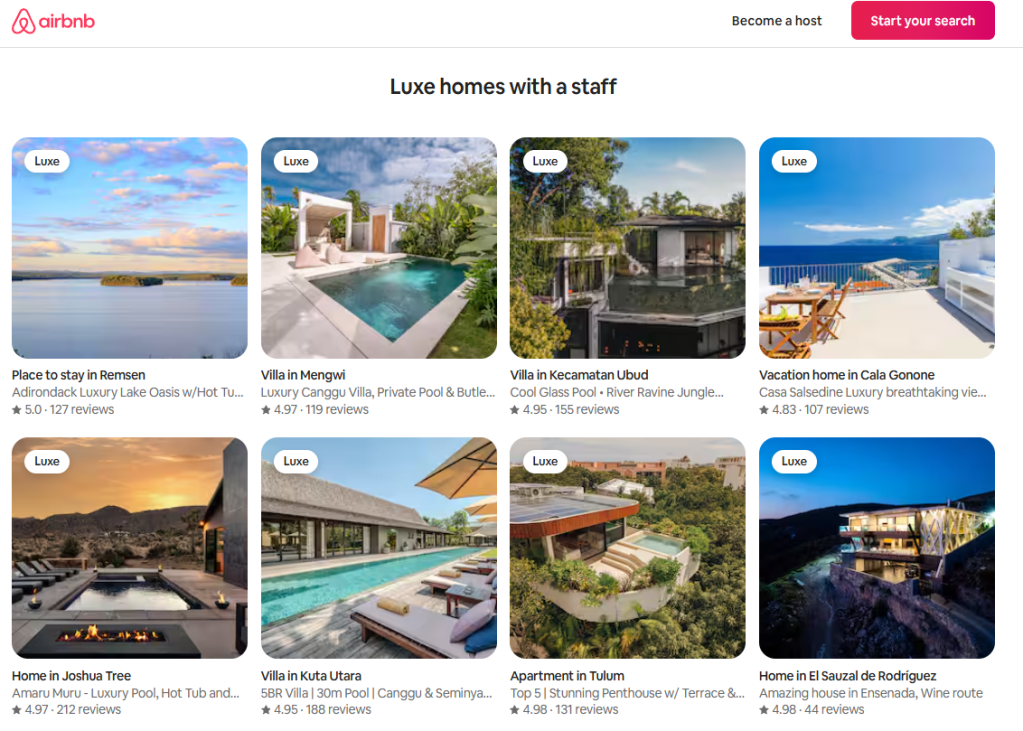
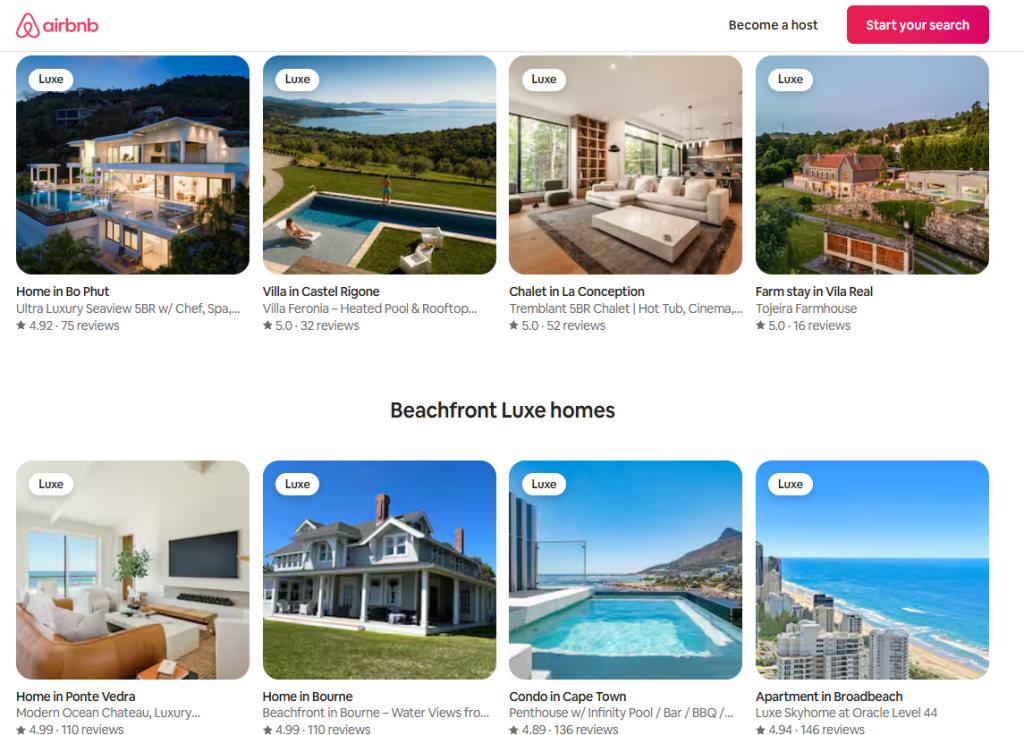
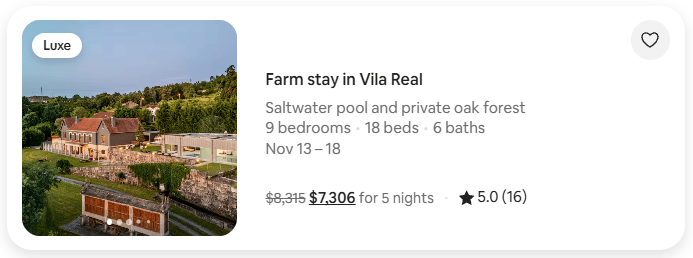
These high end properties are quite expensive to rent, for instance the “Farm Stay in Vila Real” costs $7306 for 5 nights, or $1461 per night.
From early on, in terms of its business structure, Airbnb claimed to be merely a third party payment platform, where it took money from one party and transmitted those funds to a second party, keeping a service fee for itself.
If this were really the case, that all Airbnb was, was a payment platform, then it would never interfere in the host’s running of their own business, and hosts would be free to run their homes as they saw fit, which should always have been the case. As well, if Airbnb were simply a payment platform, it would certainly not function like a court of law and “resolve disputes” between guests and hosts, or decide on things like reimbursements for damages, or refunds for stays that the guest claimed were not satisfactory, or restrict what types of cancellation policies, fees, fines, rules, security deposits or other business related matters a host could set up.
But as time went on, Airbnb increasingly got involved to the point of serious meddling and overreach on all matters related to hosting, including those that were really none of its business, but were really about the host’s own boundaries and needs in their own private home.
Over time, the direction of Airbnb’s increasing meddling, its decisions in disputes, and its own preferences, as seen in ads and other materials, I believe clearly shows a bias towards guests over hosts, as well as a preference for the most hotel-like listings, meaning, investor listings, not those hosting in their own homes.
Analysis of The Development Airbnb’s Preference for Hotel Like Listings and Booking Process
From early on as well, Airbnb wanted to emphasize ease and reliability of booking through Airbnb. Because they wanted guests to have an easy time doing bookings, they introduced “Instant Book”, whereby hosts could set their listings so that a guest could instantly book, without the host having to approve their request and take action to accept them. This made a host’s home very much like a hotel, where pretty much anyone (except those on a hotel blacklist, say, for credit card fraud or serious vandalism) can simply call any hotel and book a room. Foolish were the hosts who failed to see the potentially serious problems with Instant Book. Because there are some Airbnb guests that you really do not want in your home. And try as it might, Airbnb cannot possibly screen guests the way you would, because even the smartest AI used by Airbnb cannot possibly know what your own screening criteria would be.
I had a friend who, not long after Instant Book premiered, was contacted by Airbnb, which was trying to do research on the feasibility of requiring all hosts to use Instant Book, believing, quite arrogantly and impudently, that it had a smart enough AI to be able to do any host’s screening, and ensure that only those guests who passed the screening could successfully instant book a certain home.
This arrogant perspective taken by Airbnb, is just one of many examples of how the “tech bros” who founded the company, have an over-confident and unrealistic view on the ability of tech and AI to replace human thinking and discernment.
Other moves towards a more “hotel like” model came through Airbnb’s overall de-emphasis, in its advertising and content, of in-home hosts, and its emphasis of vacation rentals which were not likely the owner’s primary residence. For instance, if you watch Airbnb commercials nowadays, you’ll see vacation rentals exclusively. For instance, this Airbnb ad which represents an Airbnb rental as simply a larger hotel room.
These kinds of ads perhaps less obviously represent another problematic development: they remove the host from the picture altogether. Guests are being conditioned to expect that the host isn’t at the rental and perhaps even think that the host doesn’t belong there.
There were other moves that Airbnb made, which imposed “hotel-like” conditions on hosts who did not want to run their homes as hotels, simply open to any passer-by. For instance, when Airbnb started to hide the profile photo of the guest until after booking was confirmed, claiming that if the host saw what the guest looked like, they might “discriminate” against them. What idiocy this was: as if the only use of a photo is as a basis for discrimination!
Later on, Airbnb also hid most of what guests had written about themselves on their profile, until after booking was confirmed, as if what guests wrote about themselves, was only for other guests to read, and not for hosts? Since guests can choose what to say about themselves on their profile, why in God’s name would this info they willingly convey, need to be hidden from those whose homes they want to stay in?
Too many hosts on the woke bandwagon simply swallowed this nonsense, eager to virtue-signal and further enslave themselves, and argue themselves into having less and less ability to screen any guest.
Another way that Airbnb made host’s rentals more like hotels, was by forcing new cancellation and refund policies onto the hosts, over and above their objections. These cancellation and refund policy changes favored guests. For instance: Airbnb first introduced a 24 hr cancellation window, where guests could get a full refund if they cancelled a stay within 24 hrs. Then that expanded to 48 hrs. As well, Airbnb got rid of the “Strict” cancellation policy for new listings, which stipulated that guests would never get a full refund on cancellation, unless they cancelled within 24 or 48 hrs of booking. After that point, they’d get 50% refund at most. But with the new “Firm” cancellation policy, guests would get a 100% refund if they cancelled over 30 days from check in date. This change was hardest on hosts who tended to get seasonal bookings, such as guests coming for ski season, and who booked far in advance.
Over the years, pretty much every host has realized that Airbnb’s decisions on disputes, by far and away tend to favor guests. This doesn’t mean that guests win in every dispute, but I’ve found that in every case of a guest claiming that my house wasn’t clean enough, Airbnb gave them a full refund at least for days not stayed if they left early, and more recently also an additional 30% refund for days stayed, even though there is no way that a guest can prove that my house “wasn’t clean enough.” A picture of a cobweb or a spot on the floor doesn’t mean the house isn’t clean enough. Airbnb in all fairness cannot, but does, apply totally unrealistic expectations of absolute cleanliness such as one is likely to find only in a super hygenic operating room or research laboratory to lived-in homes. Again, this shows a pattern of disrespect for in-home hosts and an expectation that all listings are essentially larger hotel rooms.
This brings up the issue of the very divergent viewpoints of guests vs hosts. Especially given the environment, pretty much ubiquitously present all over the world, where there is prevalent (if not omnipresent) animosity between tenants and landlords ( I explain in other articles what I view as the causes of this animosity: they are structural and social causes quite unrelated to property owners themselves) , one can hardly expect that this animosity would not leak over into the guest and host relationship, and contaminate that area as well.
So, Airbnb is put in the position of the environment of this stressed guest vs host relationship, and just like the corrupt and criminal governments which pass unconstitutional “laws” like rent control which favor tenants, Airbnb has created policy after policy favoring guests.
Airbnb’s March of Tyranny
Now I want to move on from describing what heretofore has been more a merely hotel-favoring and guest-biased standpoint, and explain how over time, Airbnb has become more overtly a tyrant, taking one step after another which has reduced hosts’ ability to screen guests and even communicate with guests, reducing hosts’ control over their own home, as well as actually taking steps to destroy hosts’ own personal boundaries.
These are changes Airbnb has introduced over the years which tyrannically interfere with hosts control over their business…which Airbnb is increasingly hinting, is not actually their own business:
*Hide guests’ profile photo until after the guest books
*Hide most all information about the guest which the guest themselves has written on their Airbnb profile, until after guest books
*Hide from hosts the reviews guests wrote about other hosts and other stays
*Hide guests’ phone numbers from hosts
*Allow guests to use pseudonyms when booking, so you may not even know the real identity of the person who stays at your home
*Allow guests to post reviews which include lies and false claims, and dishonestly represent their stay
*Start deducting “depreciation” from reimbursements paid to hosts for damages to their property by guests
*Stop paying hosts for certain types of linen damage
*Not allow hosts to use any cancellation policy of their own choosing, but require them to refund guests for cancelled stays in the way Airbnb dictates
*Support guests’ false claims about the condition of the rental so that they can get fully reimbursed for their stay over and above hosts’ objection, without ever providing a single iota of evidence to the host about these claims that supposedly justified a full refund. It should be obvious that no court in the land operates in this way, only listening to one side, and refusing to show evidence to both parties.
*Apparently require that even in-home hosts who are lawfully exempt from accepting service animals (because they rent fewer than 5 rooms), accept service animals, unless they meet the 3 criteria listed here, including providing a doctor’s note explaining that they are allergic to such.
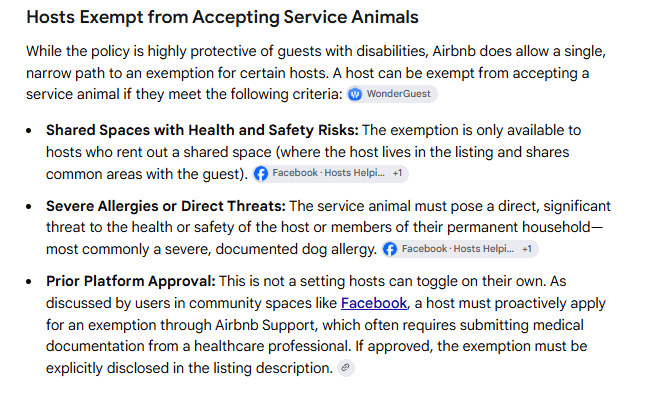
It is quite unclear what Airbnb’s position would be, if it were not the host who needed an exemption and provided “medical documentation from a health care professional”, but rather, if it were another Airbnb guest, in a home where the host has more than one guest at a time. And, any guest could be allergic, at any time.
In any case it is utterly absurd that a guest can bring a service animal without even needing to provide documentation that it is in fact a service animal, but the host isn’t allowed to refuse to accept a service animal, unless the host has documentation, even when US law (ADA law) allows the host to refuse to accept service animals.
It should also be mentioned that Airbnb set up a rating system which they explain very dishonestly to guests. In the rating system itself, Airbnb explains that 4 stars means “very good”, but the reality is, as some hosts have discovered to their great dismay, any host who averages a 4.0 star rating, will be removed from the Airbnb platform due to unacceptably low ratings. Both the written review and rating system are far more impactful upon hosts than on guests, since as a guest it’s extremely easy to get an all 5 star rating. You simply have to be considerate and follow the house rules, and leave the place clean. Easy peasy. Hosts have no reason to be vindictive towards guests and backstab them with poor reviews, if they were decent guests. As well, hosts understand that Airbnb has distorted the rating system, to where, in contrast to how they explain it, the way Airbnb interprets the ratings is 5 stars= pass, 4 stars or less = fail. So hosts who understand this rating system are less likely to “fail” guests than are guests who don’t understand how Airbnb lies about the ratings.
Guests do often backstab their hosts, for instance, as I’ve experienced, giving a host 3 stars for communication because the host said no to a request for being exempted from some house rule, or rating the host 1 star for cleanliness because the host had the audacity to talk to the guest about leaving a mess in the bathroom, which affected other guests.
But even guests who mean no harm to hosts, cause harm by not understanding the rating system at all. I recently had a guest request to stay, and as usual, I went to look at the reviews hosts had written for her, and made use of AirReview, a Chrome Extension app that allows hosts to see the reviews prospective guests have written about other hosts listings. I saw that she’d given a 4 star rating to a host in my area, but her written review of this host was glowing and favorable. I asked why she gave him a 4 star rating. What she said revealed the basic problem with guests’ ignorance. She said she gave him a 4 star rating because his home needed remodeling, meaning, major renovation. Nope. I told her this was totally unreasonable, that in essence she went to a car rental lot, rented a Toyota Corolla, and then gave the car rental business a low rating because the car she rented wasn’t a Porsche. “You do not fucking do this,” I felt like yelling at her. That host never claimed his home was a Porsche. His listing description clearly said “Toyota Corolla.”
I declined this guest with a tongue-lashing about her actions that harm others simply for having the homes that they have.
Apparently, Airbnb doesn’t care if guests lie about the condition of the listing or anything else, and guests lie a lot. Because this is a known problem that Airbnb is confronted with on a daily basis, the best way to deal with this would be to ditch the rating system altogether, since backstabbing ratings are not only meaningless but harmful, especially if Airbnb takes action to punish hosts based on the lies of a guest who was upset when asked to take responsibility for himself, clean up after himself, or follow the house rules. If the system only included written reviews, and both hosts and guests could reply to reviews, then the potential for harm due to dishonesty and baldfaced lies would be vastly mitigated. But Airbnb doesn’t care to mitigate harm to hosts, they seem only concerned with pleasing the guests.
Airbnb Finally Comes Out and Says the Truth Hosts Have Suspected All Along: “Your House, Our Rules.”
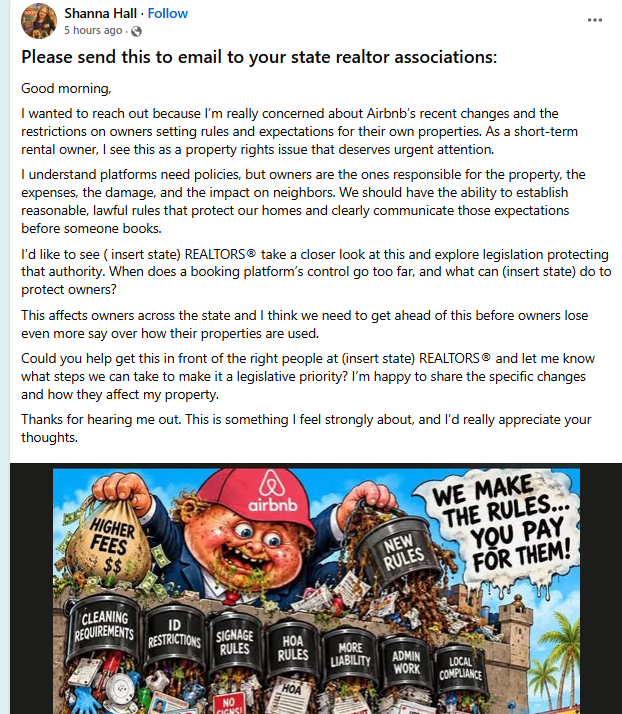
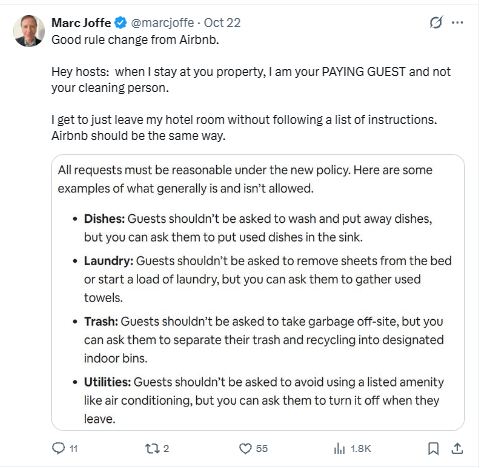
Just this last week, Airbnb made a tyrannical move that has upset even some of the most dyed-in-the-wool Airbnb brown-nosers, schills, apologists and cult members. It issued policy changes which prohibit hosts from requiring guests to complete “check out chores” https://apnews.com/article/airbnb-guests-checkout-chores-new-policy-24a2d80b09ae1fca77d0411c6a08dddd, but the bigger and much, much more unreasonable move, was that Airbnb is totally overhauling its position on house rules, to where it now will not allow hosts to set up their own house rules! https://www.usatoday.com/story/travel/2026/10/22/airbnb-hosts-policy-change-pushback/92383744007/ and https://www.airbnb.com/resources/hosting-homes/a/important-changes-to-house-rules-21
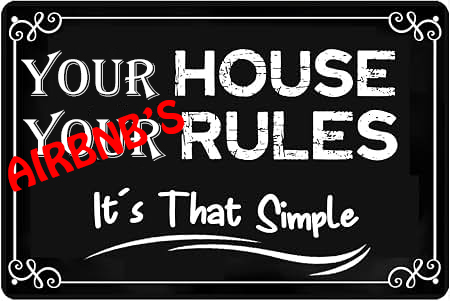
Let me provide some context on house rules, based on my 13.5 years of hosting and participation as a leader in the host community.
Hosts tend to fall more or less into 2 camps: those who believe in minimal house rules, and those who, often because of significant problems they’ve had with guests in various areas, have found it best to be as clear as possible to create the right expectations in guests before arrival, and thus have longer house rules.
The more experience one has as a host, the more likely one will perceive the need for additional house rules, because one has seen issues arise, and because the basis of contract law in all business, is that you can only enforce the terms of the contract, not things which aren’t mentioned in the contract. Which means that if a guest “assumes” they will be able to use the kitchen at your private home, and you haven’t communicated to them in advance that they are not allowed to use the kitchen, then if they complain to Airbnb that you didn’t say in your listing description or house rules that kitchen use isn’t allowed, you don’t have a leg to stand on. The guest will be refunded and you also might end up punished for disallowing kitchen use when you never communicated about that.
Ditto with countless other possible iterations of what you decide is or is not allowed at your home. Having a rule in writing, and being sure the guest read all the rules prior to booking, isn’t absolutely necessary, but can be useful in the case of a dispute. Because a contract is valid whether or not both parties read all the terms of the contract.
All that said, I can appreciate that long lists of house rules can feel onerous to guests, and be off-putting.
However, the simple solution to that, which hosts have repeated ad nauseum but guests somehow cannot comprehend, is that no one is being forced to stay at any particular home, and a guest who doesn’t like “long house rules lists” is in no manner obligated to book at a home that has those! Problem solved, right?
The beauty of Airbnb has been that you can book what suits you.
However, the additional problem for guests has been a failure of their own responsibility. The fact that they don’t want to put in the work to find what suits them. And Airbnb, which has always sided with guests, has taken their enabling of guests’ refusal to do their due diligence, to new extremes.
In spite of Airbnb’s original vision and uniqueness being in that it offered unique stays, all kinds of different stays, in different homes, with different hosts, the problem is that guests have actually not wanted difference. They’ve wanted sameness. In essence, they’ve wanted hotels. “I’ve come for the lower price, and the neighborhood location, but make it just a bigger type of hotel.” They want predictability, quick booking, ease of access, ease of everything, and really no responsibilities at all, not even to wash their own dishes after their meal, apparently.
Because the thrust of Airbnb’s first change, was that upon checkout, guests can no longer be required to wash their dishes, strip the beds, or take out the trash. Of course, this brings up another matter, which is whether by exempting guests from such “checkout chores”, guests will decide that they are totally exempted from washing any dishes at all throughout their entire stay, and leave a pile of dishes in the sink that extends halfway to the ceiling.
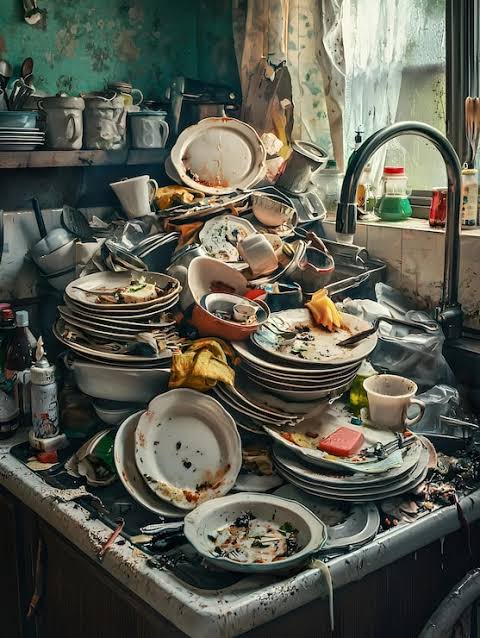
People who have never been hosts, only guests, may delight in this change by Airbnb, as I saw evidence of in some social media posts.
And:
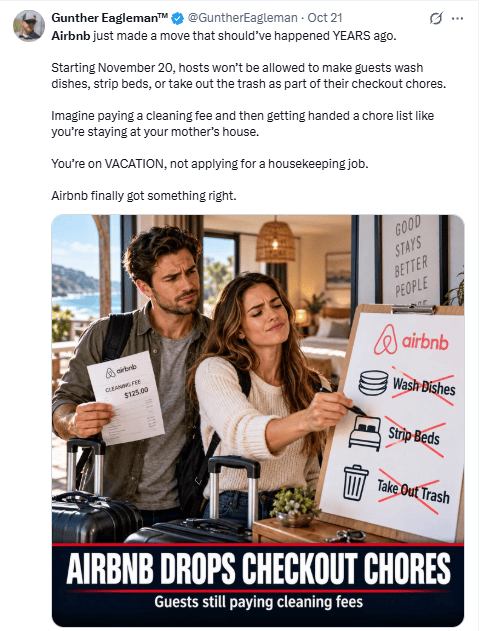
And:
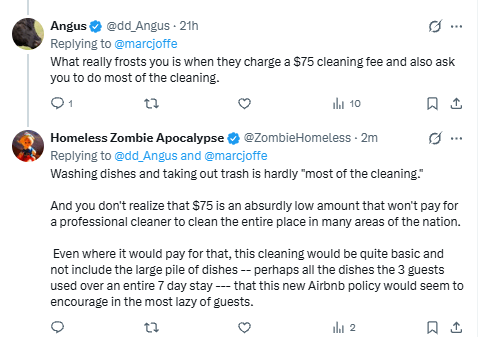
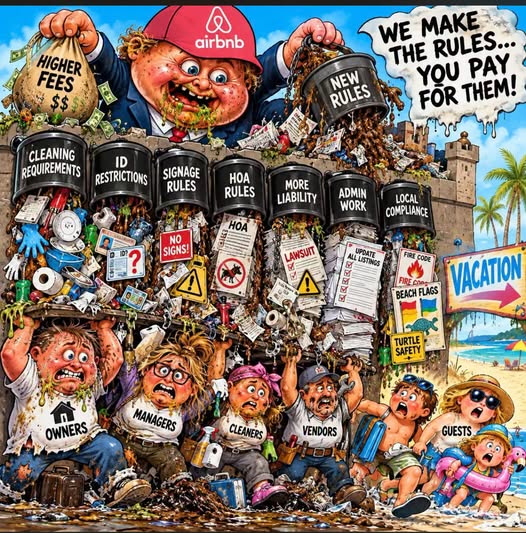
As if it weren’t bad enough to slap every host in the face by telling them they can’t set their own check out procedures in their own private home, Airbnb then stomped every host in the world into the mud under its boot, by dictating that as of November 20th, no homeowner or host is allowed to set their own house rules. Ah, they finally are revealing the totalitarian corporation that they really are, drunk on their own power. Perhaps it should be a relief that Airbnb finally comes out and openly admits what they have really been all along: a pack of arrogant tech-bro people drunk on power, control and their own egos, and not caring at all for the hosts and homes upon which they built their empire. This is particularly significant, and particularly despicable, because for everyone who owns their own home and has tenants, visitors or guests, there are perhaps few sayings that as aptly represent their maintenance of their own boundaries in their own home, than the saying, “My house, my rules.” But now Airbnb has replaced that saying, with a new saying, which goes, “Your house, Airbnb’s rules.”
This new policy, more than anything else Airbnb has ever done, more than any other tyrannical move, clearly demonstrates that Airbnb no longer allows hosts to run their own homes, or their own businesses, but are now being viewed as mere franchise managers in Airbnb’s gargantuan hotel chain.
Life is about boundaries, healthy relationships are about boundaries, good business relationships are about boundaries, and certainly, tenant and landlord and host and guest arrangements, are about boundaries.
By saying that you can no longer make your own rules in your own home, Airbnb is telling you that you cannot have your own boundaries. Not only is this despicable business practice, but it is the stance of a narcissist, predator or psychopath. And some would say, that with this move, Airbnb has become openly narcissistic or sociopathic.
It was ironic to me, to go onto social media, and see that some of the same people whose general stance is pro-freedom, anti-tyranny, anti-big government, who believe in reducing regulation and government control, are now cheering Airbnb’s tyranny, because they feel advantaged by this as guests. The big bully Airbnb is going to whip those hosts and homeowners into line, forcing the property owners to do their bidding and be slaves to their will, and invite guests to have much more freedom and fun, while hosts bear the costs of this and the harm from this idiocy, as well as having their own property rights, boundaries and basic ability to run a business completely trampled upon.
Folks: here’s a clue. If you are opposed to tyranny, you need to see it even when, and perhaps especially when, it seems to work to your advantage.
Airbnb Limits Host to 7 House Rules
As of November 20 2026, all Airbnb listings worldwide, both entire place listings and private rooms, both investor-hotel listings and hosts’ own primary residences, will no longer be able to use their own house rules.
They can only select from 7 possible house rules, https://www.airbnb.com/resources/hosting-homes/a/important-changes-to-house-rules-21 as follows:
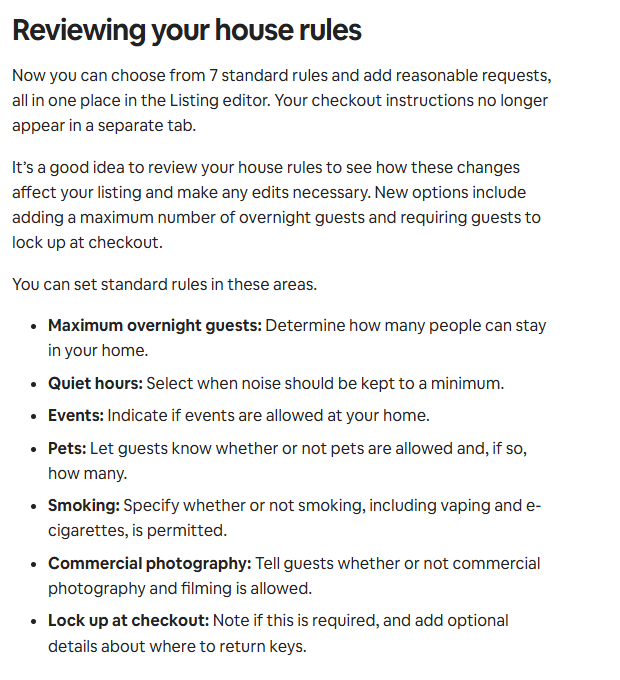
The first thing that stands out for me when I look at this, is that this makes no sense whatsoever, and is utterly absurd, as applied to in-home hosts who do private room rentals. And the second thing that stands out, is that this would be totally unacceptable to many of the home insurers who provide vacation rental insurance for hosts who rent out entire places, as it apparently disallows hosts that their own home insurer dictates are required as a condition of their coverage.
Let’s examine these two situations in more detail to look at all the absurdities.
In Home Hosts Doing Private Room Rentals
Even though only 11 to 16% of hosts do this kind of rental now, Airbnb apparently intends to impose the house rule limitations on these hosts and listings too.
Imagine how ridiculous it would be, for instance, if you were a host like myself, who either shares common areas with 1 or more guests, or has more than one guest room so that common areas were always shared, and you were told you could not have a rule requiring guests to clean up after themselves in common areas. This would be so absurd that it would be virtually unbelievable, to think Airbnb would either say you could not have such a rule, or that Airbnb was so stupid that it created a new policy to apply to every host in the world, without having even thought of this type of situation and factored that in. Obviously, a guest refusing to clean up after himself in shared areas would be creating serious problems not only for the host but for other paying Airbnb guests.
There are countless other situations where a host may need to create a rule because they’ve had an issue. For instance:
You’ve had damage to your hardwood floors caused by guests wearing hard soled shoes or heels in your home, or found that guests who do not remove shoes before coming in can readily track in dirt and mud, so you have a shoes-off policy in your home. Is Airbnb really going to insist you can’t do this?
Because you have more than one guest using common areas, you’ve set up designated storage spaces for guests to use, labeled with their room name, and tell guests to use those areas only for their things. Is Airbnb really going to tell you that you can’t prohibit a guest from using other guests’ storage areas?
Say that you want your home as a quiet refuge — both for yourself and for other guests — and market it as such to guests, so that you do not allow guests to bring business clients over to your house, or bring friends or family over to socialize or have dinner in your kitchen. Because these things create too much noise and commotion, and would mean that you cannot honor your promise to one guest that he will have a quiet retreat like experience, if another guest brings over two or three friends and engages in loud socializing. Is Airbnb really going to tell you that you’re not allowed to have the intention of making your home a quiet retreat, that you cannot set your own boundaries about who enters your own home, but one guest has to be allowed to do whatever noisy thing they want to do, even if this causes problems for you or another paying Airbnb guest?
You offer laundry facilities to guests, but have had problems with guests who overuse the laundry, such as by doing a load of laundry every 2 days, even every day. So you create a rule that guests may not do more than 2 loads of laundry per week. Is Airbnb really going to say that you cannot have a rule about this, but have to permit the guest to do however much laundry they want to do, with no limit?
Or, you are a host who lives in an area where marijuana is legal, but you hate the smell of it, as do many of your guests. So you have a rule that anyone bringing marijuana to your home must keep it in an airtight container. Is Airbnb really going to tell you that you cannot do this, and anyone must be allowed to make your home smell vile with their weed, ruining not only your own experience in your own home and violating your boundaries, but also creating a problem for other paying Airbnb guests?
There are any number of unique situations that in-home hosts especially could find themselves in, where they need to create a rule to try to prevent problems, not only for themselves, but for other guests.
Insurer Requirements
Now consider the situation of a host who has an entire place listing, who is told by Airbnb, that she cannot impose certain requirements on guests, which are dictated by her insurance policy, or which interfere with her ability to adequately maintain her home.
To begin with, as I mentioned before, a guest who is enabled by Airbnb that they do not have to wash dishes, may consider this as license for them to refuse to wash any of their dishes on their entire stay. Such behavior could create a problem with pests, which could be attracted to food bits and crumbs that accumulate on unwashed dishes. As an example of this, a recent guest only spilled a small amount of soda on a table in my guest room, but even that small amount attracted a few ants, which I found entering the room through the window. Multiply that by a factor of 10 or 20 or more, with a whole pile of unwashed dishes, and you can readily see this could invite ants, fruitflies, roaches, and more into a home, to the point where the homeowner now has to pay pest control to come take care of the problem.
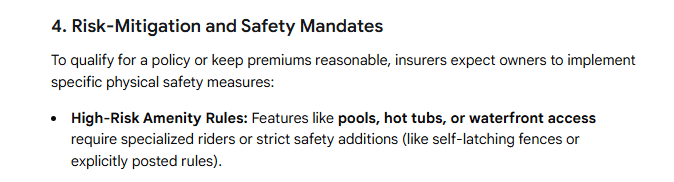
Many home insurers impose certain requirements on hosts when they insure vacation rental properties, as a condition of coverage. Is Airbnb really going to tell hosts that they cannot run their properties as their home insurer requires?
Examples of types of requirements are things like “explicitly posted rules” on pools and hot tubs or waterfront access, which Airbnb’s new policy would prohibit. Or, requiring guests to sign a contract. Among its sweeping tyrannical list of changes, Airbnb is now prohibiting hosts from having guests sign contracts, except for those legally required or required by an HOA. They apparently do not make an exception for what is required by home insurers.
Some home insurers require the renter be 25 years of age or older, but Airbnb’s changes would seem to prohibit hosts from a rule that they rent to guests only 25 or older.
Some home insurers disallow unlisted day guests, but Airbnb won’t allow hosts to prohibit day guests, and only allows a rule be set on overnight guests.
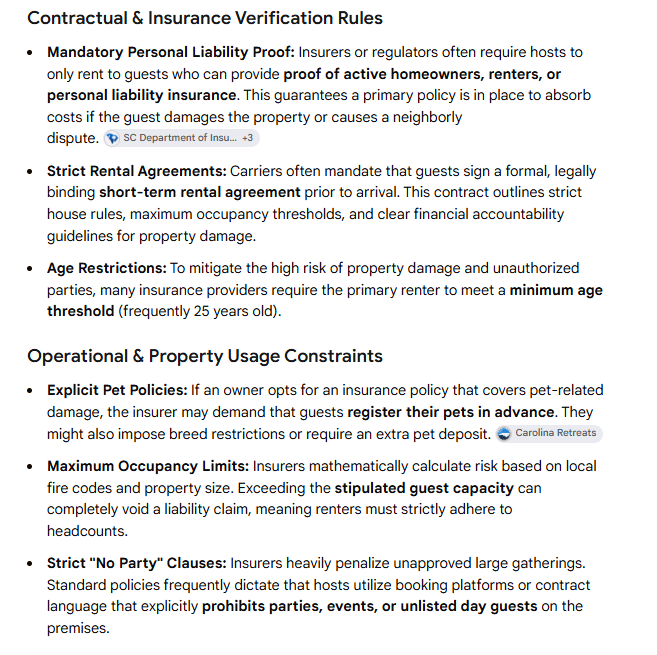
As well, some hosts have pointed out that they need a signed contract with guests, in case a problem arises that may require legal or police intervention….which is not provided by Airbnb.
Hotels Are Worse off on Airbnb
Even hotels are worse off listing on Airbnb, than in operating independently. Sure, you can get bookings from Airbnb, but you can’t protect yourself as well on Airbnb. Hotels can charge a fee if someone breaks the no-smoking rules and smokes in the unit, which can require the hotel to do extra work to air the place out. Hosts would no longer be able to charge a fee for this, in connection with Airbnb’s other restrictions on hosts.
But…There’s More…
Even though Airbnb had said these new policies would not come into effect until November 20th, some hosts are reporting that even at the present time, they’ve found that when doing a review of a guest, they are unable to rate the guest less than 5 stars, unless they check one of 4 boxes, none of which may apply.
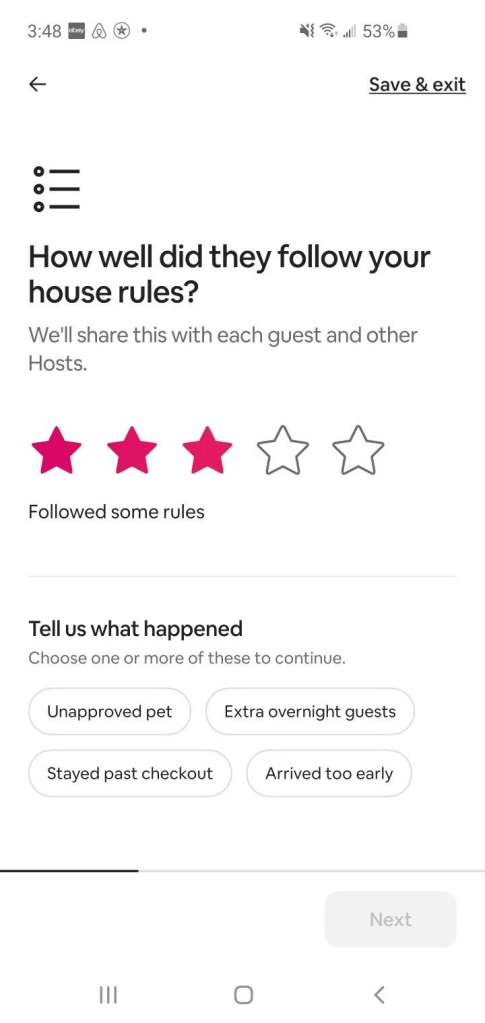
So, obviously this doesn’t work, if you have other rules that the guest didn’t follow.
In fact, this is doubly absurd, because the 4 options listed do not even cover all of Airbnb’s new 7 rules that they “allow” guests to have. For instance, if they didn’t observe quiet hours, if they had an event at the place, if they smoked, did commercial photos at your unit, you would not be able to rate them less than 5 stars in following house rules.
Hosts are Almost Universally Outraged
The overwhelming response to Airbnb’s new and draconian overreach, is outrage. More are talking, and talking seriously, about leaving Airbnb, than I’ve ever seen before as a reaction to any other Airbnb move. Hosts are talking about boycotts, collective actions, lawsuits, and more.
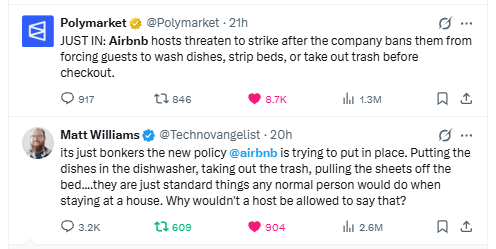
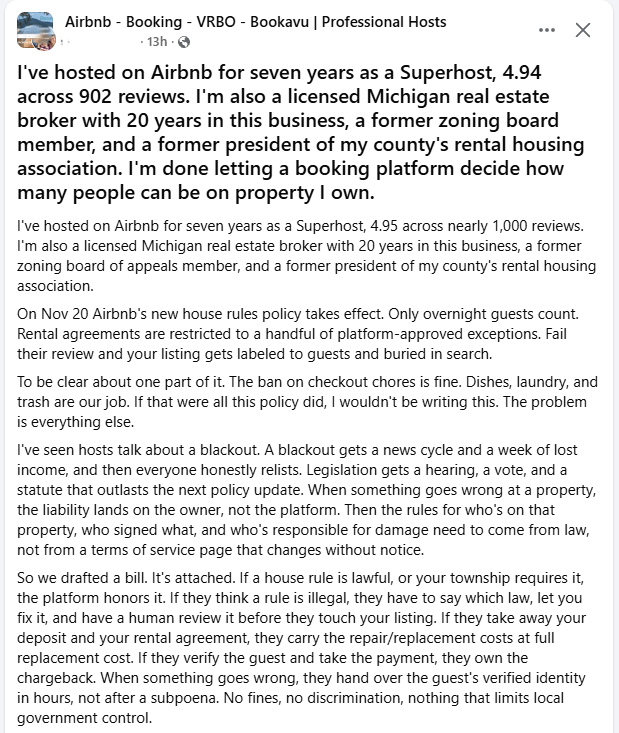
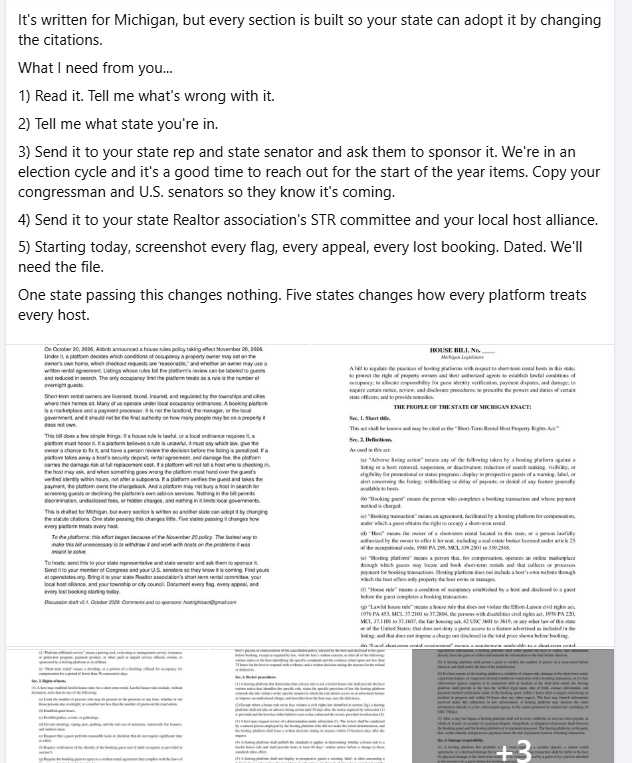
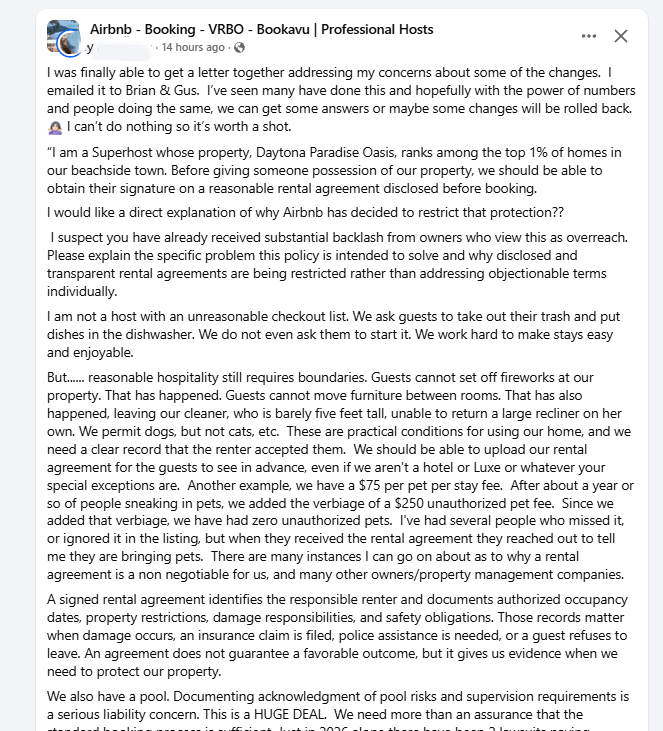
I think that host feedback to Airbnb about their outrage is quite important, as are other individual or collective actions that are in service of getting Airbnb to reconsider these incredibly stupid and tyrannical moves.
If anyone is interested to do so, you can contact Brian Chesky, Airbnb CEO, and Gus Fuldner, Global Head of Airbnb Operations, here:
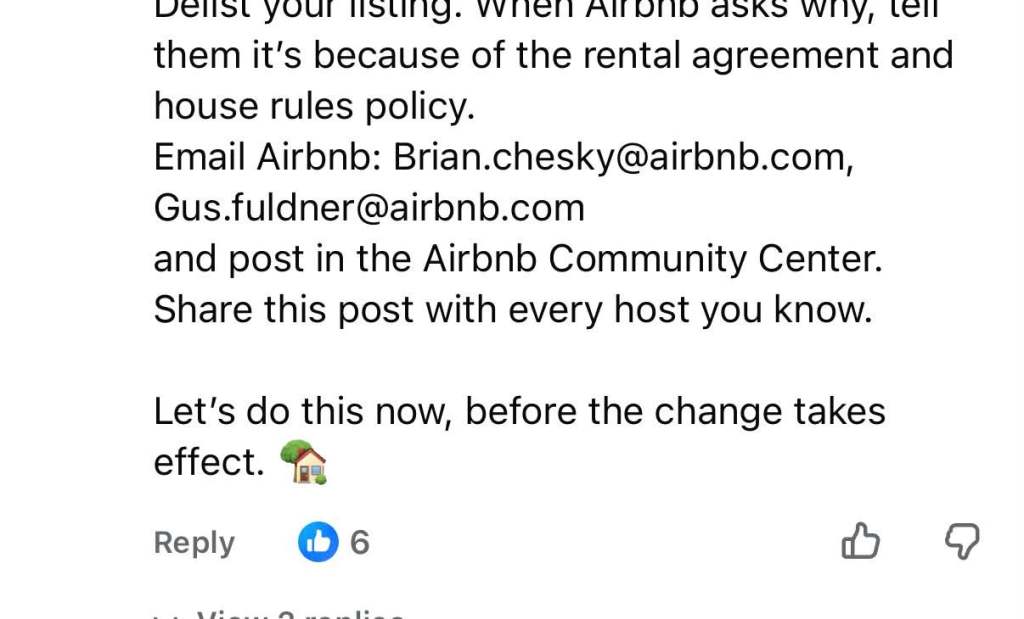
Beyond feedback and trying to get Airbnb to reconsider, I believe that one of the best collective actions in response to this highly unreasonable and absurd tyranny, is simply to rebel en masse, and refuse to follow Airbnb’s new policies. Simply keep the check out procedures that you have, simply keep the house rules that you have, simply keep doing the signed contracts that you need. If Airbnb doesn’t allow you to put your house rules on your listing, there are some options on how to work with that.
WorkArounds and Suggestions
Call your house rules “guidelines” or “house practices” instead of rules, and instead of presenting guests with a list of “house rules”, and telling them they need to follow these, you would ask them if they would be willing to follow the listed “guidelines” or “practices” that you explain in a message, which could include your standard check out requirements such as washing dishes, taking out trash, or what you formerly called house rules, such as no day visitors allowed, no shoes in house, clean up after yourself in common areas, etc. Since Airbnb does allow “requests” you could phrase these as “requests.”
If the guest says no they wouldn’t be able to follow those guidelines or practices, you say okay thank you I don’t think my listing is a good fit for you and you decline their request.
For in home hosts, renting out one or more private rooms, a certain “technicality” may come in handy.
This would be that the guest renting a private room, is not actually renting the rest of your house. Therefore, Airbnb cannot dictate what rules you create for parts of your house that the guest is not renting. Yes the guest “has access to” the kitchen and bathroom, but those are not strictly part of his or her rental, they are areas that you use, other guests use, and so a strong argument can be made (apart from the stronger argument, which is simply the use of common sense!) that you certainly can create rules for parts of your house that the guest is only using with permission, a permission which you could even stipulate in your listing description, could be revoked if “guidelines for use” are not followed.
Eg, used by permission only and only if guidelines for use are followed: bathroom, kitchen, front hallway, front porch, living room, back porch, yards, laundry facilities, etc.
The Rubber Meets the Road
I should also mention that I actually don’t think it will be a big issue, especially for in home hosts, to get most guests to respect your home and follow your rules (not Airbnb’s rules, but yours). I say this based on my experience of hosting and the difficulties I’ve had in getting guests to read the rules before they book. Because Airbnb has in my opinion taken active steps to HIDE your house rules, by setting up their site so that guests cannot even see your house rules unless they click on “show more” by the house rules section of the listing, I would say that 80 to 90% of my guests never read the house rules before arriving. And in spite of that, I don’t have problems with them. I believe this is for several reasons:
(1) I screen guests by checking how they’ve been reviewed, and what reviews they have written, before accepting their request. If there is any indication of an entitled attitude I do not accept them.
(2) I give them a house tour when they arrive, and go around and explain to them the most important “rules” that they follow while here. Such as make sure to clean hair out of tub drain, don’t leave dishes in the sink or on the counter.
(3) I am here to observe their behavior, as are other guests, and even if guests didn’t feel a need to respect me as the homeowner (some are anti-authoritarian people) they would be likely to respect other guests.
(4) Most guests have the common sense to understand the need to clean up after oneself in a shared space, and most guests would realize that they should probably ask me before bringing a friend over. Some do not ask first, in which case they end up being confronted, with me telling them they can’t have friends here, and me sending their friend away.
(5) If guests do not respect your home, even if Airbnb enables their disrespect, what Airbnb cannot do, is prevent you giving them a critical or poor review/rating, and explaining the problem you had with them.
As regards Airbnb’s attempt described above to block hosts from rating a guest down in house rules following except for a very limited number of items: it’s too bad Airbnb is forcing you to click a box that doesn’t apply in order to tell the truth, but that is what you need to do. If guest doesn’t respect your rule to not bring friends or family over to visit during the day, you simply check the box saying “extra overnight guest” or “unapproved pet” and then in the written review say the guest brought unapproved guests.
Airbnb very regularly lets guests lie about their stays, so don’t feel overscrupulous if Airbnb forces you to lie to tell the truth. Return the favor and check the wrong box to give the correct rating.
(6) I predict that Airbnb will eventually realize that taking a draconian approach to hosts and violating our own boundaries in our own homes by telling us what we can’t put in house rules, will eventually boomerang on Airbnb and its guests, when more and more guests start getting bad reviews and ratings.
Because nothing can stop a host from writing a poor review of a bad guest, or one who didn’t show respect by following rules/guidelines/practices as asked, unless Airbnb were to decide that hosts can no longer write reviews of guests. And if Airbnb did that, then that would be their collapse right there, because they’d be depriving hosts of the very last vestige of any possible way to screen prospective guests. They would in fact have completely turned you into their franchise mananger, but also foisted upon you all the possible harm that could come with running a business with no guardrails, while they sat back and reaped all the profits.
And very few “hosts” indeed would remain in such a situation. Even hotels would likely eventually realize they’d be better off and more protected if they had nothing to do with Airbnb.
Summary
As important as Airbnb has been to my entire livelihood, I am close to retirement, and hope that I’ll be able to retire soon, and then see Airbnb utterly collapse as a result of its callousness, greed, and despicable treatment of hosts.