Tag Archives: Airbnb

When To Rate Down or Write a Criticism in a Review of an Airbnb Guest?

Before saying anything else, I should say that I hate the entire Airbnb review and ratings system, and my preference would be, to have nothing to do with it.
The biggest problem with the system, is that Airbnb blatantly lies about the meaning of the star ratings. They describe 4 stars as “very good” but this is not how they interpret a 4 star rating. Their interpretation of the rating system is not at all in line with how they explain it to guests, which is a serious problem for hosts, as then many guests may give a 4 star rating to a host and think they did them a favor, when in fact, they harmed that host with that 4 star rating.

Airbnb interprets the ratings as follows:
5 stars= pass
4 stars or less = fail

I am actually surprised Airbnb has not been sued over their blatant lying about what the ratings mean.

In my opinion, Airbnb should scrap the entire ratings system and leave only written reviews.

The reviews too are problematic because guests frequently lie in their reviews, and use reviews to retaliate against the host, if for instance, the host tried to enforce house rules on the guest, who then became upset that they could not be disrespectful and violate the rules in the property owner’s home. There are any number of reasons why guests might tell lies and retaliate in their reviews.
The problem is that their retaliation is done in such a way, that Airbnb is unable to view it as the retaliation that it is.
So for instance, if you have a no smoking property, and the guest smokes on the property, and you have to tell them not to do that, or the guest booked for one person, but sneaks in a friend to spend the night in your home, and you confront them about that, you’re not likely to be able to get the review removed if they rate you way down for cleanliness because they were upset to be caught in their disrespectful and rule-violating behaviors.


So, All That Said, When to Downrate Guests or Write Critical Reviews?

Unfortunately, guests often do not give a host any clue that they are going to write a critical review or downrate you in their stay. Yes, you will get a clue if you have to confront a guest about following rules, that they are likely to retaliate in the review, but other guests seem completely fine and respectful during their stay, but then stab you in the back after departing.

Even if I suspect that a guest was unhappy about something during their stay, or was upset that I had to tell them not to leave the bathroom a mess, causing problems for other guests in my home, I will not write a critical review of them, based only on my fear that they will downrate me or criticize me unfairly. That would be wrong. I would much rather make the mistake of being overgenerous, than make a mistake I would be ashamed of, such as giving them a less than 5 star review mostly out of anxiety that they would do that to me.

So, I only review and rate guests based on actual observable behavior during their stay, and before and during their stay in their communications, not based on any fears of retaliation that I might have.

It’s So Very Easy to be a 5 Star Guest

Compared to the difficulties hosts face, and the many many ways we are exposed to potential scrutiny and criticism by guests, the hard work we have to put in to keep our homes in top order, especially if we hope to get all 5 star reviews, it is breathtakingly easy to be a 5 star guest. All you have to do is:

(1) Introduce yourself in your initial communications and reply to messages in a timely way
(2) Be honest and respectful and do not engage in entitled behavior, come with reasonable expectations appropriate to the listing you’ve booked, and do not burden or impose upon the host with many requests for help or extra services, as if they were your personal assistant
(3) Let host know about your arrival time and update them with changes
(4) Follow simple instructions and directions
(5) Follow the house rules, including observing check out time
(6) Take responsibility for anything you’ve broken or damaged
(7) Clean up after yourself and leave the space in presentable condition
(8) Show ordinary courtesy during your stay and do not engage in inappropriate behaviors in the host’s home

All of these things are very easy to do. They come quite naturally to “ordinary people with courtesy and common sense.” So the reality unfortunately is, that any guest who has to be downrated or critiqued in a review, was in some way lacking in ordinary courtesy or common sense.

Things Which Would Cause Me to Downrate or Do Wholly/Partly/Gently Critical Reviews of Guests

If I do have to make a criticism of a guest in a review or rating, I attempt to be as generous as possible, unless the guest was way out of line, or quite disrespectful, to the point where I have lost any sense of a need to be generous to them. This very rarely happens. But since this is so egregious when it happens, I’ll mention those issues first.

(1) Guests who observably lack respect for my home, myself, or other guests staying at my home.

This is one of the worst things that can happen to a host, is to find that someone enters your home who lacks a basic respect for you and your home. It feels terrible to even be around such a person. But fortunately, this is also very rare. I believe I’ve only encountered such a situation about a half dozen times in 13.5 years of hosting over 1200 Airbnb guests. The lack of respect can be demonstrated in various ways, such as repeated failure to follow house rules such as cleaning up after oneself in common areas, observation of quiet hours, or showing an unacceptable “attitude” when asked to follow house rules, or making dinner in the shared kitchen while wearing nothing but underwear or a towel wrapped around one’s waist.

I believe that guests like this should be removed from the Airbnb platform. These guests deserve an across-the-board one star rating. This is one of the very rare circumstances when I’d give a guest such a low rating.

(2) Guest has absurd or unreasonable expectations and begins to make a list of complaints based on these absurd expectations

If a guest arrives with absurd or unreasonable expectations, and gives indications that they are going to start causing problems for you based on their absurd mindset, this is another serious problem, and also, a rather rare one. This happens more often than the totally disrespectful guest –I’ve had it happen at least a dozen times in my years of hosting, perhaps more — but having unreasonable expectations, is certainly a kind of disrespect.

These unreasonable expectations could take a variety of forms. It could be that the guest is expecting something that was never mentioned as part of the rental, such as that you’ll pick them up at the train station, that you’ll provide amenities or services which were never mentioned, but “another host provided that to me”, that your house which you described as old and never remodeled, should be new and remodeled, or that your home exists at a nearly impossible level of meticulous cleanliness, every hour of every day, in spite of the fact that multiple guests use multiple common areas multiple times a day, and you cannot be cleaning the house multiple times every day while charging guests the budget rates that you offer.

I’m not talking about a guest complaining that the tub is dirty, after another guest did in fact leave the tub dirty. If that happens, all a guest has to do is tell me and I’m on it ASAP. I’m talking about a guest who appears to be thrown into a state of anxiety or serious concern because “there’s a spot on the floor” or there’s a cobweb somewhere in the house, or they took a plate off the shelf in the kitchen, a kitchen that 1 to 3 other guests use 3 times a day, and found the plate unclean.

If the guest simply registers complaints and is ameliorated and satisfied by my giving immediate attention to the matter, which I most always will do, then this isn’t as serious a problem, though I may still downrate the guest and give a gentle criticism in the review if the complaints were about issues so minor or unavoidable that they were not reasonable, such as that the guest is upset that in the middle of the night they were awakened by the sound of another guest getting up to go to the bathroom. Really?

However if the guest escalates by calling Airbnb to complain, and especially if the guest leaves my house and then demands a refund, that guest is going to get an across the board one star review. Because this is a serious level of unreasonableness and absurdity, as well as a manipulation of Airbnb to be a bully, to help the guest violate the cancellation policy and obtain a refund that they do not deserve, as well as causing Airbnb to scold me over a nonexistent problem.

I work very hard to provide very comfortable, well-kept, and very budget-friendly accommodations in a beautiful older home. I make very clear in my listing description that as an OLDER HOME, and as a BUDGET LISTING, and in a setting with SHARED COMMON AREAS, you cannot expect everything to be new, you cannot expect everything to be fancy, you cannot expect meticulous cleanliness. So if guests read and agree to all of this, and then arrive and promptly complain to Airbnb about the situation being exactly as described, that is an extremely unreasonable guest. This guest, because they are demanding money back that they don’t deserve, and creating problems for you because your listing was what you said it was, in my mind absolutely is deserving of an across the board one star rating.

(3) Guest’s communication is poor

This is the most common problem I have with guests, and sadly, it is also one that is very easy for guests to avoid. It’s that guests fail to read and reply to messages I send to them either in a prompt manner, or for many days or weeks after sending the message. This very often has to do with the fact that the guest is clueless about the need to set up Airbnb notifications on their phone, so they will get notifications and emails when the host messages them. As described here: https://www.airbnb.com/help/article/2893

Often, this begins just after a guest sends a reservation request. I’ll reply to the request with a question, such as “can you tell me a little about yourself and what brings you to my area?” and too often the guest fails to reply at all many hours later, or by the next day, such that I have to decline their request for lack of response.

Other times, the guest replies initially, but then as we approach the date of their arrival, I’ll ask them at what time of day they expect to arrive, and never hear back from them. Just yesterday I had a guest due to arrive, who by 5:15pm, had failed to respond to 3 different messages where I asked her what time she expected to arrive, so that I could arrange to meet her and show her in.

Guests will excuse themselves by saying they do not look at the Airbnb app. Well, as I mentioned above, guests must turn on notifications, so that every Airbnb message they get, is sent to their email. If they have not done this, then they need to be attentive to the app. Either way, if you book a stay with someone, you have to expect they may communicate with you. Sadly, many guests just do not know the basics of how to use the Airbnb website, and this ends up inconveniencing hosts in multiple ways.

Because this happens with so many guests, I actually do not generally downrate a guest or mention anything gently critical in their review about this, unless this lack of communication significantly inconveniences me, or, as happened yesterday, it’s past 5pm on the day of arrival and the guest still has not demonstrated the courtesy to let me know when they’ll be arriving. Yes, self check in is available, but I prefer to check guests in in person, as it reduces the likelihood that they might inadvertently create problems for other guests in shared spaces of my home, if they do not follow certain practices in my house that I go over on the initial house tour.

If I do downrate them or mention anything, I’ll only downrate them to 4 stars for communication, nothing less, and I’ll say in their review that they could improve on communication vis a vis replying within a reasonable time to host messaging.

(4) Guest is not adequately clean in common areas or in their room

This is another quite common issue that I have with guests. That they do not adequately clean up after themselves in common areas, or that in some way the room they stayed in, is not left adequately clean. If this only happens once, or happens in an insignificant manner such as a plate, cup and spoon left in the sink one time, it’s not really a concern. It becomes a concern if it’s a big mess or happens several times: such as leaving the bathtub dirty, or leaving dishes out every day. This is a more serious problem than communication issues, because it impacts other guests as well as myself.

However, because I rent out more than one guest room in my home, and almost always have more than one guest using common areas, it is generally the case that if a mess is several times left in a common area — such as the bathtub is left dirty, or there are dishes left in the kitchen sink, or the stovetop is left with oil splattered on it — I do not know which guest did this. For this reason, I have difficulties with reviews, because I would not want to risk blaming the wrong person for this.

If I do know who is responsible for common areas messes, how much uncleanliness warrants a critical review or downrating?

As mentioned, I won’t downrate someone for simply forgetting to put things away in common areas one or two times. But if it happens several times and I know who is responsible, they will be downrated to 4 stars or perhaps less, depending on the severity of the situation. If I know who is responsible I will immediately remind them of the requirement to clean up after oneself in common areas. This is the only reminder they will get before they will earn themselves a downrating. If after the warning, they continue to fail to clean up after themselves, I will not speak to them about this issue any more, unless they happen to be on a longer stay. I will simply wait until they depart and then rate them down and mention in the review that they did not clean up after themselves in common areas as required. Usually I’ll downrate only to 4 stars, possibly 3 stars, unless the situation appears to be one of manifest disrespect, in which case they will get one star for cleanliness and perhaps also 1 star in the two other categories.

What if the guest doesn’t leave their room adequately clean on check out?

I do not expect guests to leave things in perfect condition when they check out. I only expect a minimal effort and use of ordinary courtesy to leave the room presentable. They don’t have to vacuum the room (unless there are small bits of trash or food all over the floor, which if they used ordinary care, would not occur) , or strip the bed, or make the bed, put towels in any particular place, they don’t have to take out their trash, it’s fine if they leave a cup or dish on the table in their room, it’s fine if they leave food in the refrigerator, it’s fine if there are food crumbs on the table, or a little spilled drink on the table, or a couple items of trash on the floor. None of those things are concerns for me. Where I become concerned or upset are when I find one or more of the following:

(a) Bits of food all over the carpet or in the bed
(b) Significant staining of linens or other damage to the room, which is doubly concerning if guest left things like this without bothering to mention to me the obvious damage
(c) A significant amount of abandoned belongings
(d) Trash can left overflowing, with trash spilling out onto the carpet
(e) The room not left in a presentable manner, such as all the bedding and towels tossed in a random way around the room or onto the floor, or multiple items of trash discarded at random around the room and on the floor
(f) Room furniture has been moved around, in violation of my house rule prohibiting this, and not put back in place
(g) Guest has stuck things to the walls with sticky material that causes paint damage when removed
(h) Any other type of situation that causes the room to be “not in presentable condition” upon guest departure.

To me, leaving the room “presentable” means, a homeowner is not aghast or feeling disrespected at what they see when they open the door and look at the room. One unusual example of a room not being left in a presentable condition, was when I had a guest who had some type of serious skin condition, such that when I opened the room door after he left, I found a carpet and bed that both looked like they were covered in freshly fallen light snow. There was dandruff or dead skin bits absolutely everywhere. I’ve never seen anything like it. This was totally unacceptable to leave a room that way, because it was disgusting.

I realize that people can’t help having this type of physical issue, but the fact that one has such an issue, doesn’t mean others are obliged to accommodate this and be left with a disgusting mess like this in the room. I have a vacuum cleaner readily available to any guest to use, and I expect it to be used if a person like this stays at my home, so that they can leave the room in a presentable condition. However, my perhaps unpopular opinion is, that no one with a condition like this should be staying in someone else’s private home. They should stay in hotels which are more suited for cleaning up after any type of guest.

Many hosts will cry out that hosts are obligated to accept anyone and everything, that being in the hospitality business means you are obliged to accept anyone and everyone’s various types of illnesses or physical, emotional or mental issues. I strongly disagree with that. This is exactly what distinguishes in home hosts especially from hotels, in that we do NOT accept absolutely everyone, we choose who we accept, and people with certain types of problems that would affect a host’s home or negatively impact the host or their other guests, simply do not belong in our home.

Depending upon how badly the room was left after guest departure, I will downrate the guest to 4 or 3 stars. I don’t think I’ve ever had a room left in such poor condition that I had to downrate a guest lower than 3 stars for this issue. I should also mention, that it is fairly rare that I have to downrate any guest because of the room not being left presentable or adequately clean. Most all guests do a decent job on this. But food bits left all over the floor and in the bed is something I find quite disrespectful, especially given that eating is generally done in the kitchen/dining room, not in a bedroom, so that I’m already being generous by allowing guests to eat in their bedrooms, something not all in-home hosts allow. By allowing guests to eat in their rooms, I am implying that care must be taken when doing so.

Sometimes, I may be willing to forgive a guest not leaving the room in a presentable state, however if I had some other issue with the guest as well, such as poor communication, or failure to follow check out procedures, I will then feel like the guest has passed the tipping point where I can simply forgive everything, and I need to downrate them or mention something in a review.

For instance, I recently had a guest who failed to follow the check out procedure I’d just sent to him the day prior to checkout, in a short message. I could tell from looking at the Airbnb message thread, that he hadn’t even read the message. When he checked out, he did not leave the room door open as required, so I had no way of knowing if he’d departed. Meaning I wasn’t able to start cleaning the room on time, especially because when I messaged him and asked if he’d left, he didn’t respond. Finally I just unlocked the room door and found he’d gone, but he’d also failed to leave the keys in the correct place.
So because I’d already had all these problems with him, I then rated him down in house rules following (didn’t follow checkout procedure) and in cleanliness, to 4 stars in each of those categories.

Another thing to mention about this particular guest in this example: when I told him that he hadn’t followed check out instructions, he had the nerve to argue that there was no problem because he simply checked out using the procedure he was asked for in other Airbnb stays! LOL. This guest was literally telling me that he didn’t have to follow MY house rules and procedures, that it was fine if he followed someone ELSE’s house rules and procedures. Idiot! This is a good example of the point I made in my recent article about Airbnb’s new “Your House, Our Rules” policies. How many guests really do not appreciate the very thing that characterized Airbnb in its origins: the uniqueness of each listing and each stay. Too many guests want sameness, not difference. In reality they want hotels in residential areas.

Any guest who thinks that every home should have the exact same rules and checkout procedures, so that he never has to read anything the host has written in listing description, house rules or checkout procedures, should not be staying in private homes. He clearly should be staying in hotels.

(5) Guest is significantly late in checking out

I do not mind if a guest is a few minutes late in checking out. I can usually excuse them being up to 15 or 20 minutes late in checking out, with no feeling that I need to downrate them or mention this in a review, especially if they take an apologetic attitude towards this when I come to see if they have left and find them still packing.

But if a guest is sitting in my kitchen 30 minutes after checkout time, and I ask how it’s going with checkout and the guest says, “I’m finishing my tea, if that’s okay”, while they slowly drink their tea, and giving me a look that suggests I am being viewed as rudely interrupting their morning ritual, that is not okay. This suggests an entitled guest who thinks checkout time is a suggestion, rather than a requirement. And if they are more than 30 or 40 minutes late in checking out, barring any good explanation for this, this is definitely going to be mentioned in their review and lead to downrating them. A good explanation might be something like, “I’m sorry, I just found out my car was broken into” or “Sorry, my suitcase zipper just broke and I’m struggling” or something else that reasonably explains the delay. But the mere fact that they woke up late, or just got out of the shower, or were on a phone call, obviously is no excuse for this violation of check out time.

Another somewhat related matter that leads to downrating a guest and a critical review, is if, as has happened to me more than once, a guest actually arrives a day earlier than his reservation begins, and expects to check in on the wrong day. In both these cases the room actually happened to be available for the guests’ reservation to be altered to add the day, but suffice it to say, it’s never acceptable for a guest to be so completely confused that they arrive a day early for their stay.

(6) Guest books a stay in a private room in a home where the host lives, and shows complete lack of interest in meeting the host, or even seems to be intentionally avoiding the host

I am an introvert myself, so I can easily understand guests who prefer to have privacy or solitude, and not interact much with others in the house. However, there is a difference between liking one’s solitude, and showing zero interest in even meeting the person whose private home you’re staying in, or even worse, intentionally trying to avoid the in home host.

I consider it rude, as well as inappropriate, for a guest to book a stay in a private room in a shared home, where the host themselves lives, and then avoid the host in this way. I can’t always tell if a particular guest is just really busy, or if they are intentionally avoiding me. But sometimes things can occur which make that clear.

If there’s someone staying in my house who arrived late so that they used self check-in, I will always send a message saying that I’d like to meet them the next day to show them around. This is not just to say hello, but also to give them the house tour where I show them where things are (thus preventing the problem of guests interrupting me several times or at inconvenient times asking where things are, that would have been pointed out in a couple minutes on a short house tour) as well as mention a couple important rules about cleaning up after oneself in common areas.

If a guest does not respond to this message in any manner, this does not reflect well on them. It may be the case that they are very busy and do not have time to meet, which is understandable, and if they tell me this, this is fine.

If I’ve not met a certain guest yet, if I happen to see or hear that guest coming or going, that’s usually a good opportunity for me to make a beeline for their room door or the front door of my house, and say hello and introduce myself to them, no matter how uncomfortable this makes them feel. It’s just never acceptable in my mind, to behave as though one can stay in someone’s home and refuse to acknowledge them.

If I do this and the guest is clearly uncomfortable even saying hello to me, or doesn’t even look me in the eye as I’m speaking, or seems annoyed that I am greeting them, this might lead to downrating them and to a criticism in a review, but generally only if this is combined with some other issue. The lack of acknowledgement of the host in and of itself it may not merit any mention, even though it rubs me the wrong way, and may lead to me not accepting this particular guest in the future.

(7) Guest does something that violates house rules and is not apologetic

Generally if a guest breaks a house rule that they didn’t know was a rule, (because they haven’t read the rules like they were supposed to) I forgive them readily if they are apologetic when I speak to them about this. Such as if they are using the kitchen after 10pm. The only time they would get downrated or get a criticism in their review, is if I speak to them about this and instead of being apologetic, they act entitled, and seem to be upset at ME for asking THEM to follow the rules they agreed to in advance of their stay. In which case, depending on the level of entitlement or disrespect I experience from them, they could be downrated anwhere from 4 stars down to 1 star.

(8) Guest engages in behavior which creates problems or discomfort for myself or other guests, such as showing poor boundaries or inappropriate behavior in common areas.

The thing about house rules is that no matter how “long” your house rules list is, you cannot possibly cover every possible issue or problem that might arise with a guest. Still, there is a basic expectation of appropriate and reasonable behavior, use of common sense, and respect for boundaries.

As far as inappropriate behavior by a guest: for instance, if a guest simply opened my or another guests’ bedroom door and walked into the room, violating privacy in doing so, that isn’t something that I have a “house rule” about, but it’s obviously highly inappropriate and violates basic boundaries.

Or, a guest books a stay in your home, and begins to impose upon other guests and host to listen to her sob story about how she’s fleeing from domestic violence, or just broke up with partner, or lost a job and is experiencing depression and anxiety, etc. This is all “TMI” meaning, too much information. All this is oversharing. These are things you talk to friends about, you should not bring all this to an Airbnb and throw it on others. A host wants to maintain a light and upbeat atmosphere in their home, so that it’s not appropriate to overshare or bring “heavy” issues of one’s life and lay them out on the table there. This is just common sense, but again, some guests do not have common sense.

Similarly, guests should not come into the common areas and spill out intimate details of their lives, or start up uncomfortable political discussions that become divisive.

Other examples of inappropriate behavior might be: a guest hacked into my wifi system, that isn’t something I prohibit in house rules, but it would be extremely inappropriate.

Or, a guest has a very strong and bad body odor. Sorry that he has that issue, perhaps he can’t help it, but such a person is absolutely not suited to book a stay in a hosts’ home where common areas are shared with host and other guests, all of whom would be gagging over his horrible stink.

Some guests lack ordinary social skills, or lack common sense about how to behave in shared areas, and for that reason, in my view they should not be booking a stay in a shared home, where they share common areas with the host and other guests. One such issue is what I mentioned above about guests who feel free to wander about the house in a towel or their underwear. (And yes, I have had two guests who did that) Another example is the guest who sings loudly to himself while using the kitchen, which creates an uncomfortable and awkward situation for other guests. (I have had a guest who did that).

Yet another example is the guest who made loud, bizarre cooing sounds to herself while in the kitchen, and also in her room, where she could be heard by others. I did research on this issue and found that some autistic people have this issue. This particular guest had problems with directions, which I discovered could also be related to autism. But my opinion is that people who can’t behave appropriately in common areas and may have bizarre behavior, should not be booking private rooms in private homes where they share common areas with others. Their lack of ability to behave appropriately in shared areas makes them a poor fit for such.

They should be staying in entire place listings only, where their socially inappropriate or bizarre behavior does not negatively impact other Airbnb guests. The mere fact that a guest books a stay in my home, does not oblige them to put up with bizarre behavior from other guests, that they may not understand. And the mere fact that a person happens to be autistic, does not mean that others will not see their behavior as bizarre, or perhaps even experience it as disturbing. At my house, I have to consider the needs of ALL my guests, not just the autistic ones.

(9) Guest needs excessive assistance or cannot figure out simple things

One item of common sense that all guests should understand, is that simply renting a room in my house and use of common areas, does not entitle them to additional services or special-needs assistance. Some hosts would be quite happy to provide extra help to a guest in need of more handholding or assistance, especially if that host is a person who is oriented to helping others. But other hosts, like myself, may have to have a second job, because their hosting doesn’t earn them enough income, or may have a significant vocation or volunteer position which demands much of their time, and will regard it as an imposition if they keep being interrupted during their work day by a guest who can’t figure out something quite simple, like how to turn on the shower, or forgets where just yesterday I told them to store their things, or can’t figure out how to open a lock on a door which I showed them how to do the day they arrived, or how to navigate to a store 5 blocks away, or what restaurant to go to, or whether to have coffee or tea. (I’ve had guests who needed help with all those things) If a guest becomes annoying enough with their special-needs demands, then they may end up being slightly downrated (not more than to 4 stars) and gently critiqued, because this is by no means what the host agreed to provide.

Not every host would have difficulty with this, since some hosts view it as nearly their purpose in life to be of service to others. But just because someone is an Airbnb host, doesn’t mean that they cannot have boundaries or limits, or have to be eager to help any guest in any way needed.

It happens to be the case that being an Airbnb host is a demanding career, not least because you are “on call” all the time, and have to be very responsive to Airbnb messages from guests, either guests who want to book, or those at your home who need help with something. Hence for many hosts, there is always a feeling of pressure to be looking at one’s phone and not missing a message.

For this reason, the fact that any Airbnb message is going to be experienced by the host as an urgency, and will interrupt them in whatever they are doing, hosts who have a lot to do not related to hosting, or who need intensive focus on other work or projects, will be most annoyed by guests who send too many messages unnecessarily, or need more assistance than a guest should need. If a guest cannot figure out something quite simple, such as how to follow simple instructions or directions, or seems to need help from the host to figure out where to go for dinner, or what beverage to have with a meal, this is likely to be experienced as particularly aggravating to a host. And this aggravation will translate to being downrated or critiqued in a review as someone who needs a lot of handholding and extra help.


No Host Can Be Forced To Accept A Particular Guest

As regards this issue with inappropriate behavior from a possibly autistic guest, as well as from other guests who may be narcissistic, traumatized with early childhood wounding, experiencing depression, anxiety, or have some type of mental illness or emotional distress, I already hear some hosts screaming, “Diskwiminashun!! Diskwiminashun!” so I want to address this in a larger context manner.

Due to decades of what has been called “woke insanity” and its propaganda, many have been conditioned to think, that some groups of people are not really responsible for their own behavior. That they are free to do whatever they want, even if it harms or negatively impacts others, because they are in some allegedly oppressed group or minority.
This is BS. And sanity is starting to return to the world, as more and more people reject the woke insane ideologies and propaganda.

Everybody, no matter what group or subgroup they are in, no matter what their ethnicity, no matter what physical or emotional or mental condition they may have, is responsible for their own behavior.
And while it does make sense that people with physical disabilities be accommodated by true “public accommodations” which are places like hospitals, medical offices, schools, government buildings, restaurants, grocery stores and hotels, or large apartment buildings, so that they can at the very least, get into the place or business, no Airbnb host runs a “public accommodation”. Those who say that Airbnb listings are “public accommodations” are either quite misinformed, or they are intentionally spreading misinformation, or they are part of a criminal government system which doesn’t hesitate to spread lies and pass unconstitutional ordinances.

The mere fact that an Airbnb host CHOOSES whom they want to rent to, and that their doors are not open to the public at large to come on in, makes it clear that they are not a public accommodation. And in my view, non-discrimination laws should not apply to any such situation that is not a public accommodation, but is a private home. Regardless what criminals in government or tyrants at Airbnb may say. We private property owners MUST be allowed to and WILL be allowed to choose who we accept at our private home, and can never be forced to accept anyone or any situation which would cause violation of OUR house rules (not Airbnb’s rules imposed upon us) and our own personal boundaries.

I’m going to assert the perhaps unpopular opinion, that (almost) all of Airbnb’s “non discrimination policy” is illegal and unconstitutional as applied to in-home hosts, and that no private property owner can be forced to take into their home, anyone whom they do not want there. I’ve discussed in other articles how the “Mrs Murphy Exemption” applies to us, and how in my opinion, Airbnb is not entitled to deprive us of our rights under this exemption. https://www.payrent.com/articles/mrs-murphy-and-fair-housing-act-exemptions-explained

I’d like to go even further and assert that I believe our rights within our own home are even stronger and broader than what is described by the Mrs Murphy exemption. However, going on about that takes us astray, so that is for another article.

All this said, however: a person with a mental illness or disability, or anyone who behaves inappropriately in social situations (as found in a home with shared common areas), such as someone with autism, is not someone who merely by reason of their inappropriate behavior, should suddenly gain through force of law and nondiscrimination policy (autistic people are considered disabled and thus covered by ADA laws) , the ability to force you to accept them into your home, just by virtue of their being autistic and having inappriate behavior. When stated that way I hope readers can see how absurd that would be.

Summary

In summary, I will say again that the vast majority of reviews I do for guests are all 5 star reviews, and I hate having to rate anyone down, because I don’t want to hurt anyone’s feelings, or cause them problems, and I know how it can hurt to receive criticism in a review.

However, I would not be forced into doing downrating in reviews, if guests behaved appropriately, and/or didn’t book a private room in a shared home, if they knew (or should have known) that they would not be able to behave appropriately in such circumstances.

So if you’re a clueless person who can’t see that you make others uncomfortable singing loudly to yourself in a shared kitchen, or can’t manage to clean up after yourself in the bath or kitchen, then you could avoid negative reviews by just not booking a shared home situation.

Just use common sense, or perhaps get others to help you make decisions if you know you lack common sense, and things will go better for everyone.

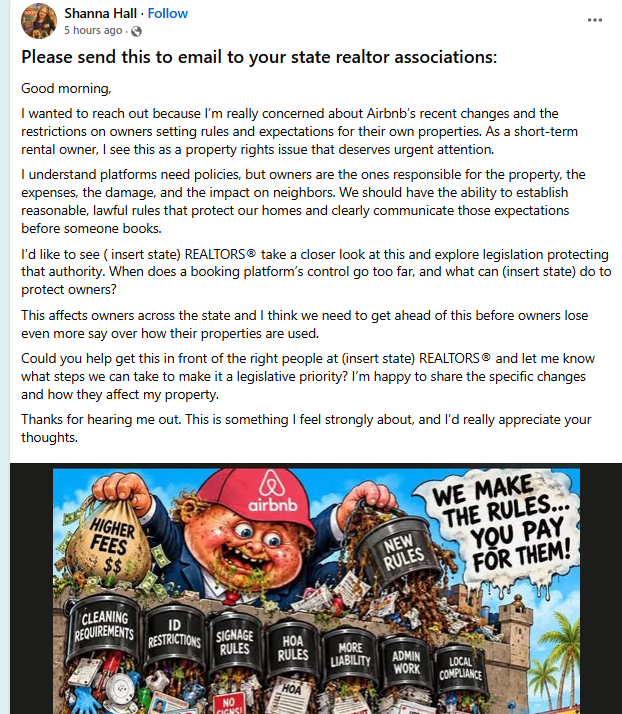
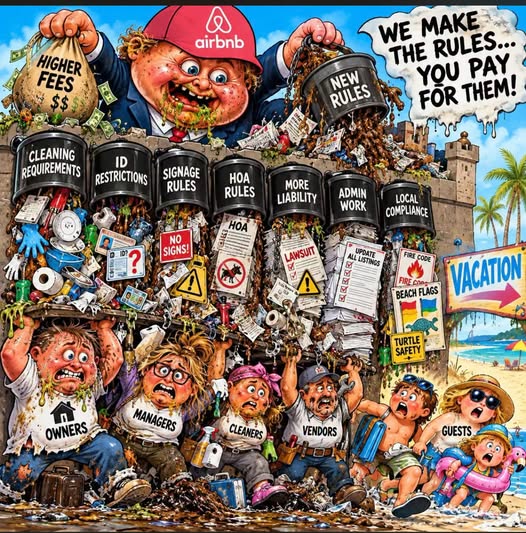
Airbnb Says, “Your House, Our Rules” and Clarifies that Hosts Do Not Run Their Own Homes


In This Article

In this article I’ll provide a condensed history of changes in Airbnb from its inception, describing how it has become more overreaching, more controlling, and finally more tyrannical and totalitarian, especially with its recent policy changes this past week that have so many hosts upset. Then, I’ll explain some options for hosts on how to contend with these changes, either individually or collectively, and provide some tips on “workarounds.”

Airbnb History

I’ve been an Airbnb host for 13.5 years, since early 2013, and have observed the changes in Airbnb since it’s beginning stages. I’ve had the opportunity to observe the host community at large since the early years as well, since I was an early host community leader, running the New Hosts Forum along with Glenn and Andrew on the first iteration of the Airbnb Community Center, which back in those days was simply a motley collection of all kinds of host groups, all set up, run and moderated by hosts. On my Global Hosting Forum, I have a board with some info on early host groups: https://globalhosting.freeforums.net/board/119/history-original-airbnb-community-groups and about early Airbnb history: https://globalhosting.freeforums.net/board/199/early-airbnb-history

After Airbnb shut down those host-run groups, I followed the migration of hosts either onto the Airbnb Community Center (which many hosts didn’t want to use, since Airbnb controlled it and your Airbnb acct would be linked with whatever you posted) or over to independent host Facebook groups or other host forum websites.

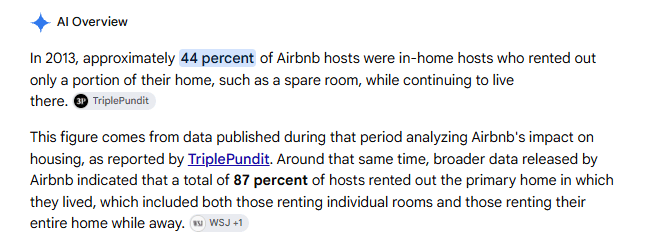
The changes in Airbnb over these years have been quite significant and disappointing to hosts who were around in the early days. We often refer to those fun and exciting early years as “the old days of hosting.” In those days, in-home hosting was much more common than it is now. Those who know the history of Airbnb’s start will realize that Brian Chesky and his co-founders Joe Gebbia and Nathan Blecharczyk rented out an air mattress in their apartment, hence the name “Airbnb”. In 2013, 44% of hosts were in-home hosts, and 87% of hosts were renting out some or all of their own primary residence.

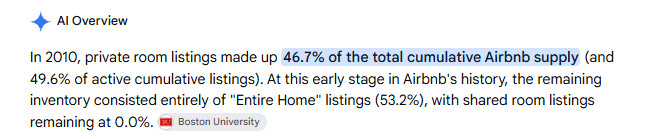
If we go back further in time, the number of hosts renting out private rooms is larger. In 2010, the percentage was 46.7%:

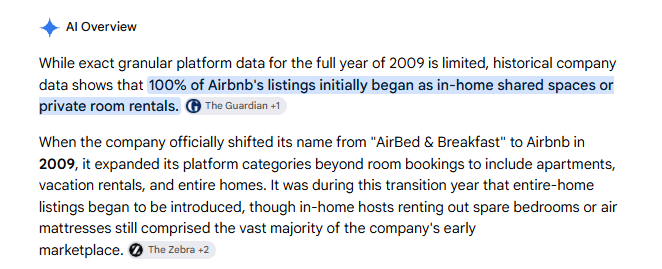
If we go back to 2009, which is a transitional year, the percentage of hosts renting private rooms in their own home was 100%!

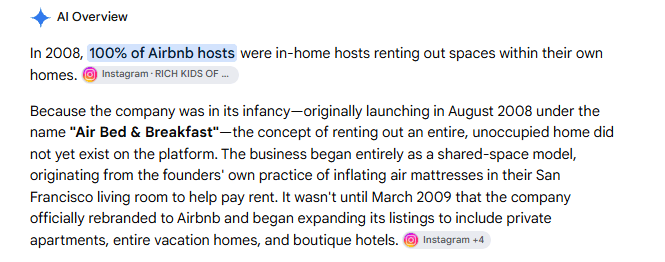
And in 2008, the concept of renting out one’s whole home didn’t even exist yet in the mind of Airbnb, which was founded in 2007.

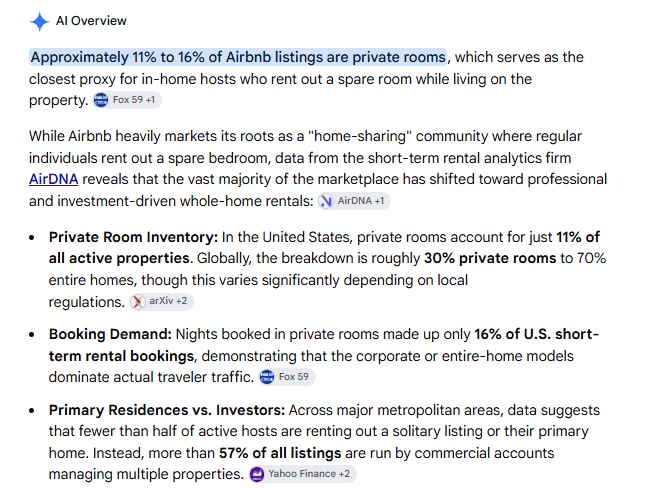
But at this point in time, in 2026, in the US, the number of in-home hosts renting out space in their own primary residence, while they themselves live there too, is much smaller, only 11 to 16%:

Further, whereas in 2013 only 13% of hosts were “investors” who rented out spaces that were neither private rooms in their home nor their primary residence, at this point, 57% of hosts are such “investors.”

Hosts who were around in the early days, and especially those who are in-home hosts, have felt disappointed and even betrayed as Airbnb has changed over the years, because our model of hosting has taken on minority status, and not a minority that earns much respect, either from Airbnb, or the host community, which often behaves, acts and talks as if there are no in-home hosts. The presumption in so many host posts on social media, is that their investor model of hosting is THE way to host. Many are the posts where hosts make assumptions about hosting which simply do not apply to in-home hosts.

So we in-home hosts find ourselves in the odd position of apparently being the standard-bearer of a valuable, meaningful and fun cultural phenomenon that even its originators have long ago forsaken.

Airbnb Shows an Increasing Preference for Hotel Like Listings

Why did Airbnb forsake the in-home host model? What I noticed, virtually from the very start in 2013, was that while on the one hand Brian, Joe and Nate started as in-home hosts themselves, their vision of hosting didn’t really match the reality of a primary residence, or a room rented in a host’s home. To begin with, they were all single men and didn’t own the property where they rented out an air mattress (they were renters of a San Francisco apartment), and hence, they didn’t necessarily have an appreciation of all the concerns that in-home hosts would have renting a room in their home. Concerns such as: if they had a partner and/or children, if they had pets, if they were allergic to pets, if they had valuables in their home, if they had to pay insurance, if they had a pool someone could drown in, if they had expensive furnishings someone could damage, if they had insurance claims for incidents caused by guests, if they were sued, if their home looked lived-in because it was lived in, and the hosts couldn’t afford a maid to clean it every other day, if they weren’t making hosting the center of their lives because they werne’t Airbnb founders, etc.

In other words, even at the start, Airbnb’s founders were relatively insulated and in a position to be ignorant of the real issues associated with home ownership and renting out all or part of one’s own home.

When I looked at Airbnb’s advertising, even early on, I always noticed that its depiction of host’s homes was, shall we say, “airbrushed.” Everything was always perfect: unrealistically perfectly arranged, perfectly clean, and hosted by perfectly attractive people. In fact the homes tended to look not like homes lived in by actual people, but as homes designed and set up just for guests. So, from an early point in time, Airbnb was unfortunately already conditioning guests to expect an unrealistic perfection in Airbnb rentals, as well as creating an expectation to be able to rent homes that were not lived in at all by anyone except guests: meaning, Airbnb listings which were more and more like hotels, rather than primary homes.

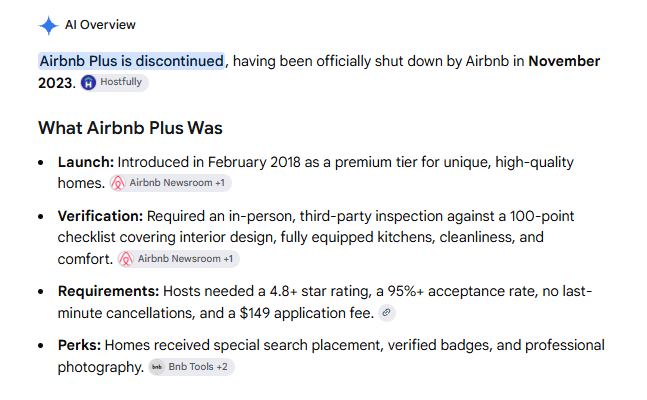
Airbnb’s early ventures into “Airbnb Plus” and “Airbnb Luxe” were further evidence of its desire to emphasize perfection and perfect cleanliness. As described in the AI Overview below, Airbnb Plus featured “high quality homes” which were extremely unlikely to be the host’s primary residence, for the simple reason that virtually no one who isn’t wealthy enough to have a maid on nearly daily service, can realistically live permanently in such circumstances as described. And anyone wealthy enough to do so, really doesn’t need the annoyance and stress that is part and parcel of having Airbnb guests.

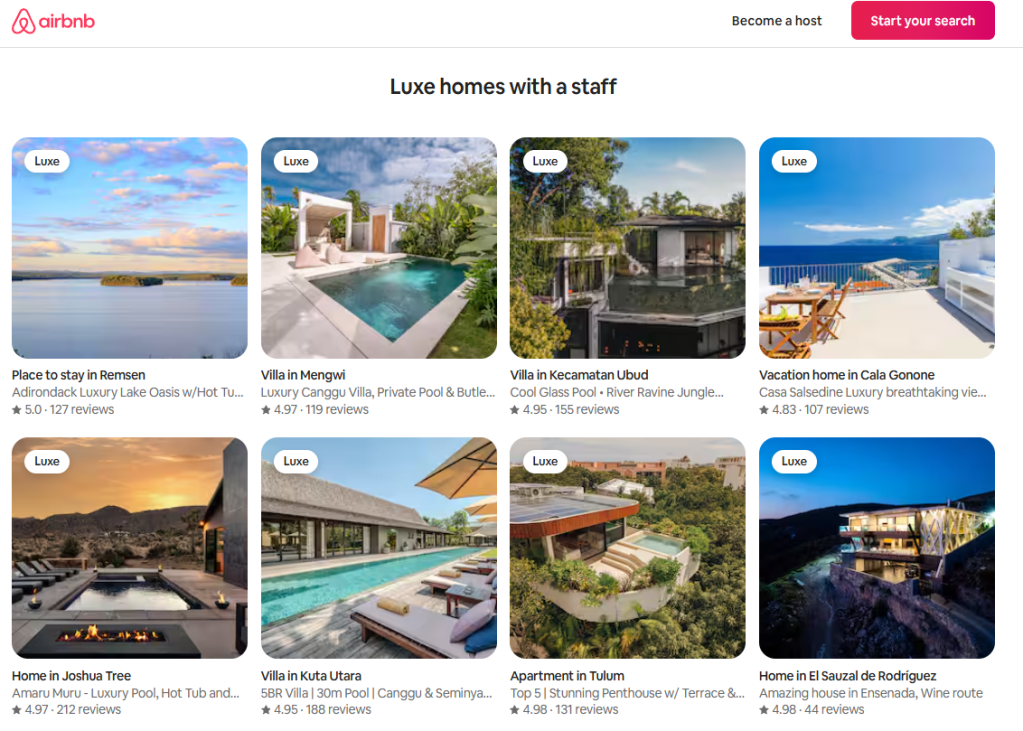
Airbnb Luxe was the next iteration of this kind of emphasis.
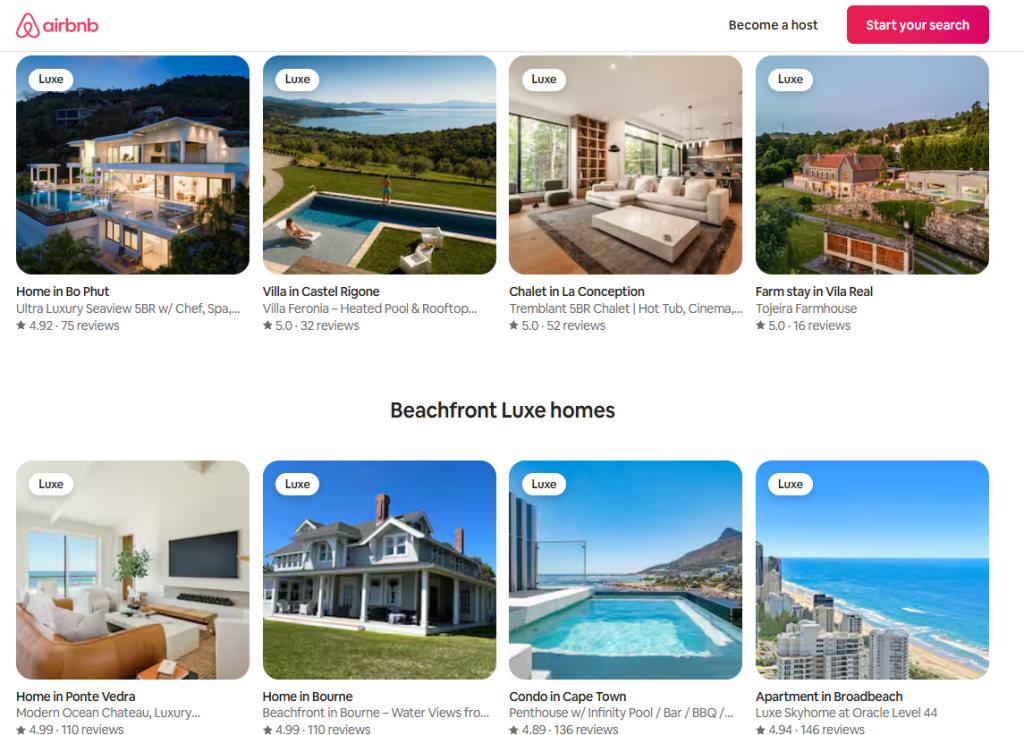
Again, these high-end, spectacular homes are quite unlikely to be the host’s primary residence, and are likely to be entirely investor properties.

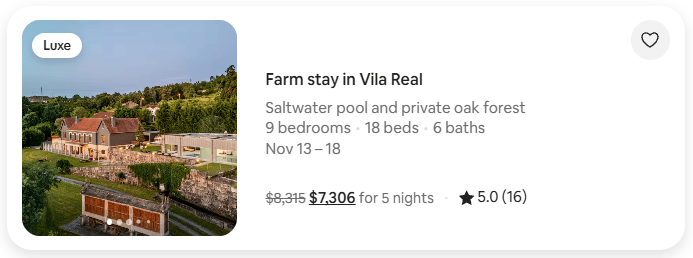
These high end properties are quite expensive to rent, for instance the “Farm Stay in Vila Real” costs $7306 for 5 nights, or $1461 per night.

From early on, in terms of its business structure, Airbnb claimed to be merely a third party payment platform, where it took money from one party and transmitted those funds to a second party, keeping a service fee for itself.

If this were really the case, that all Airbnb was, was a payment platform, then it would never interfere in the host’s running of their own business, and hosts would be free to run their homes as they saw fit, which should always have been the case. As well, if Airbnb were simply a payment platform, it would certainly not function like a court of law and “resolve disputes” between guests and hosts, or decide on things like reimbursements for damages, or refunds for stays that the guest claimed were not satisfactory, or restrict what types of cancellation policies, fees, fines, rules, security deposits or other business related matters a host could set up.

But as time went on, Airbnb increasingly got involved to the point of serious meddling and overreach on all matters related to hosting, including those that were really none of its business, but were really about the host’s own boundaries and needs in their own private home.

Over time, the direction of Airbnb’s increasing meddling, its decisions in disputes, and its own preferences, as seen in ads and other materials, I believe clearly shows a bias towards guests over hosts, as well as a preference for the most hotel-like listings, meaning, investor listings, not those hosting in their own homes.

Analysis of The Development Airbnb’s Preference for Hotel Like Listings and Booking Process

From early on as well, Airbnb wanted to emphasize ease and reliability of booking through Airbnb. Because they wanted guests to have an easy time doing bookings, they introduced “Instant Book”, whereby hosts could set their listings so that a guest could instantly book, without the host having to approve their request and take action to accept them. This made a host’s home very much like a hotel, where pretty much anyone (except those on a hotel blacklist, say, for credit card fraud or serious vandalism) can simply call any hotel and book a room. Foolish were the hosts who failed to see the potentially serious problems with Instant Book. Because there are some Airbnb guests that you really do not want in your home. And try as it might, Airbnb cannot possibly screen guests the way you would, because even the smartest AI used by Airbnb cannot possibly know what your own screening criteria would be.

I had a friend who, not long after Instant Book premiered, was contacted by Airbnb, which was trying to do research on the feasibility of requiring all hosts to use Instant Book, believing, quite arrogantly and impudently, that it had a smart enough AI to be able to do any host’s screening, and ensure that only those guests who passed the screening could successfully instant book a certain home.

This arrogant perspective taken by Airbnb, is just one of many examples of how the “tech bros” who founded the company, have an over-confident and unrealistic view on the ability of tech and AI to replace human thinking and discernment.

Other moves towards a more “hotel like” model came through Airbnb’s overall de-emphasis, in its advertising and content, of in-home hosts, and its emphasis of vacation rentals which were not likely the owner’s primary residence. For instance, if you watch Airbnb commercials nowadays, you’ll see vacation rentals exclusively. For instance, this Airbnb ad created 1 year ago, which represents an Airbnb rental as simply a larger hotel room.

These kinds of ads perhaps less obviously represent another problematic development: they remove the host from the picture altogether. Guests are being conditioned to expect that the host isn’t at the rental and perhaps even think that the host doesn’t belong there.

There were other moves that Airbnb made, which imposed “hotel-like” conditions on hosts who did not want to run their homes as hotels, simply open to any passer-by. For instance, when Airbnb started to hide the profile photo of the guest until after booking was confirmed, claiming that if the host saw what the guest looked like, they might “discriminate” against them. What idiocy this was: as if the only use of a photo is as a basis for discrimination!
Later on, Airbnb also hid most of what guests had written about themselves on their profile, until after booking was confirmed, as if what guests wrote about themselves, was only for other guests to read, and not for hosts? Since guests can choose what to say about themselves on their profile, why in God’s name would this info they willingly convey, need to be hidden from those whose homes they want to stay in?
Too many hosts on the woke bandwagon simply swallowed this nonsense, eager to virtue-signal and further enslave themselves, and argue themselves into having less and less ability to screen any guest.

Another way that Airbnb made host’s rentals more like hotels, was by forcing new cancellation and refund policies onto the hosts, over and above their objections. These cancellation and refund policy changes favored guests. For instance: Airbnb first introduced a 24 hr cancellation window, where guests could get a full refund if they cancelled a stay within 24 hrs. Then that expanded to 48 hrs. As well, Airbnb got rid of the “Strict” cancellation policy for new listings, which stipulated that guests would never get a full refund on cancellation, unless they cancelled within 24 or 48 hrs of booking. After that point, they’d get 50% refund at most. But with the new “Firm” cancellation policy, guests would get a 100% refund if they cancelled over 30 days from check in date. This change was hardest on hosts who tended to get seasonal bookings, such as guests coming for ski season, and who booked far in advance.

Over the years, pretty much every host has realized that Airbnb’s decisions on disputes, by far and away tend to favor guests. This doesn’t mean that guests win in every dispute, but I’ve found that in every case of a guest claiming that my house wasn’t clean enough, Airbnb gave them a full refund at least for days not stayed if they left early, and more recently also an additional 30% refund for days stayed, even though there is no way that a guest can prove that my house “wasn’t clean enough.” A picture of a cobweb or a spot on the floor doesn’t mean the house isn’t clean enough and lacks very basic cleanliness. But that is how Airbnb interprets any guest complaint whatsoever.

Airbnb in all fairness cannot, but does, apply totally unrealistic expectations of absolute cleanliness such as one is likely to find only in a super hygenic operating room or research laboratory to lived-in homes. Again, this shows a pattern of disrespect for in-home hosts and an expectation that all listings are essentially larger hotel rooms.

This brings up the issue of the very divergent viewpoints of guests vs hosts. Especially given the environment, pretty much ubiquitously present all over the world, where there is prevalent (if not omnipresent) animosity between tenants and landlords ( I explain in other articles what I view as the causes of this animosity: they are structural and social causes quite unrelated to property owners themselves) , one can hardly expect that this animosity would not leak over into the guest and host relationship, and contaminate that area as well.

So, Airbnb is put in the position of the environment of this stressed guest vs host relationship, and just like the corrupt and criminal governments which pass unconstitutional “laws” like rent control which favor tenants, and continually whittle away at property owner’s rights (for instance, in Berkeley, California, a property owner is actually PROHIBITED from ever moving into THEIR OWN HOME, if they have had a senior renter, someone over age 65, who’s rented the home for over 5 years: this is so wildly unlawful as to be utterly absurd…) , Airbnb has created policy after policy favoring guests.

Airbnb’s March of Tyranny

Now I want to move on from describing what heretofore has been more a merely hotel-favoring and guest-biased standpoint, and explain how over time, Airbnb has become more overtly a tyrant, taking one step after another which has reduced hosts’ ability to screen guests and even communicate with guests, reducing hosts’ control over and ability to protect their own home, as well as actually taking steps to destroy hosts’ own personal boundaries.

These are changes Airbnb has introduced over the years which tyrannically interfere with hosts control over their business…which Airbnb is increasingly hinting, is not actually their own business:

*Hide guests’ profile photo until after the guest books
*Hide most all information about the guest which the guest themselves has written on their Airbnb profile, until after guest books
*Hide from hosts the reviews guests wrote about other hosts and other stays
*Hide guests’ phone numbers from hosts
*Allow guests to use pseudonyms when booking, so you may not even know the real identity of the person who stays at your home (imagine trying to call the police or emergency services and saying, “this person staying at my house, I don’t know who they are….” )
*Allow guests to post reviews which include lies and false claims, and dishonestly represent their stay
*Start deducting “depreciation” from reimbursements paid to hosts for damages to their property by guests
*Stop paying hosts for certain types of linen damage
*Not allow hosts to use any cancellation policy of their own choosing, but require them to refund guests for cancelled stays in the way Airbnb dictates
*Support guests’ false claims about the condition of the rental so that they can get fully reimbursed for their stay over and above hosts’ objection, without ever providing a single iota of evidence to the host about these claims that supposedly justified a full refund. It should be obvious that no court in the land operates in this way, only listening to one side, and refusing to show evidence to both parties.
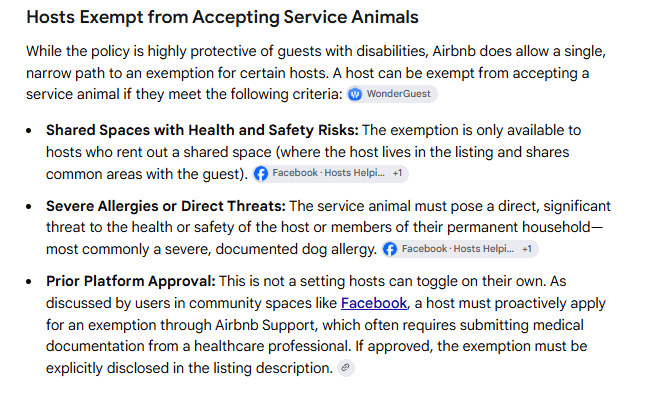
*Apparently require that even in-home hosts who are lawfully exempt from accepting service animals (because they rent fewer than 5 rooms), accept service animals, unless they meet the 3 criteria listed here, including providing a doctor’s note explaining that they are allergic to such.

On the service animal issue: It is quite unclear what Airbnb’s position would be, if it were not the host who needed an exemption and provided “medical documentation from a health care professional”, but rather, if it were another Airbnb guest, in a home where the host has more than one guest at a time. And, any guest could be allergic, at any time.
In any case it is utterly absurd that a guest can bring a service animal without even needing to provide documentation that it is in fact a service animal, but the host isn’t allowed to refuse to accept a service animal, unless the host has documentation, even when US law (ADA law) allows the host to refuse to accept service animals.

It should also be mentioned that Airbnb set up a rating system which they explain very dishonestly to guests. In the rating system itself, Airbnb explains that 4 stars means “very good”, but the reality is, as some hosts have discovered to their great dismay, any host who averages a 4.0 star or lower rating, will be removed from the Airbnb platform due to unacceptably low ratings. Both the written review and rating system are far more impactful upon hosts than on guests, since as a guest it’s extremely easy to get an all 5 star rating. You simply have to be considerate and follow the house rules, and leave the place clean. Easy peasy. Hosts have no reason to be vindictive towards guests and backstab them with poor reviews, if they were decent guests. As well, hosts understand that Airbnb has distorted the rating system, to where, in contrast to how they explain it, the way Airbnb interprets the ratings is 5 stars= pass, 4 stars or less = fail. So hosts who understand this rating system are less likely to “fail” guests than are guests who don’t understand how Airbnb lies about the ratings.

Guests do often backstab their hosts, for instance, as I’ve experienced, giving a host 3 stars for communication because the host said no to a request for being exempted from some house rule, or rating the host 1 star for cleanliness because the host had the audacity to talk to the guest about leaving a mess in the bathroom, which affected other guests.

But even guests who mean no harm to hosts, cause harm by not understanding the rating system at all. I recently had a guest request to stay, and as usual, I went to look at the reviews hosts had written for her, and made use of AirReview, a Chrome Extension app that allows hosts to see the reviews prospective guests have written about other hosts listings. I saw that she’d given a 4 star rating to a host in my area, but her written review of this host was glowing and favorable. I asked why she gave him a 4 star rating. What she said revealed the basic problem with guests’ ignorance. She said she gave him a 4 star rating because his home needed remodeling, meaning, major renovation. Nope. I told her this was totally unreasonable, that in essence she went to a car rental lot, rented a Toyota Corolla, and then gave the car rental business a low rating because the car she rented wasn’t a Porsche. “You do not fucking do this,” I felt like yelling at her. That host never claimed his home was a Porsche. His listing description clearly said “Toyota Corolla.”
I declined this guest with a tongue-lashing about her actions that harm others simply for having the homes that they have.

Apparently, Airbnb doesn’t care if guests lie about the condition of the listing or anything else, and guests lie a lot. Because this is a known problem that Airbnb is confronted with on a daily basis, the best way to deal with this would be to ditch the rating system altogether, since backstabbing ratings are not only meaningless but harmful, especially if Airbnb takes action to punish hosts based on the lies of a guest who was upset when asked to take responsibility for himself, clean up after himself, or follow the house rules. If the system only included written reviews, and both hosts and guests could reply to reviews, then the potential for harm due to dishonesty and baldfaced lies would be vastly mitigated. But Airbnb doesn’t care to mitigate harm to hosts, they seem only concerned with pleasing the guests.

Airbnb Finally Comes Out and Says the Truth Hosts Have Suspected All Along: “Your House, Our Rules.”

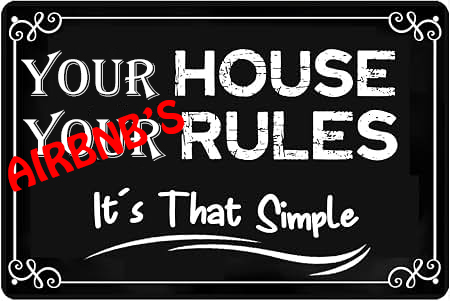
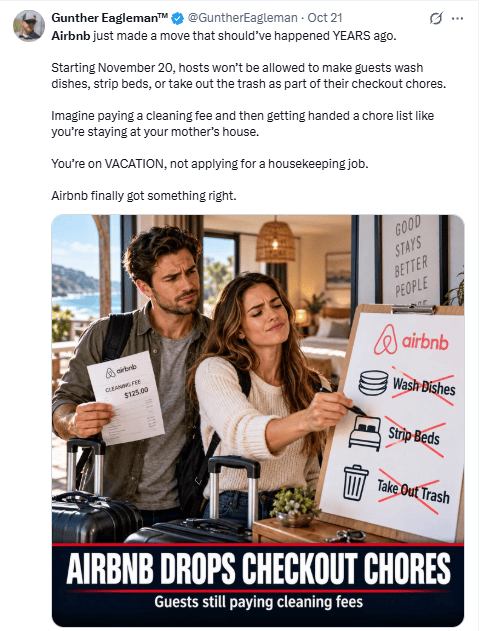
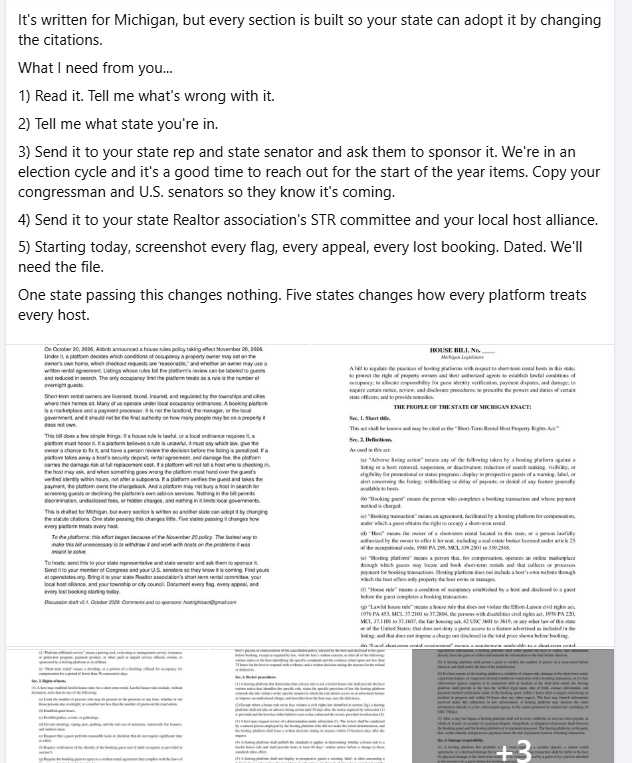
Just this last week, Airbnb made a tyrannical move that has upset even some of the most dyed-in-the-wool Airbnb brown-nosers, schills, apologists and cult members. It issued policy changes which prohibit hosts from requiring guests to complete “check out chores” https://apnews.com/article/airbnb-guests-checkout-chores-new-policy-24a2d80b09ae1fca77d0411c6a08dddd, but the bigger and much more unreasonable move, was that Airbnb is totally overhauling its position on other things, such as prohibiting hosts from requiring guests to sign a rental agreement (required by some insurers) or changing house rules, to where it now will not allow hosts to set up their own house rules! https://www.usatoday.com/story/travel/2026/10/22/airbnb-hosts-policy-change-pushback/92383744007/ and https://www.airbnb.com/resources/hosting-homes/a/important-changes-to-house-rules-21

Let me provide some context on house rules, based on my 13.5 years of hosting and participation as a leader in the host community.

Hosts tend to fall more or less into 2 camps: those who believe in minimal house rules, and those who, often because of significant problems they’ve had with guests in various areas, have found it best to be as clear as possible to create the right expectations in guests before arrival, and thus have longer house rules.

The more experience one has as a host, the more likely one will perceive the need for additional house rules, because one has seen issues arise, and because the basis of contract law in all business, is that you can only enforce the terms of the contract, not things which aren’t mentioned in the contract. Which means that if a guest “assumes” they will be able to use the kitchen at your private home, and you haven’t communicated to them in advance that they are not allowed to use the kitchen, then if they complain to Airbnb that you didn’t say in your listing description or house rules that kitchen use isn’t allowed, you don’t have a leg to stand on. The guest will be refunded and you also might end up punished for disallowing kitchen use when you never communicated about that.

Ditto with countless other possible iterations of what you decide is or is not allowed at your home. Having a rule in writing, and being sure the guest read all the rules prior to booking, isn’t absolutely necessary, but can be useful in the case of a dispute. Because a contract is valid whether or not both parties read all the terms of the contract.

All that said, I can appreciate that long lists of house rules can feel onerous to guests, and be off-putting.

However, the simple solution to that, which hosts have repeated ad nauseum but guests somehow cannot comprehend, is that no one is being forced to stay at any particular home, and a guest who doesn’t like “long house rules lists” is in no manner obligated to book at a home that has those! Problem solved, right?

The beauty of Airbnb has been that you can book what suits you.

However, the additional problem for guests has been a failure of their own responsibility. The fact that they don’t want to put in the work to find what suits them. And Airbnb, which has always sided with guests, has taken their enabling of guests’ refusal to do their due diligence, to new extremes.

In spite of Airbnb’s original vision and uniqueness being in that it offered unique stays, all kinds of different stays, in different homes, with different hosts, the problem is that guests have actually not wanted difference. They’ve wanted sameness. In essence, they’ve wanted hotels. “I’ve come for the lower price, and the neighborhood location, but make it just a bigger type of hotel.” They want predictability, quick booking, ease of access, ease of everything, and really no responsibilities at all, not even to wash their own dishes after their meal, apparently.

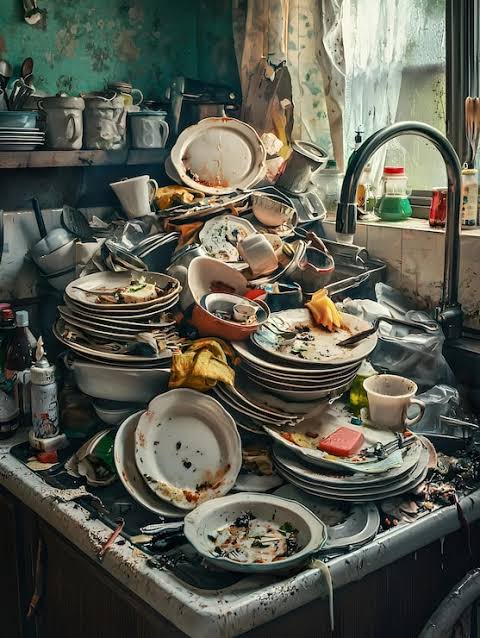
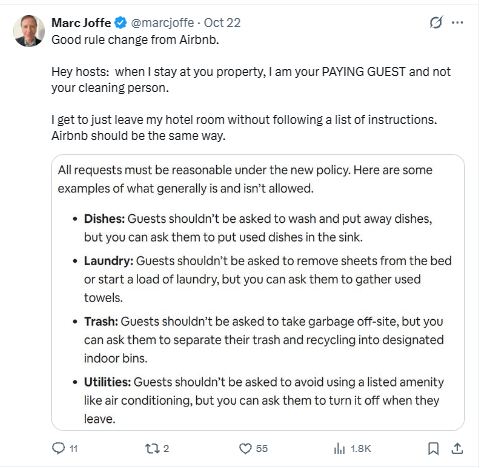
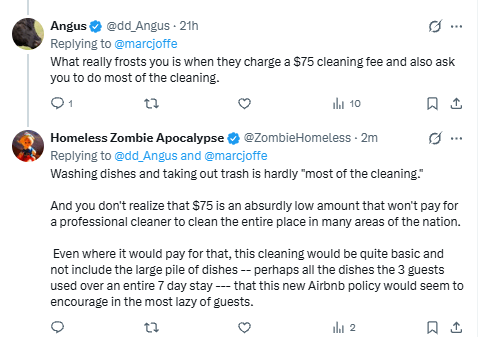
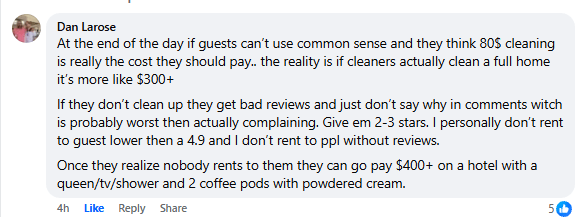
Because the thrust of Airbnb’s first change, was that upon checkout, guests can no longer be required to wash their dishes, strip the beds, or take out the trash. Of course, this brings up another matter, which is whether by exempting guests from such “checkout chores”, guests will decide that they are totally exempted from washing any dishes at all throughout their entire stay, and leave a pile of dishes in the sink that extends halfway to the ceiling.

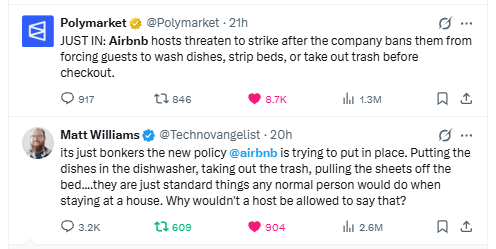
People who have never been hosts, only guests, may delight in this change by Airbnb, as I saw evidence of in some social media posts.

And:

And:

As if it weren’t bad enough to slap every host in the face by telling them they can’t set their own check out procedures in their own private home, Airbnb then stomped every host in the world into the mud under its boot, by dictating that as of November 20th, no homeowner or host is allowed to set their own house rules. Ah, they finally are revealing the totalitarian corporation that they really are, drunk on their own power. Perhaps it should be a relief that Airbnb finally comes out and openly admits what they have really been all along: a pack of arrogant tech-bro people drunk on power, control and their own egos, and not caring at all for the hosts and homes upon which they built their empire. This is particularly significant, and particularly despicable, because for everyone who owns their own home and has tenants, visitors or guests, there are perhaps few sayings that as aptly represent their maintenance of their own boundaries in their own home, than the saying, “My house, my rules.” But now Airbnb has replaced that saying, with a new saying, which goes, “Your house, Airbnb’s rules.”

This new policy, more than anything else Airbnb has ever done, more than any other tyrannical move, clearly demonstrates that Airbnb no longer allows hosts to run their own homes, or their own businesses, but are now being viewed as mere franchise managers in Airbnb’s gargantuan hotel chain.

Life is about boundaries, healthy relationships are about boundaries, good business relationships are about boundaries, and certainly, tenant and landlord and host and guest arrangements, are about boundaries.

By saying that you can no longer make your own rules in your own home, Airbnb is telling you that you cannot have your own boundaries. Not only is this despicable business practice, but it is the stance of a narcissist, predator or psychopath. And some would say, that with this move, Airbnb has become openly narcissistic or sociopathic.

It was ironic to me, to go onto social media, and see that some of the same people whose general stance is pro-freedom, anti-tyranny, anti-big government, who believe in reducing regulation and government control, are now cheering Airbnb’s tyranny, because they feel advantaged by this as guests. The big bully Airbnb is going to whip those hosts and homeowners into line, forcing the property owners to do their bidding and be slaves to their will, and invite guests to have much more freedom and fun, while hosts bear the costs of this and the harm from this idiocy, as well as having their own property rights, boundaries and basic ability to run a business completely trampled upon.

Folks: here’s a clue. If you are opposed to tyranny, you need to see it and oppose it even when, and perhaps especially when, it seems to work to your advantage.

Airbnb Limits Host to 7 House Rules

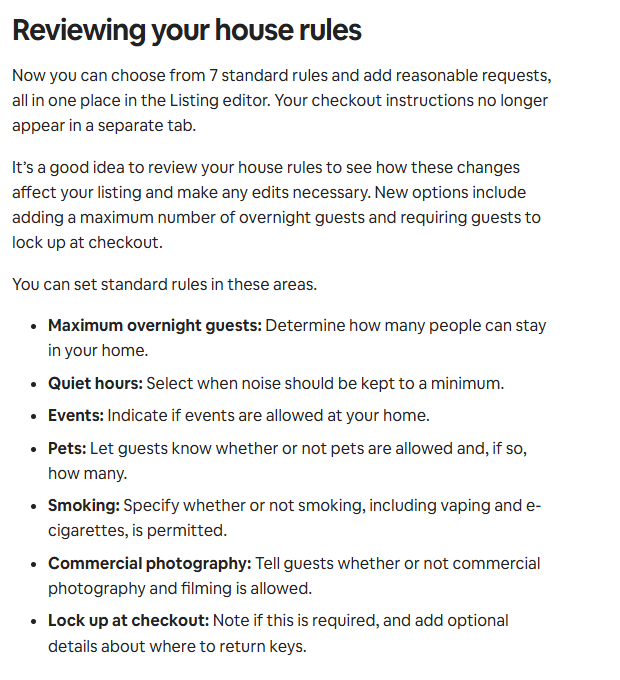
As of November 20 2026, all Airbnb listings worldwide, both entire place listings and private rooms, both investor-hotel listings and hosts’ own primary residences, will no longer be able to use their own house rules.
They can only select from 7 possible house rules, https://www.airbnb.com/resources/hosting-homes/a/important-changes-to-house-rules-21 as follows:

The first thing that stands out for me when I look at this, is that this makes no sense whatsoever, and is utterly absurd, as applied to in-home hosts who do private room rentals. And the second thing that stands out, is that this would be totally unacceptable to many of the home insurers who provide vacation rental insurance for hosts who rent out entire places, as it apparently disallows hosts that their own home insurer dictates are required as a condition of their coverage.

Let’s examine these two situations in more detail to look at all the absurdities.

In Home Hosts Doing Private Room Rentals

Even though only 11 to 16% of hosts do this kind of rental now, Airbnb apparently intends to impose the house rule limitations on these hosts and listings too.

Imagine how ridiculous it would be, for instance, if you were a host like myself, who either shares common areas with 1 or more guests, or has more than one guest room so that common areas were always shared, and you were told you could not have a rule requiring guests to clean up after themselves in common areas. This would be so absurd that it would be virtually unbelievable, to think Airbnb would either say you could not have such a rule, or that Airbnb was so stupid that it created a new policy to apply to every host in the world, without having even thought of this type of situation and factored that in. Obviously, a guest refusing to clean up after himself in shared areas would be creating serious problems not only for the host but for other paying Airbnb guests.

There are countless other situations where a host may need to create a rule because they’ve had an issue. For instance:

You’ve had damage to your hardwood floors caused by guests wearing hard soled shoes or heels in your home, or found that guests who do not remove shoes before coming in can readily track in dirt and mud, so you have a shoes-off policy in your home. Is Airbnb really going to insist you can’t do this?

Because you have more than one guest using common areas, you’ve set up designated storage spaces for guests to use, labeled with their room name, and tell guests to use those areas only for their things. Is Airbnb really going to tell you that you can’t prohibit a guest from using other guests’ storage areas?

Because you’ve had problems with past guests walking around in common areas in their underwear, or half-naked, and making breakfast with just a towel wrapped around their waist, making other guests uncomfortable, you have a rule that guests need to be fully clothed in common areas. Is Airbnb really going to say you can’t do that, that guests have the right to prance around half naked in your home if they so desire?

Because you’ve had problems with some guests thinking that they can just adjust your home thermostat whenver they want, without asking you, you have a rule that guests cannot do this, and that in fact, you’re not likely to adjust the thermostat on request for an entire 3 story house, where this guest is only one out of 5 people present in the home: himself, 2 other guests, and yourself and your partner. Rather, you’re going to tell this guest that he is getting what he paid for, and no, he’s not going to require me to pay 50% more for heating for by raising the temperature in the house all day and all night long, but rather that he needs to put on additional clothing if he is “freezing” when the indoor temperature is 68 degrees Fahrenheit or 20 degrees Celsius.

Because you’ve had problems in the past with guests staying only a few days at your home, using your home address to set up their bank account, or as their permanent DMV address or for other official business, you have a rule stating that guests may not use your address for such things, or to receive mail. Is Airbnb really going to say you can’t stop a guest staying 3 days from using your address as their permanent DMV address?

Say that you want your home as a quiet refuge — both for yourself and for other guests — and market it as such to guests, so that you do not allow guests to bring business clients over to your house, or bring friends or family over to socialize or have dinner in your kitchen. Because these things create too much noise and commotion, and would mean that you cannot honor your promise to one guest that he will have a quiet retreat like experience, if another guest brings over two or three friends and engages in loud socializing. Is Airbnb really going to tell you that you’re not allowed to have the intention of making your home a quiet retreat, that you cannot set your own boundaries about who enters your own home, but one guest has to be allowed to do whatever noisy thing they want to do, even if this causes problems for you or another paying Airbnb guest?

You offer laundry facilities to guests, but have had problems with guests who overuse the laundry, such as by doing a load of laundry every 2 days, even every day. So you create a rule that guests may not do more than 2 loads of laundry per week. Is Airbnb really going to say that you cannot have a rule about this, but have to permit the guest to do however much laundry they want to do, with no limit?

Or, you are a host who lives in an area where marijuana is legal, but you hate the smell of it, as do many of your guests. So you have a rule that anyone bringing marijuana to your home must keep it in an airtight container. Is Airbnb really going to tell you that you cannot do this, and anyone must be allowed to make your home smell vile with their weed, ruining not only your own experience in your own home and violating your boundaries, but also creating a problem for other paying Airbnb guests?

There are any number of unique situations that in-home hosts especially could find themselves in, where they need to create a rule to try to prevent problems, not only for themselves, but for other guests. Though most guests by far and away are reasonable, a few are not, and it certainly helps if you have a rule in place so that everyone can (if they choose to read all the details, which many do not) understand in advance exactly what their contract entails (this is what contract law in business is all about) , as well as to confront them with, when they are doing something that is quite inappropriate.


Insurer Requirements

Now consider the situation of a host who has an entire place listing, who is told by Airbnb, that she cannot impose certain requirements on guests, which are dictated by her insurance policy, or which interfere with her ability to adequately maintain her home.

To begin with, as I mentioned before, a guest who is enabled by Airbnb that they do not have to wash dishes, may consider this as license for them to refuse to wash any of their dishes on their entire stay. Such behavior could create a problem with pests, which could be attracted to food bits and crumbs that accumulate on unwashed dishes. As an example of this, a recent guest only spilled a small amount of soda on a table in my guest room, but even that small amount attracted a few ants, which I found entering the room through the window. Multiply that by a factor of 10 or 20 or more, with a whole pile of unwashed dishes, and you can readily see this could invite ants, fruitflies, roaches, even rodents and more into a home, to the point where the homeowner now has to pay pest control to come take care of the problem.

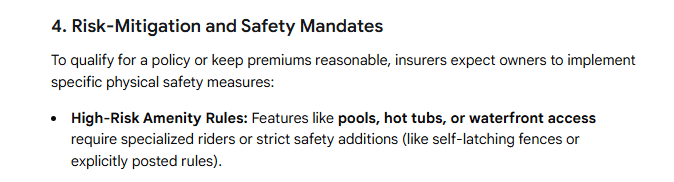
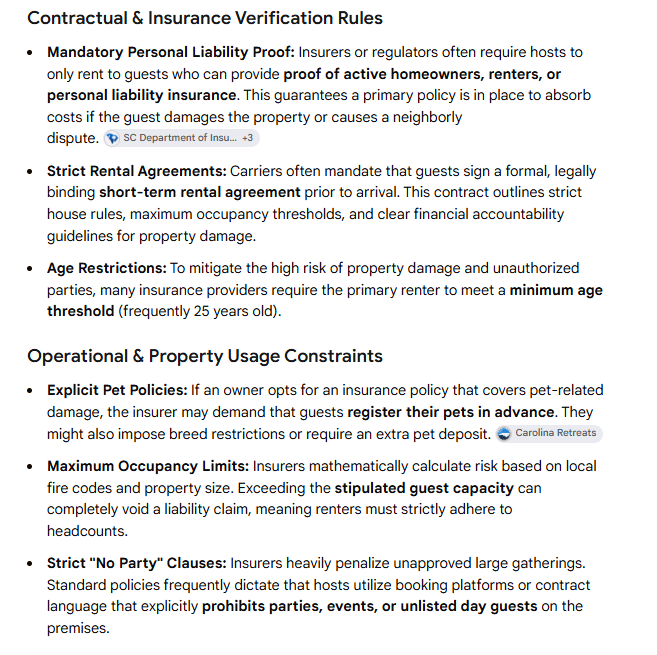
Many home insurers impose certain requirements on hosts when they insure vacation rental properties, as a condition of coverage. Is Airbnb really going to tell hosts that they cannot run their properties as their home insurer requires?

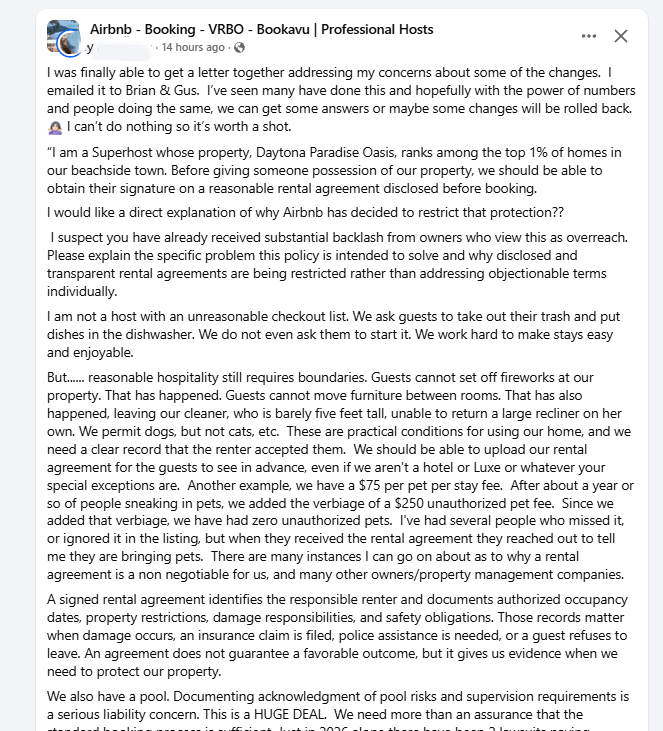
Examples of types of requirements are things like “explicitly posted rules” on pools and hot tubs or waterfront access, which Airbnb’s new policy would prohibit. Or, requiring guests to sign a contract. Among its sweeping tyrannical list of changes, Airbnb is now prohibiting hosts from having guests sign contracts, except for those legally required or required by an HOA. They apparently do not make an exception for what is required by home insurers.

Some home insurers require the renter be 25 years of age or older, but Airbnb’s changes would seem to prohibit hosts from a rule that they rent to guests only 25 or older.

Some home insurers disallow unlisted day guests, but Airbnb won’t allow hosts to prohibit day guests, and only allows a rule be set on overnight guests.

As well, some hosts have pointed out that they need a signed contract with guests, in case a problem arises that may require legal or police intervention….which is not provided by Airbnb.

Hotels Are Worse off on Airbnb

Even hotels are worse off listing on Airbnb, than in operating independently. Sure, you can get bookings from Airbnb, but you can’t protect yourself as well on Airbnb. Hotels can charge a fee if someone breaks the no-smoking rules and smokes in the unit, which can require the hotel to do extra work to air the place out. Hosts would no longer be able to charge a fee for this, in connection with Airbnb’s other restrictions on hosts.

But…There’s More…

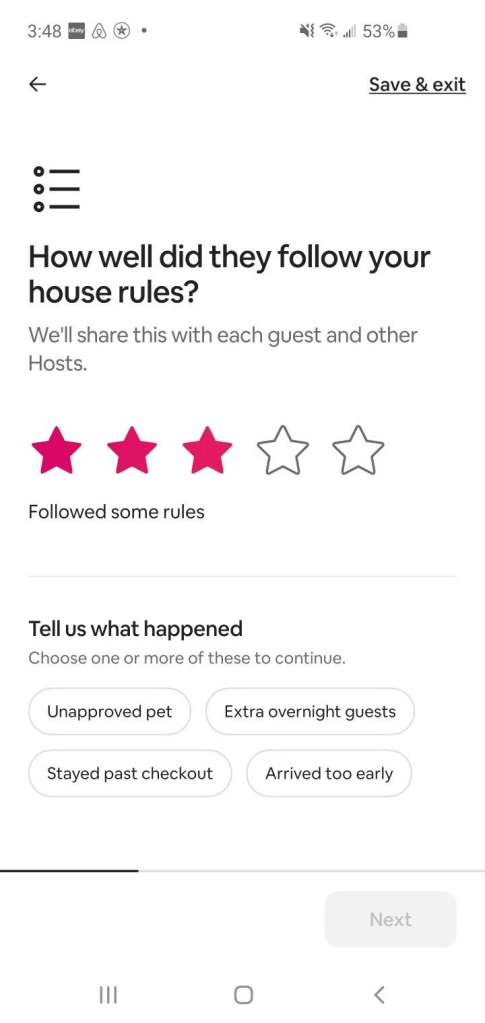
Even though Airbnb had said these new policies would not come into effect until November 20th, some hosts are reporting that even at the present time, they’ve found that when doing a review of a guest, they are unable to rate the guest less than 5 stars, unless they check one of 4 boxes, none of which may apply.

So, obviously this doesn’t work, if you have other rules that the guest didn’t follow.

In fact, this is doubly absurd, because the 4 options listed do not even cover all of Airbnb’s new 7 rules that they “allow” guests to have. For instance, if they didn’t observe quiet hours, if they had an event at the place, if they smoked, did commercial photos at your unit, you would not be able to rate them less than 5 stars in following house rules.


Hosts are Almost Universally Outraged

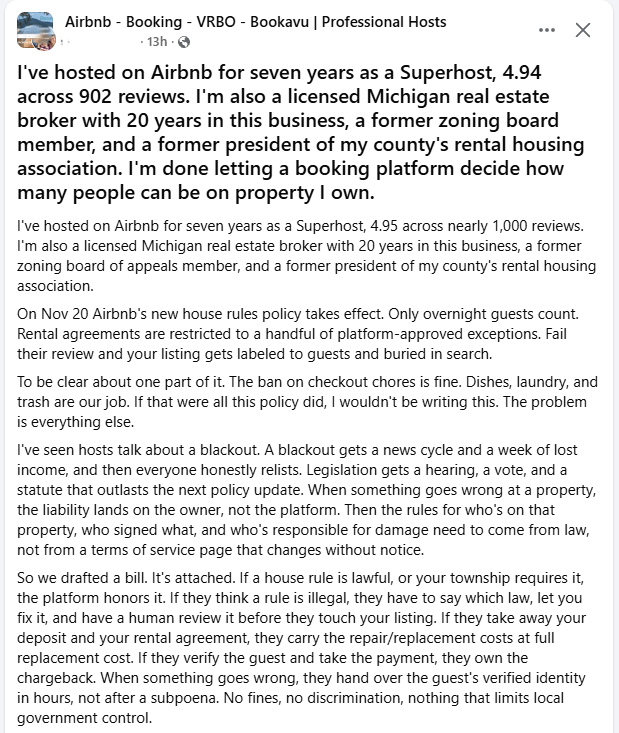
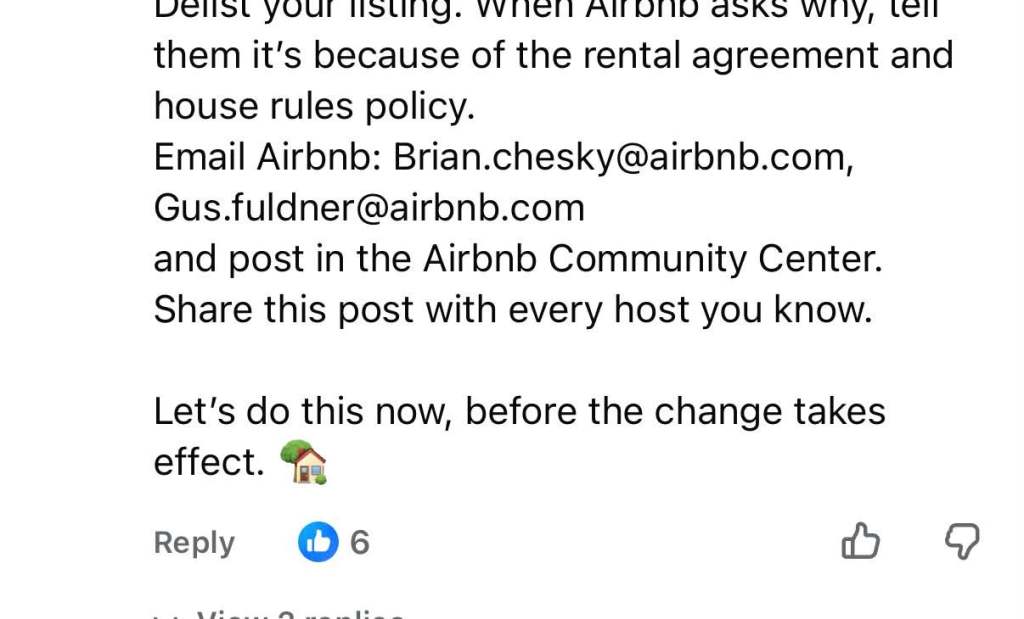
While not every host is upset over these Airbnb changes, the overwhelming response to Airbnb’s new and draconian overreach, is outrage. More are talking, and talking seriously, about leaving Airbnb, than I’ve ever seen before as a reaction to any other Airbnb move. Hosts are talking about boycotts, collective actions, lawsuits, and more.

I think that host feedback to Airbnb about their outrage is quite important, as are other individual or collective actions that are in service of getting Airbnb to reconsider these incredibly stupid and tyrannical moves.
If anyone is interested to do so, you can contact Brian Chesky, Airbnb CEO, and Gus Fuldner, Global Head of Airbnb Operations, here:


You can also send feedback to Airbnb here: https://www.airbnb.com/help/feedback

Beyond feedback and trying to get Airbnb to reconsider, I believe that one of the best collective actions in response to this highly unreasonable and absurd tyranny, is simply to rebel en masse, and refuse to follow Airbnb’s new policies. Simply keep the check out procedures that you have, simply keep the house rules that you have, simply keep doing the signed contracts that you need. If Airbnb doesn’t allow you to put your house rules on your listing, there are various options on how to work with that.

WorkArounds and Suggestions

Call your house rules “guidelines” or “house practices” or “requests” instead of rules, and instead of presenting guests with a list of “house rules”, and telling them they need to follow these, you would ask them if they would be willing to follow the listed “guidelines” or “practices” or “requests” that you explain in a message, which could include your standard check out requirements such as washing dishes, taking out trash, or what you formerly called house rules, such as no day visitors allowed, no shoes in house, clean up after yourself in common areas, etc. Since Airbnb does allow “requests” I believe you could phrase these as “requests.”

If the guest says no they wouldn’t be able to follow those guidelines or practices, you say okay thank you I don’t think my listing is a good fit for you and you decline their request to stay.


For in home hosts, renting out one or more private rooms, a certain “technicality” may come in handy.
This would be that the guest renting a private room, is not actually renting the rest of your house. Therefore, Airbnb cannot dictate what rules you create for parts of your house that the guest is not renting. Yes the guest “has access to” the kitchen and bathroom, but those are not strictly part of his or her rental, they are areas that you use, other guests use, and so a strong argument can be made (apart from the stronger argument, which is simply the use of common sense!) that you certainly can create rules for parts of your house that the guest is only using with permission, a permission which you could even stipulate in your listing description, could be revoked if “guidelines for use” are not followed.

Eg, used by permission only and only if guidelines for use are followed: bathroom, kitchen, front hallway, front porch, living room, back porch, yards, laundry facilities, etc.

The Rubber Meets the Road

I believe the hosts who are most harmed by the new Airbnb tyranny, are those renting out entire place listings. Since the host is not there on site to see what is going on, these hosts need to implement more extensive means of protection and control over their properties, such as are gained by ID being shared in advance so that background checks can be done, by signed rental agreements, check out procedures involving cleaning dishes and taking out trash, But Airbnb would now disallow all of that.

I should also mention that I don’t think it will be a big issue, especially for in home hosts, to get most all guests to respect your home and follow your “requests” or rules (not Airbnb’s rules, but yours). I say this based on my experience of hosting and the difficulties I’ve had in getting guests to even just read the rules before they book. Because Airbnb has in my opinion taken active steps to HIDE your house rules, by setting up their site so that guests cannot even see your house rules unless they click on “show more” by the house rules section of the listing, I would say that 75 to 90% of my guests have not read my house rules before arriving. And in spite of that, I don’t have problems with them. I believe this is for several reasons:
(1) I screen guests by checking how they’ve been reviewed, and what reviews they have written, before accepting their request. If there is any indication of an entitled attitude or a tendency to give low ratings to hosts, I do not accept them.
(2) I give them a house tour when they arrive, and go around and explain to them the most important (but few) “rules” pertaining to day to day activities, that they follow while here. Such as make sure to clean hair out of tub drain, don’t leave dishes in the sink or on the counter. There are other rules I have on my house rules list, such as no use of incense, candles or space heaters in the house, no mail can be sent to my home, etc, but I don’t mention these to every guest, and will only talk about this if a guest asks about using a space heater, or I smell incense in the house, or the guest asks about having mail sent to my home.
(3) I am here to observe their behavior, as are other guests, and even if guests didn’t feel a need to respect me as the homeowner (some are anti-authoritarian people) they would be likely to respect other guests.
(4) Most guests have the common sense to understand the need to clean up after oneself in a shared space, and most guests (but not all) realize that they should probably ask me before bringing a friend over. Some do not ask first, in which case they end up being confronted, and an awkward situation develops with me telling them they can’t have friends here, while their friend is standing in my house. For those who really want to bring friends over to their Airbnb, there are other places where that is allowed. Book one of those. I just don’t want the awkwardness or discomfort of suddenly finding people in my own house who I do not know, and don’t know how they got in here. Capiche, Airbnb?
(5) If guests do not respect your home, even if Airbnb enables their disrespect, what Airbnb cannot do, is prevent you giving them a critical or poor review/rating, and explaining the problem you had with them.
As regards Airbnb’s attempt described above to block hosts from rating a guest down in house rules following except for a very limited number of items: it’s too bad Airbnb is forcing you to click a box that doesn’t apply in order to tell the truth, but perhaps that is what you need to do. If guest doesn’t respect your rule to not bring friends or family over to visit during the day, you simply check the box saying “extra overnight guest” or “unapproved pet” and then in the written review say the guest brought unapproved guests, or you write a vague reference stating that guest violated important house rules, was disrespectful, etc.
Airbnb very regularly lets guests lie about their stays — in fact, sometimes it seems Airbnb invites guests to lie about their stays— so don’t feel overscrupulous if Airbnb forces you to lie to tell the truth. Return the favor and check the wrong box to give the correct rating.
(6) I predict that Airbnb will eventually realize that taking a draconian approach to hosts and violating our own boundaries in our own homes by telling us what we can’t put in house rules, will eventually boomerang on Airbnb and its guests, when more and more guests start getting bad reviews and ratings.

Recall the screenshots I posted above, of the guests who were elated that hosts could no longer tell them to wash their own g-damn dishes before they left? Yeah, if Airbnb’s policy changes go through as planned, those guests will be on the receiving end of the outrage of thousands, perhaps millions of Airbnb hosts, and will quite likely be sufficiently downrated that no host will accept them again. Rule, request, guideline, whatever the frick you call it, if any guest thinks they can bully around a host in their own property, they’ve got another thing coming. This kind of disrespect is why so many property owners got out of long term rentals, where corrupt and criminal governments have codified into thousands of unconstitutional ordinances, the whittling away of property owner’s rights. Short term rentals are the “last stand” of these owners, and they are sure as heck not going to allow Airbnb and a bunch of entitled and infantile guest-renters to collectively cause them to lose control of their own property.


Really there is nothing that can stop a host from writing a poor review of a bad guest, or one who didn’t show respect by following rules/guidelines/practices as asked, unless Airbnb were to decide that hosts can no longer write reviews of guests. And if Airbnb did that, then that would be their collapse right there, because they’d be depriving hosts of the very last vestige of any possible way to screen prospective guests. They would in fact have completely turned you into their franchise mananger, but also foisted upon you all kinds of harm that could come with running a business with no guardrails, while they sat back and reaped the profits.
And very few “hosts” indeed would remain in such a situation. Even hotels would likely eventually realize they’d be better off and more protected if they had nothing to do with Airbnb.

Summary

As important as Airbnb has been to my entire livelihood, I am close to retirement, and hope that I’ll be able to retire soon, and then maybe see Airbnb utterly collapse as a result of its callousness, greed, and despicable treatment of hosts. I’d love to see a new short term rental platform emerge, which doesn’t get drunk on its own power as Airbnb has done.


How Much Racism and Discrimination Actually Exists?

This is a longer read, but it’s very relevant to the existence, and imposition upon everyone, if a whole litany of “nondiscrimination” policies by Airbnb and other corporations. So bear with me through the relatively long introduction.

The entire premise of the ubiquitousness of so many “nondiscrimination” policies that are found everywhere these days, from government, to corporations (including Airbnb, which is the reason for this post here) , education, and beyond, is that there is so much racism, prejudice and discrimination out there, that governments and corporations must be active to work to prevent it.

But what if that entire premise is flawed? Or if it’s actually fictional, a fake “problem” created entirely by the leftists who’ve constructed the “wascism, wascism everywhere” narrative, because they appear to NEED racism in order to force their authoritarian “solutions” to racism on everyone?

Some would find it offensive to even suggest that the phenomenon of widespread racism, “institutional” anti-black racism, was a fake phenomenon, totally manufactured by fake, fraudulent and criminal entities, like the Southern Poverty Law Center.

However the truth that many of us have realized for many years, is now publicly emerging with more force and clarity than ever. I think we are still at the “tip of the iceberg” stage, in terms of it being revealed to the public how much lies, fraud and propaganda has been fed to us through the leftist controlled, CIA controlled mainstream media, and criminal organizations masquerading as nonprofit agencies, like the Southern Poverty Law Center. As many of us have already deduced, there is an entire, gargantuan apparatus that’s been constructed to lie to us and indoctrinate us, for decades, with the intent of brainwashing us sufficiently to move our entire nation, and the world, towards a future of communist style totalitarianism, under the guise of “social justice” and imposing “final solutions” for the problems this crime syndicate has been been working so hard to manufacture for decades, such as the fakery of racism racism everywhere, the mess of homelessness, drug addiction and crime it has intentionally created in its intentional destruction of cities, and an affordable housing crisis it has engineered, and the inflation it has wrought via the criminal Federal Reserve, and more.

Just this past week the FBI and DOJ announced the indictment the Southern Poverty Law Center on 11 counts of fraud and conspiracy to commit money laundering.

Just this past week the FBI and DOJ announced the indictment of he Southern Poverty Law Center on 11 counts of fraud and conspiracy to commit money laundering.

For those dimwits claiming that the SPLC was simply “paying informants” to get information from these groups: realize the SPLC is not permitted to do this. They are a nonprofit, not a law enforcement agency. They are not the FBI. They’re not permitted to “pay informants.” And as info comes out, we will see that this is not what they were doing. They were in fact attempting to manufacture and support the very types of extremism, hate and racism that they claimed to be fighting. And in my view, they will not be the only nonprofit agency found to be doing this.

https://nypost.com/2026/04/22/us-news/southern-poverty-law-center-accused-of-secretly-paying-ex-kkk-imperial-wizard-as-informant/

As well, if they were somehow paying informants in a lawful manner, they would not have had to create shell companies to do this.

It turns out that the Southern Poverty Law Center, while claiming to be fighting the “far right”, was actually, literally funding neo-Nazis, the KKK, and the white nationalist supremacist groups it claimed to be fighting.

These indictments were brought by a grand jury.

l

The “Charlottesville” rally in 2017. lies about which were used to smear President Trump, was organized by an organization the Southern Poverty Law Center funded.

And

As it turns out, the leftists NEEDED more and more racism, in order to justify their authoritarian policies and massive “anti-racism” campaign (which in reality has been a massive, racist anti-white campaign). But because so little racism and hate actually existed, they had to manufacture racism and hate. This can be summed up as Elon put it, “Incentives explain outcomes.” Whatever is incentivized, continues to exist or increases in its existence.

Other Twitter posts where Elon talks about this theme of how what is incentivized, will appear. This is one of those elements of logic and common sense, that liberals have not yet been able to grasp.

Namely, that whenever you pay “nonprofits” to END some phenomenon or problem in the world —such as homelessness, drug addiction, crime, racism, hate — whatever — you simply strongly incentivize them to CONTINUE and MAINTAIN that phenomenon or problem. Or, to PRETEND the problem is bigger than it is. This is just a logical conclusion one can reach through basic understanding of cause and effect. Organizations, unless truly altruistic, do not want to put themselves out of business by solving the problem they were created to address. And if you spend and spend and see you’re not causing a dent in the problem (as with the billions spent on homelessness in California for decades) this is a big clue that this incentivizing phenomenon is at work.

https://x.com/elonmusk/status/2047757400866963632
And
https://x.com/elonmusk/status/2002605302932517339
And
https://x.com/elonmusk/status/1973628335487127753

The nonprofits want the business, they want the jobs, and most of all, they want to leverage “wascism, wascism everywhere” in order to continue to steal from Americans and impose their ever more authoritarian solutions on America, and the world (this kind of theft and fraud is happening in all western nations).

As well, the leftists in government (and many branches of government have for a long while now, hired ONLY leftists) have structured the system with fraud, such that they could funnel an enormous amount of money to nonprofits which created whatever type of problem, or propaganda, they needed to further their agenda, which was to move us collectively ever closer to a communist totalitarian future where “You will own nothing and be happy.”

This has been the plan of the global crime syndicate, the Cabal, for quite some time now.

Thus, we’ve seen billions be spent to combat homelessness throughout California and the West coast especially, all the while, homelessness has increased massively. It’s bizarre to me that some people simply accepted this, never questioning what was happening to our money. As it turns out, massive fraud on a scale never before seen, is now being discovered in California, in Minnesota, and will be found, I predict, in connection with government at every level, as well as many if not most nonprofits. WE began finding this fraud via the Department of DOGE in the federal government in early 2025. Then we found massive fraud in Minnesota, such as in relation to nonexistent “Learing Centers” for children. Now more than $180 billion in fraud has been found in California, the biggest fraud in the history of our nation. Nonprofits paid to help the homeless, diverted money to their directo rs and staff to buy luxury cars, expensive villas, costly vacations and jewels. Recently, it was discovered that 500 of 500 hospices in California were fake. Some of these had offices in abandoned buildings, one had been set up in a burrito shop. Californians have been stolen from on an unprecedented and jaw-dropping scale. As has the entire nation of taxpayers. It’s becoming quite clear that we have lived for our entire lives in a nation run by criminals installed in government at every level, thieving from us throughout our lives, 6 ways from Sunday. It would be idiotic, amidst all this fraud that’s been revealed, to think that there has not also been organized election fraud occurring, at every level. Meaning not only have we had our money stolen from us, we’ve had our votes and our entire nation stolen from us by these criminals.

It’s likely going to turn out that many states people have for decades thought were “blue” states, like California, were never blue at all. Rather we’ve just had decades of election fraud, as the criminals have attempted to impose their lunatic leftist authoritarian regime upon us, their totalitarian communist nightmare whose extreme “solutions” are predicated upon the fake “problems” (like racism everywhere, homelessness everywhere, out of control crime everywhere) that they themselves have created, just in order to demoralize people and lead people to accept their totalitarian solutions.

What too many fail to realize, is that it was the Democratic party, not the Republicans, that started the KKK, and fewer Democrats than Republicans were in favor of the Civil Rights Act. Today’s liberals do not understand history.

docs.house.gov/meetings/JU/JU00/20210414/111451/HMKP-117-JU00-20210414-SD002.pdf

Anyone using their brains, should have been aware for some time now, that the media, Democrats in government, corporations, institutions everywhere, have blathered on nonstop about “right wing extremism” and the supposed danger of the “far right”, whilst these have been totally silent on the dangers of the far left. This has been especially idiotic since the vandalism, violence, criminality, and assaults that we have seen, as well as the vast majority of “hate” we have seen, has been from the left, not the right. This was seen very clearly in what’s been called the “Summer of Love”, summer 2020, when BLM and Antifa wrecked havoc around the nation with vandalism and violence with the George Floyd riots, where thousands of brainwashed nincompoops protested violently over a drug addict criminal who died of a drug overdose. Thus, those who were thinking clearly, should have realized that lies and propaganda were being deployed to intentionally brainwash the public NOT to see that it was the left and Democrat run governments who were the cause of so many problems they saw in their society, while the entire apparatus was blaming the “far right.”

Many leftie bumblebrains and dweebledorks have lately been wailing about so-called authoritarianism and fascism in Trump and the Trump Administration. They have no idea what Constitutional law is. These are the same mindless obedient sheep who didn’t blink an eye when a truly authoritarian government shut down the world in a scamdemic lockdown, and unconstitutionally, tyrannically, forced people to wear masks, and get Covid jabberdoos, which were never real vaccines. Sit down you retards. You cannot recognize real fascism when it locks you up in your home during a fake pandemic and tramples your rights from here to doomsday.

To sum it up again: the lefties who’ve been screaming at Trump, MAGA, conservatives and Patriots for years, calling us “Nazis”, are turning out to be the very Nazis they have been screaming about.

And this type sign they put up in their yards, insinuating that Trump voters are supporting a Nazi or totalitarian regime, boomerangs on them, and their pointing blaming finger, is pointing right back at them. 

Some of Us Have Known This For Years

The sad thing about the exposure of the Southern Poverty Law Center fraud, is that many of us have known for years, decades even, the general jist of the fraud being perpetrated by these leftist organizations, and really all the woke insanity and leftist propaganda that’s been used to deceive people about the nature of our society and world. We’ve known for a very long time that there is actually very little racism, hate, white supremacy, white nationalism, Christian nationalism, or other “far right threats” to our society and the world. We’ve been able to look past the smoke and mirrors, the fraud, the lies, the propaganda, and see the truth. Our society is overwhelmingly NOT racist: except for the way that the woke insanity spreading over the nation has created an ugly anti-white racism around the nation and the world. There has been an entire industry of making up lies to use to hate on white people. (And, sadly, a large number of white people are complicit in this anti-white industry built on lies and hatred). And we are just about done with this shyte right now.

This Twitter post video sums things up pretty accurately. The Southern Poverty Law Center, whose staff is largely black at this point, is exploiting white guilt, to rob white people blind, to fund Nazis and White Supremacists, in order to manufacture hate and racism, because they don’t have enough of it to exploit for their lying, criminal, fraudulent purposes.

What Does This Mean for Airbnb Hosts?

So that’s a long introduction, but is necessary in order to finally get around to the question of what this means for Airbnb hosts.

The upshot from all that I’ve presented here, is that the very basis for DEI policies and nondiscrimination policies of any kind, is questionable, given that so much “discrimination”, and racism, that’s been alleged, likely does not exist. Think about how much control Airbnb has justified having over you, and how much it’s intentionally hidden from you (you can’t see guest profile photos before the guest books, all because of the myth, really the LIE, of “wascism, wascism everywhere”). What if you found out, as you are finding out now, that it looks like this whole big “discrimination/racism” phenomenon is totally fake, and has been manufactured, JUST in order to justify an increasing level of control over you by governments, corporations, education systems….and Airbnb?

It’s been surprising to me, and very disappointing, to have observed for many years now, how so many people, generally those on the left, have failed to deploy adequate critical thinking skills. They’ve failed to notice that an increasing level of control and authoritarian policy has been enacted over them, by governments, corporations, and education systems, ostensibly for purposes of “social justice” and to combat hate and racism, as well as supposed threats to public health, like the fake Covid “pandemic” which was really a scamdemic or more accurately, a Plandemic. Because all this was supposedly done for “social justice” and to protect public health, these mindless people, generally leftists, failed to question these authoritarian moves, and now, quite bizarrely, they hurl accusations of “authoritarian” against the first man and administration to stand against all this fraud, indoctrination, trampling upon your rights and criminality, President Trump and the Trump Adminstration.

What the left is going to have to face, and it will be quite uncomfortable, is that they literally ARE the Nazis that they have thought all along they were fighting against. They have voted for the Nazis, they’ve funded the Nazis (Southern Poverty Law Center is a darling organization to the lefties, and it’s promoted and funded racism and hate for many years while claiming to fight these), and they have believed the lies and propaganda of the Nazis. All the while they’ve been manipulated by the koolaid they’ve drunk, to hate the very person and administration which is finally working to free them from these Nazis.

Wake up folks. The entire premise of heavy-handed “nondiscrimination” policies in Airbnb or really any corporation or government agency, has been based on lies, propaganda, and fraud.

And…beyond that…the fake racism accusations, the institutional racism fakery, all this fraud, has done enormous damage on not only a national, but a global scale.

Xenia and Theoxeny

Hosts  like to say that Home Sharing is as old as the story of Mary and Joseph in Bethlehem. Actually it is older. It occurs to me that the subject of receiving guests at one’s home, and the theme of hospitality, must be a theme in many an ancient myth. So I set out to find some.

I found a few ancient gods (pagan deities, pre-dating Mary, Joseph and Jesus) associated with hospitality.

Empanada was the Roman Goddess of Hospitality:
www.thaliatook.com/OGOD/empanada.html

Empanada

And Nephele was the Greek Goddess of Hospitality:

en.wikipedia.org/wiki/Nephele

Nephele is the seated figure here

As well,  Zeus in his role as Zeus Xenios was the protector of travelers. In the Odyssey, we read:

zeus

Zeus is the protector of suppliants and guests
Zeus Xeinios, who attends to revered guests


Xenia, the ancient Greek concept of Hospitality

en.wikipedia.org/wiki/Xenia_(Greek)

From WIKIPEDIA:

Xenia (Greek: ξενία, xenía, trans. “guest-friendship”) is the ancient Greek concept of hospitality, the generosity and courtesy shown to those who are travelers who’ve wandered far from home, or who may be the associates of the person bestowing guest-friendship. The rituals of hospitality in Greece created and expressed a reciprocal relationship between guest and host expressed in both material benefits (such as the giving of gifts to each party) as well as non-material ones (such as protection, shelter, favors, or certain  rights).

The Greek god Zeus is sometimes called “Zeus Xenios” in his role as a protector of travelers.  He represented  the religious obligation to be hospitable to travelers. Theoxeny or theoxenia is a theme in Greek mythology in which humans demonstrate their virtue or piety by extending hospitality to a humble stranger (xenos), who turns out to be a disguised deity (theos) with the capacity to bestow rewards. These stories caution mortals that any guest should be treated as if they were a hidden divinity and help establish the idea of xenia as a  Greek custom. The term theoxenia also covered entertaining among the gods, a popular subject in classical art, which was revived at the Renaissance in works depicting a Feast of the Gods.

Xenia consists of two basic rules:

(1)The respect from host to guest. The host must be hospitable to the guest and provide him/her with food and drink and a bath, if required. It is not polite to ask questions until the guest has stated his/her needs.
(2) The respect from guest to host. The guest must be courteous to the host and not be a burden.
Xenia was considered to be particularly important in ancient times when people thought gods mingled among them. If one had poorly played host to a stranger, there was the risk of incurring the wrath of a god disguised as the stranger. It is thought that the Greek practice of theoxenia may have been the antecedent of the Roman rite of Lectisternium, or the draping of couches.

While this particular origin of the practices of guest-friendship are centralized around the divine, however, it would become common practice among the Greeks to incorporate xenia into their customs and manners for very much all of ancient Greek history. Indeed, while originating from mythical traditions, xenia would very much become a standard practice throughout much (if not, all) of Greece as customarily proper in the affair of men interacting with men as well as men interacting with the Gods.

Xenia in Homer’s Odyssey

Xenia is an important theme in Homer’s The Odyssey. Every household in the epic is seen alongside xenia. Odysseus’ house is inhabited by suitors with demands beyond the bounds of xenia — in other words, RUDE GUESTS!. Menelaus and Nestor’s houses are seen when Telemachus visits. There are many other households observed in the epic, including those of Circe, Calypso, and the Phaeacians. The Phaeacians, and in particular Nausicaä, were famed for their immaculate application of xenia, as the princess and her maids offered to bathe Odysseus and then led him to the palace to be fed and entertained. It should be noted, however, that because Odysseus was indirectly responsible for Poseidon’s sinking one of their ships, the Phaeacians resolved to be less trusting of subsequent travelers. However, Polyphemus showed lack of xenia, despite Odysseus reminding him of it, and refused to honor the travelers’ requests, instead eating some of Odysseus’ men. BAD GUEST!!   The suitor Ctesippus mocks xenia by hurling a hoof, disguised as a ‘gift,’ at Odysseus. When he is speared by Philoetius, the cowherd claims this avenges his disrespect. Book 1 has Telemachus showing xenia to the disguised Athena. Eumaeus the Swineherd shows xenia to the disguised Odysseus, claiming guests come under the protection of Zeus. When the leading suitor Antinous throws a stool at the disguised Odysseus and strikes his right shoulder as he asks for food, even the other suitors are worried, saying Antinous is ‘doomed’ if the stranger is a disguised god. As well as this, whenever Homer describes the details of ‘xenia,’ he uses the same formula every time: for example, the maid pouring wine into the gold cups, etc.

In the Odyssey, Calypso had wanted to keep Odysseus in her cavern as her husband, but he refused. Circe had also tried to keep Odysseus in her home, but her attempts failed as well. Although both these women had homes and much to offer him, their hospitality was too much for Odysseus. He instead left each with the goal of returning to Ithaca and reclaiming his family and his home. Sometimes Hospitality was unwanted or was given unwillingly.

Historian Gabriel Herman lays out the use of xenia in political alliances in the Near East.

Solemn pronouncements were often used to establish a ritualised personal relationship, such as when “Xerxes, having been offered lavish hospitality and most valuable gifts by Pythios the Lydian, declared “…in return for this I give you these privileges (gera): I make you my Xenos. …the same set of words could be applied in non-face-to-face situations, when a ruler wished to contract an alliance through the intermediary of messengers.” Herman points out that this is correspondent to pacts made by African tribal societies studied by Harry Tegnaeus (in his 1952 ethno-sociological book Blood Brothers) where “the partners proclaim themselves in the course of the blood ceremony each other’s ‘brothers’, ‘foster-brothers’, ‘cousins’. The surviving treaties of ‘fraternity’ ‘paternity’ and ‘love and friendship’ between the petty rules of the ancient Near East in the second half of the second millennium B.C. incorporate what are probably written versions of such declarations.” (Herman also sees an echo of this in the medieval ceremony of homage, in the exchange between a would-be-vassal and the lord.)

Herman goes on to point out “No less important an element in forging the alliance was the exchange of highly specialized category of gifts, designated in our sources as xénia (as distinct from xenía, the term of the relationship itself) or dora. It was as important to give such gifts as to receive, and refusal to reciprocate as tantamount to a declaration of hostility. Mutual acceptance of the gifts, on the other hand, was a clear mark of the beginning of friendship.” Herman points to the account of Odysseys giving Iphitos a sword and spear after having been given a formidable bow while saying they were “the first toke of loving guest-friendship”. Herman also shows that Herodotus holds “the conclusion of an alliance and the exchange of gifts appeared as two inseparable acts: Polykrates, having seized the government in Samos, “concluded a pact of xenia with Amasis king of Egypt, sending and receiving from him gifts (dora)”. Within the ritual it was important that the return gift be offered immediately after receiving a gift with each commensurate rather than attempting to surpass each other in value. The initial gifts in such an exchange would fall somewhere between being symbolic but useless, and of high use-value but without any special symbolic significance. The initial gifts would serve as both object and symbol. Herman points out that these good were not viewed as trade or barter, “for the exchange was not an end in itself, but a means to another end.” While trade ends with the exchange, the ritual exchange “was meant to symbolize the establishment of obligations which, ideally, would last for ever.”

Hospitality in other ancient societies

In ancient Ireland, hospitality was not only a courtesy, but a legal requirement, and the inhospitable were bitterly criticized. (Hospitable God: THe Transformative Dream, pg 31) With the coming of Christian Monasteries, guest houses were created for guests. Welsh folklore reflected an equally high estimation of hospitality, and Julius Caesar, traveling in Teutonic lands, recorded the serious demands of hospitality among the Teutons, as did Mauricius among the Slavs.

In the Slavic Lands, Ragegast was the deity associated with hospitality:

www.thewhitegoddess.co.uk/divinity_of_the_day/slavic/radegast.asp

the god Radegast

Ivan Hudec, in his book, “Tales from Slavic Myths” (page 104) says that in ancient times, Prince Helmhold wrote this in the Slavic Chronicle (or Chronica Slavorum, written by Helmhold in the 12th century) :

There are no other people like the Slavs for extending their hospitality to strangers.

Hudec says that the Slavic people were extremely generous to their guests, and didn’t wait for guests to request something before offering it.  He says that “if a member of the Slavic community was exposed as reluctant to welcome a stranger at his home, such a host could expect to have his abode set on fire. Moreover, those reluctant to offer hospitality would be “condemned in public for having denied bread to a stranger.”

Of course, this was long ago, in days before hotels existed, and when travellers relied more heavily on the hospitality of those whose regions they passed through, than is the case today.  And though the hospitality we refer to in this article was given without expectation of compensation in exchange, it remains true that welcoming “strangers” into one’s home, whether they are paying guests or not, is a form of hospitality which has its connections and  roots to these ancient times.


← Back

Thank you for your response. ✨